Apartheid SADF Wits Command Headquarters Bombed
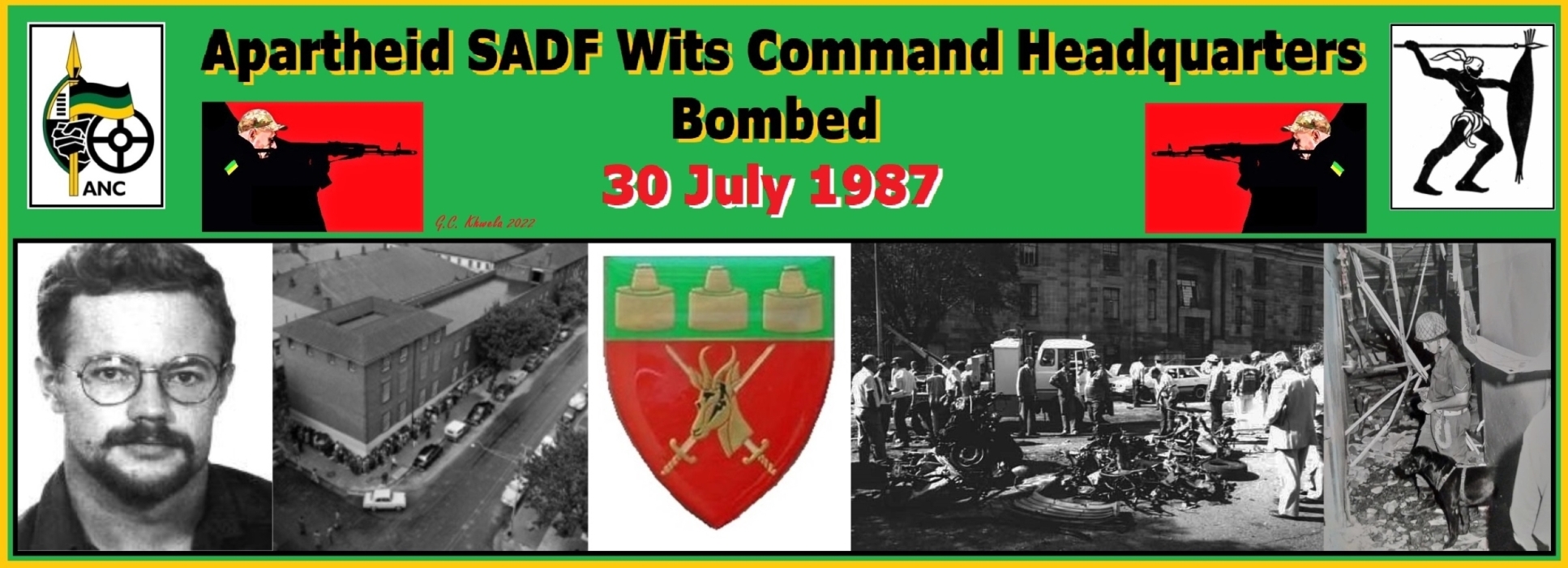
On 30 July 1987, a car bomb was detonated outside the headquarters of the apartheid South African Defence Force (SADF) Witwatersrand Command army base in Drill Hall, on Quartz Street, Johannesburg. The car with explosives in it blew up in front of the Witwatersrand Command army base, shattering all the windows in the vicinity and damaging buildings.
The bomb was set to go off at a time when most children would be at school and people at work. It was set up to deliberately target those guarding and staffing the military buildings. The eventual costs of the attack resulted in one SADF member being killed and injuring sixty-eight military personnel and civilians. Millions of rands of damage were caused by the explosion, resulting in more than 120 buildings in the surroundings being affected. The Sterland complex, which was near the Wits Command had a huge hole blown in the wall, as bricks were thrown all-over the street and the pavement. At the time, this was regarded as the biggest bomb ever exploded since the beginning of the armed struggle in South Africa.
120 kilograms of high explosives were used, which were reinforced with four-five-kilogram hollow charges that were meant to direct the force of the blast. Additionally, limpet mines and other small arms were placed in a compartment that was specially built behind the seats of the bakkie. In order to conceal the smell of the explosive charges, bitumen and paint were used on top of a steel plate that was welded to cover the entire compartment.
Following the blast, apartheid Defence Minister, Magnus Malan, accompanied by a top-level military delegation visited the Wits Command, where Malan threatened the neighbours against harbouring “terrorists”. Malan also lambasted members of the opposition Progressive Federal Party (PFP), such as Frederik van Zyl Slabbert and Colin Eglin, for supporting talks with the African National Congress (ANC). The attack was also described by apartheid President P.W. Botha as a “dastardly and callous act committed by ‘terrorists’ under the control of Godless communists”.
In the morning of 30 July 1987, around 09:00, Heinrich Grosskopf, the son of a well-known Afrikaans institution, Stellenbosch University professor, and a former editor of the Beeld newspaper, Johannes Grosskopf, was driving a Valiant bakkie from Linden, Randburg, where he rented a flat using a false passport in the name of J.R. Evans, to Johannesburg, wearing a white medical/laboratory-type coat. At approximately 09:45, Grosskopf parked the Valiant in a space in Quartz Street, living it idling, while he lashed the steering wheel securely. A few seconds later, Grosskopf exited the car, locked it and started walking in the direction of the nearby Sterland cinema complex.
Ten seconds thereafter, when Grosskopf was about to reach the Sterland cinema complex, the vehicle exploded, sending glass flying as far as some properties in front of him. Grosskopf then ran through the cinema complex, removed his white overcoat and threw it into a rubbish bin. He then walked to where a motorcycle was parked, and then rode the motorcycle to Linden, where he collected his belongings and departed with his motorbike to Botswana, through the Ramatlabama border gate.
In Botswana, he then made his way to a prearranged rendezvous spot, where he reported to his Umkhonto we Sizwe (MK) Special Operations Unit Support Group, which included the Commander, Aboobaker Ismail (aka “Rashid”), Johannes Mnisi (aka “Victor Molefe”) and Ernest Pule (aka “Themba T-man”). The following day, Grosskopf left for Lusaka, where he was debriefed by the Special Operations Unit and the MK Military Headquarters. After the debriefing, Grosskopf was sent for further military training in Luanda, where he got to specialise in clandestine radio communications, including morse code, coding systems and special transmissions that were designed to avoid detection.
Heinrich “Hein” Grosskopf, who was in his early twenties, was under the instruction of the ANC, in particular the MK Special Operations Unit, when he executed the operation. He had joined the ANC in Swaziland in January 1986, and was linked up with the ANC in Lusaka, where he volunteered for MK military service and after undergoing training in Pango Camp, Angola, from May to October 1986, he returned to Lusaka at the end of 1986. He was then sent for specialised training by the Special Operations Command Structure with the intention of having him operating on his own receiving support from exile.
In June 1987, Grosskopf entered South Africa on a motorcycle from Botswana, along the way he bought an old Valiant pickup bakkie in De Deur and travelled to Johannesburg with the motorcycle in the back of the bakkie. The attack on the Army Headquarters was in response to the apartheid government deploying troops in the townships to stifle anti-apartheid resistance as part of the 1986 State of Emergency. Drill Hall was also targeted because not only was it a military installation, it was also the same historic Hall in which the 1956 Treason Trial took place, thus being significant to the politics and history of the Congress struggle.
This incident remained obscured from the media and the public for two key reasons. Firstly, although a bomb had gone off in downtown Johannesburg, which could not be hidden, the grip of the apartheid government over the South African media limited it and ensured the incident would be carefully managed. The main reason was that attacks on apartheid SADF military installations were dreaded to affect the morale of the military personnel. Secondly, and more importantly, it was very carefully managed because of the profile of the MK operative who committed it, who was from an upper class, White Afrikaner, well to do and influential family.
Grosskopf grew up in an up-market Whites-Only conservative suburb and attended a prestigious Afrikaans high school. This did not fit-in well with the “swart-gevaar” (Black danger) or “rooi-gevaar” (Communist danger) terrorist narrative of the time. He was in fact embarrassing enough to be “one of their own”. Apartheid Law and Order Minister, Adriaan Vlok, mentioned a few months later that the bomber, Grosskopf, was also wanted for three car bomb blasts, which had resulted in seven casualties and 102 injuries within a period of one year. A reward of R50 000 was offered for information leading to his arrest.
Ms Johanna Aleta Klaasen submitted a statement in respect of injuries sustained in the explosion to the Truth and Reconciliation Commission (TRC), and Heinrich Johannes Grosskopf, Aboobaker Ismail, Joseph Mnisi and Colin Mike de Souza applied for amnesty for their roles in the operation. Grosskopf stated that his reason for joining the ANC was because of a statement delivered by the apartheid Minister of Law and Order, Louis le Grange, in late 1985, wherein he cited, without remorse, the fact that the police were killing an average of six people a day as evidence that they had the situation “under control”.
Sources:
Wikipedia.
Aboobaker Ismail (Rashid), “The ANC’s Special Operations Unit”, The Thinker, Vol. 58, 2013.
Peter Dickens, “The Truth Behind the Bombing of Witwatersrand Command”, The Observation Post: South African Military History, 05 August 2017.
Staff Reporter, “Grosskopf Spills Beans on Car Bomb”, Mail & Guardian, 22 November 2000.
South African Press Association, “Grosskopf Recounts 1987 Wits Command Bombing”, Independent Online, 21 November 2000.
Truth and Reconciliation Commission, “Amnesty Applications: Aboobaker Ismail, Johannes Mnisi, Mohammed Iqbal Shaik, Mohammed Abdulhai Ismail, Colin Mark De Sousa, David Motshwane Moisi, Sipho Matthews Thobela”, TRC Amnesty Committee, Cape Town, 16 January 2000.
Truth and Reconciliation Commission, “Truth and Reconciliation Commission of South Africa Report, Truth and Reconciliation Commission, Vol. 2, 29 October 1998.
Truth and Reconciliation Commission, “Truth and Reconciliation Commission of South Africa Report, Truth and Reconciliation Commission, Vol. 6, 21 March 2003.
Yunus Carrim, “Attacking the Heart of Apartheid: The ANC’s MK Special Operations Unit”, Penguin, 2025.
Thula Simpson, “Umkhonto we Sizwe: The ANC’s Armed Struggle”, Penguin, 2016.
Glen Segell, Sergey Kostelyanets and Hussein Solomon, “Terrorism in Africa: New Trends and Frontiers, Moscow: Institute for African Studies; Haifa: University of Haifa, 2021.
Castro Khwela
Good evening fellow Compatriots!
Discover more from CASTRO KHWELA
Subscribe to get the latest posts sent to your email.