Apartheid Security Net Closing In On the MK Underground
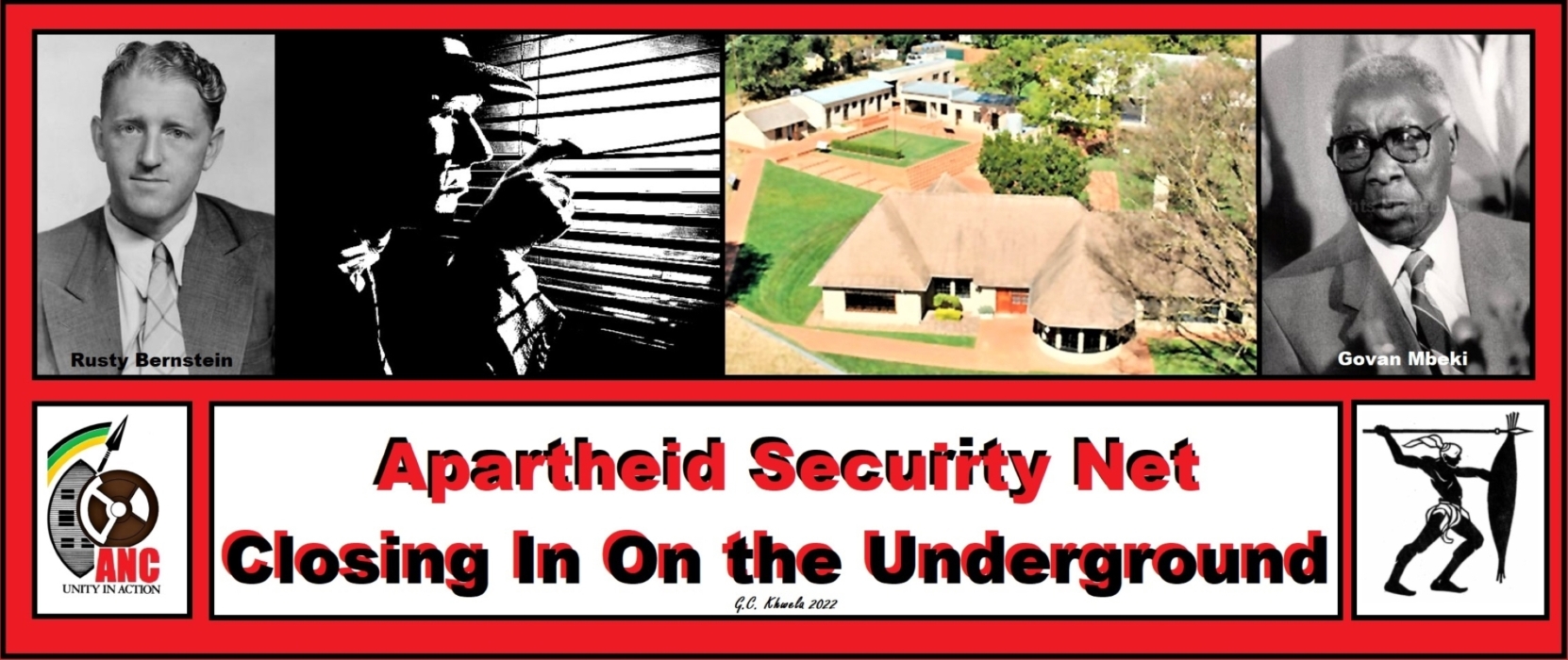
On Saturday, 6 July 1963, at approximately 02:00 in the morning, Billy Nair was arrested in his Durban home. The news spread like wildfire among the underground activists throughout the country, and as a result, when Ian David Kitson arrived for a meeting at Liliesleaf Farm on the same day, he commented that he was surprised to see his comrades being there, as he thought everyone was moving base following Billy Nair’s arrest.
Responding to Kitson, Walter Sisulu mentioned that it was the last time that they were meeting at the Farm. The meeting was called to finalise the discussion on the guerrilla warfare plan, which Lionel “Rusty” Bernstein had made adjustments to. Bernstein had placed an alternative proposal centred on limited attacks on isolated border outposts, after which guerrillas were expected to retreat into bases in the British protectorates.
This was anticipated to lead to an international incident that would precipitate strikes and a serious political crisis. According to Bernstein, the only alternative to the proposal was a protracted guerrilla war, which wouldn’t succeed given the might of the apartheid South African state and its allies. The apartheid state had thrown overboard every possibility of democratic rule and for that reason there was little, if any, room for change besides revolutionary mass action or armed resistance leading to victory by military means. This was held to be possible despite the alliance between the southern African racist settler states.
The first person to respond to the proposal was Govan Mbeki, who argued that an armed invasion and a guerrilla war were the only ways the regime could be removed. Mbeki was basing himself on the plan and direction that they had developed as part of the Umkhonto we Sizwe (MK) High Command, which considered four types of violent activities: sabotage, guerrilla warfare, terrorism and open revolution.
The consideration was that for a small and fledgling army, open revolution was inconceivable, while terrorism unavoidably reflected poorly on those who employed it, as it often undermined public support that it could otherwise mobilise. The only possibility was guerrilla warfare, but since the African National Congress (ANC) had been reluctant to embrace violence at all, it made sense to start with the form of violence that would inflict the least harm against individuals, which was sabotage.
Since it did not involve the loss of life, sabotage offered the best hope for reconciliation among the races afterwards, as the intention was not to initiate a bloody war between whites and blacks. The consequences of a bloody war could be long-lasting, as could be seen with the animosity between the Afrikaner and the English, which still remained acute fifty years after the Anglo-Boer war had ended.
If a civil war between white and black were to be provoked, it would be detrimental to cordial race relations. Moreover, sabotage had an added advantage that it required less manpower than other forms of violence. Therefore, the strategy was to make selective raids against military installations, power plants, telephone lines and transportation links, which were targets that would hamper the military effectiveness of the state, in addition to frightening supporters of the National Party, scare away foreign investors, thus weakening the apartheid economy.
The expectation was that due to the impact of these activities the apartheid regime would be forced to the negotiating table. However, if sabotage failed to produce the desired results, then MK would consider the next phases, which were guerrilla warfare and terrorism. According to Mbeki, the approach they were supposed to adopt was that only mass struggle with an armed component could hope to make a real impact and rejuvenate mass involvement. In order to draw in the masses of population, the political wing should arouse the people to participate in the struggles that were designed to create an upheaval throughout the country. Since the enemy was well organised as a well-armed state supported by the bulk of the white population, efforts would have to be undertaken through international campaigns to isolate the country, which will eventually result in victory.
After Mbeki’s input, the meeting ran out of time, as Bernstein had to leave. However, Denis Goldberg insisted that the meeting could not end without an agreement on an alternative venue for the follow-up meeting, as it was going to be difficult to get people back together again. When Bob Hepple suggested returning to Liliesleaf Farm on 11 July 1963, Bernstein jumped up and shouted, “Never again!” When Hepple insisted that it should just be for once, “The very last time!” Bernstein stood up as it was getting dark outside and repeated, “But definitely never again!” and ran to his car.
Indeed, Bernstein was correct, as the apartheid Security Branch team under Lieutenant van Wyk was consistently surveying Rivonia to identify the exact spot where the underground meetings were taking place. Naturally, the apartheid Security Branch Commander, General van den Bergh, wanted the Umkhonto Headquarters found as soon as yesterday. Eventually a huge number of vehicles were deployed to patrol all the roads leading to small farms in the Mornigside, Rivonia and Witkoppen areas.
Sources:
Nelson Mandela, “Long Walk to Freedom”, Abacus, 1994.
Thula Simpson, “Umkhonto we Sizwe: The ANC’s Armed Struggle”, Penguin, 2016.
Stephen Ellis, “External Mission: The ANC in Exile, 1960–1990”, Jonathan Ball, 2013.
Paul S. Landau, “Spear: Mandela and the Revolutionaries”, Jacana, 2022.
A. Lerumo, “Forms and Methods of Struggle the South African Democratic Revolution”, The African Communist, No. 9, April/May 1962.
Gerard Ludi, “The Communisation of the ANC”, Galago, 2011.
Castro Khwela
Good day fellow Compatriots!
Discover more from CASTRO KHWELA
Subscribe to get the latest posts sent to your email.