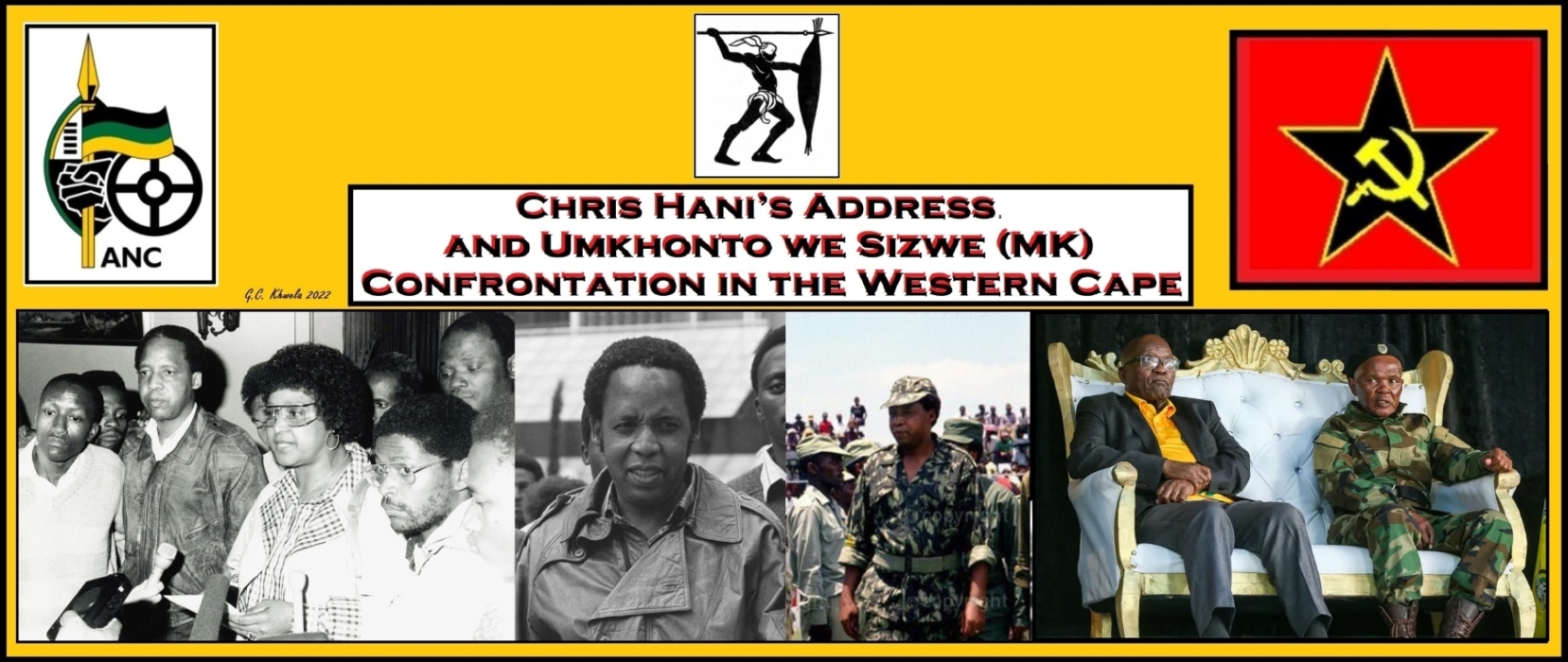
Chris Hani’s Address and MK Confrontation in the Western Cape
On 7 July 1990, at approximately 01:20 in the morning, “Wiseman” was driving a light blue Toyota Corolla from Khayelitsha to Nyanga East, in Cape Town, with a group of Umkhonto we Sizwe (MK) cadres, including “Lincoln” in the passenger seat, as well as Fumanekile Booi (aka “Edgar”) and “Mabuya” in the back seats. When they entered Nyanga East approaching a stadium, they noticed a parked police riot patrol van, with its lights off.
As the Corolla reached a T-junction further on, the police vehicle’s headlights were turned on and it began following them. In the police vehicle were three police officers, Sergeant Nicholas Johannes Els, and Constables George Beeselaar and Gavid David Moyes. When the vehicle was alongside the Corolla, Sergeant Els indicated to them with his torch to get off the road, as the police van moved to overtake. Booi, in response, ordered Wiseman to stop the car, as the van stopped slightly across the front of the Corolla, blocking it from escaping.
Sergeant Els got out of the van with a pistol in his right hand, clad in a camouflage uniform and a second policeman followed carrying a sub machine gun. When Booi saw this, he concluded that they were being ambushed by ‘askaris’, and he decided to shoot. Booi opened his window and immediately opened fire with his Makarov pistol, hitting Els in the chest, killing him instantly. While Constables Beeselaar and Moyes were attempting to return fire, Booi unleashed approximately twenty-three bullets at them, but they managed to survive using the van as cover and then fled on foot.
This incident happened the following morning after MK Chief of Staff, Chris Hani, attended a private meeting in Cape Town, addressing representatives from a number of underground MK units, and debriefing them on the pending talks between the ANC and the government, as well as how they were expected to carry on with their underground activities during that period.
After attending Hani’s briefing, Fumanekile Booi headed off to Khayelitsha, where he met up with other members of his unit, “Lincoln”, “Wiseman” and “Mabuya”. Booi told them that they needed to proceed to NY 47, because Chris Hani was going to sleep in Gugulethu that night. It was on their way to Nyanga East that they encountered the police van that began the disconcerting encounter with the apartheid forces.
Following this skirmish with the apartheid police, Chris Hani delivered an address the next day and stated that some askaris and Police Force members were continuing to seek out and assassinate MK members and “he congratulated the Commander who managed to bring all his unit members back”. Booi maintained that the skirmish with the police sent a clear message to the then government that MK was in the country and put the African National Congress (ANC) in a stronger position during the political negotiations. Hani maintained that askaris were used to destabilise the political negotiations and were operating under the command of white policemen.
According to Hani, his hope was that the ANC was going to emerge from the 6 August 1990 talks with the government being equipped with a concrete position regarding the armed struggle. In an answer to a question asking how he felt about being identified by far-right groups as an assassination target, he responded that “I feel very disappointed that the right-wing feels that I am only worth R20 000”. This was not surprising, as Chris Hani was always portrayed as the face of terror within the ANC, particularly within the auspices of its alliance with the South African Communist Party (SACP).
Chris Hani gave a media briefing in Cape Town on 6 July 1990, after spending some time in the Transkei addressing numerous rallies and visiting his family. He mentioned that he believed in a peaceful solution, but added that negotiations would not nullify the struggle, including the armed struggle, which was to continue until a mutually binding ceasefire could be agreed upon by both sides. With so many issues still outstanding, Hani was opposed to the immediate abandonment of the armed struggle. Hani maintained that “Calls for our unilateral abandonment of the armed struggle in the face of a battery of laws preventing free political activity are unrealistic”.
For Hani the “armed struggle is the mobiliser, the inspirer”. Clinging to the importance of MK, he argued that it had instilled a sense of pride among young South Africans who were able to stand up and say they were fighting back, even though they had only meagre resources. Importantly at the time, the armed struggle had also sown insecurity among whites and unsettled the sweet life that had allowed them to refuse to see the truth inside.
Hani averred that he was sure that “the ANC won’t call off the armed struggle because it has been unbanned”. He assured the MK cadres as the Army Chief of Staff when they asked him the tough questions. “Yet, ever the pragmatist”, Smith and Tromp asserted that Hani “knew in his heart that if the ANC called for its army to cool it, the organisation would have to address the morale of the cadres. He was concerned about its stock of weapons. There were still very real threats that the SADF (South African Defence Force) could oppose De Klerk’s reforms.”
Meanwhile the time would be used to educate cadres politically and prepare them for the task of demobilisation; while also keeping them at a simmer should it be necessary to build covert units inside South Africa if everything went horribly wrong. Hani insisted that “We must also teach cadres that there is a need to fight and talk, and if talks fail we must go back and fight. I think we must struggle very hard for our comrades not to feel that sitting down with our enemy is betrayal.”
What made matters more complicated was when Hani returned from exile, he quickly formed a tight partnership with Winnie Mandela, and when they went around the country addressing the angry masses, in their MK fatigues and boots, it aroused the nation’s imaginations. It was pleasing to the oppressed majority to witness a couple of revolutionaries moving around without fear and telling them what exactly they wanted to hear. When she and Hani spent months on the road as revolutionary lobbyists of the first order – their first goal the liberation of the nation, their only drive the victory of the ANC – Winnie Mandela was the queen.
However, for the white community, their relationship was abomination, as they have been groomed to loathe Winnie, and to fear Hani. There was indeed a similarity in the characters of Winnie Mandela and Chris Hani. Although she was the firebrand lacking in diplomacy, and he the soldier who preferred to listen, they were principled about their purpose: justice. There would be a time for back-slapping and a time for fury. Hani exemplified both.
Where those involved in the negotiations with the National Party were quickly learning the art of diplomacy, he could be the weapon. The MK Chief of Staff and later SACP General Secretary, Chris Hani, had become part of the graffiti in the streets of Umtata, “Viva Hani”, especially among the youth, who associated him with the power of the revolution seen in tandem with the gunfire sound of an AK-47 rifle.
In the later years, on 22 November 1999, in Cape Town, Fumanekile Booi was granted amnesty by the Truth and Reconciliation Commission (TRC) for the killing of Sergeant Nicholas Johannes Els in Nyanga in the district of Mitchells Plain on the night of 6 July 1990; the attempted killing of George Beeselaar and Gavin David Moyes at the same time and same place as mentioned above; the unlawful possession of a Makarov pistol and 38 rounds of ammunition on the same date and at the same place as mentioned above; the unlawful possession of a hand-grenade on the same date and at the same place as mentioned.
Sources:
Truth and Reconciliation Commission, “Amnesty Application: Fumanekile Booi”, Truth and Reconciliation Commission (TRC) Amnesty Committee, Cape Town, 22 November 1999.
Thula Simpson, “Umkhonto we Sizwe: The ANC’s Armed Struggle”, Penguin, 2016.
Janet Smith and Beauregard Tromp, “Hani: A Life Too Short”, Jonathan Ball, 2009.
Castro Khwela
Good evening fellow Compatriots!
Discover more from CASTRO KHWELA
Subscribe to get the latest posts sent to your email.