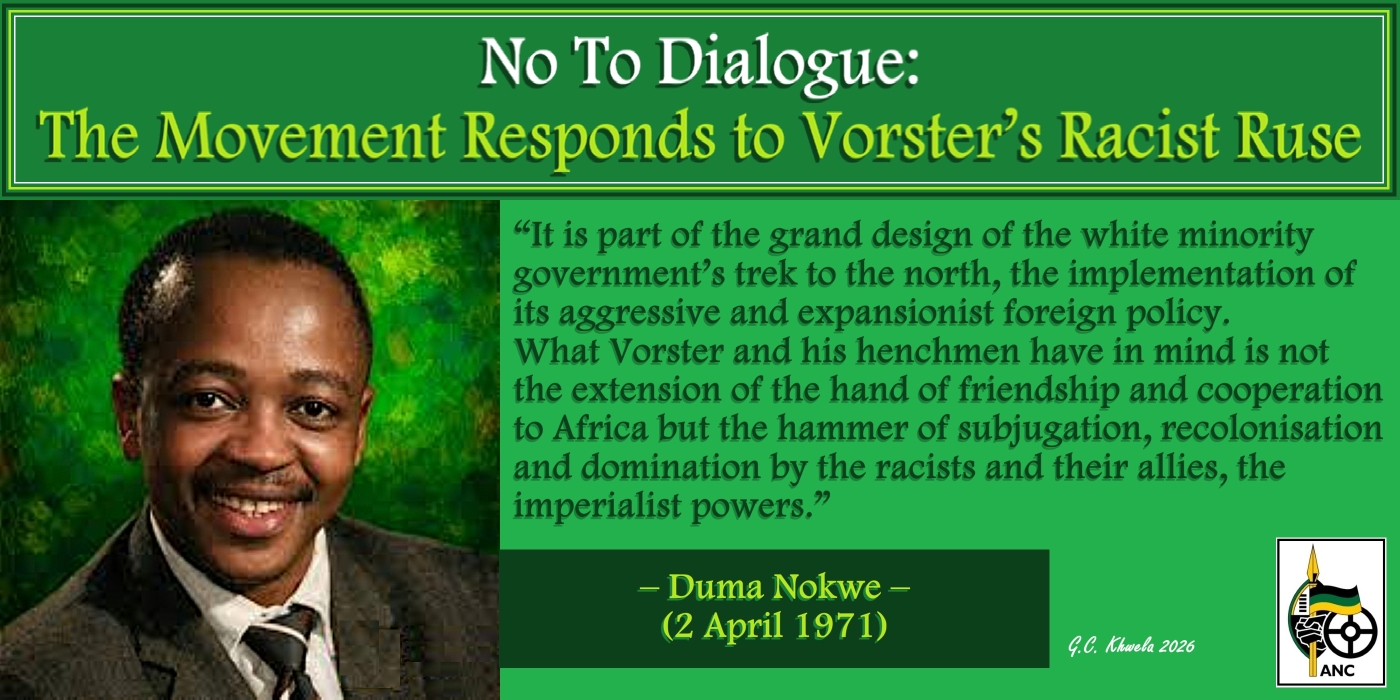
No To Dialogue: The Movement Responds to Vorster’s Racist Ruse
On 2 April 1971, the African National Congress (ANC) of South Africa’s Director of Political Affairs, Duma Nokwe, responded sternly to apartheid Prime Minister John Vorster’s statement that he was willing to discuss South Africa’s policies of racial separation with leaders of the black independent nations of Africa. Vorster’s statement was made at a press conference held on 30 March 1971 in Cape Town, at a formal news conference, which was the first to be given by an apartheid South African Prime Minister since the Nationalist party came to power in 1948.
Apartheid Prime Minister John Vorster launched this high-profile diplomatic initiative known as the “Policy of Dialogue” or “outward policy”, which was a strategy aimed to break South Africa’s international isolation by seeking formal discussions and cooperation with independent Black African nations, while simultaneously maintaining the domestic system of apartheid. Vorster’s “outward policy” was driven by several strategic goals: to build a “Southern African bloc” to prevent the spread of Soviet and Marxist influence in the region; to open new markets for South African goods and technology in Black Africa; and to present apartheid as a reasonable solution to South Africa’s unique racial situation rather than an exportable policy.
According to the statement, Vorster said invitations would be sent to selected black leaders to come to South Africa for talks, which he disclosed would start with an official visit to be paid to South Africa later in the same year by President H Kamuzu Banda of Malawi. Malawi was the first independent African state to establish formal diplomatic ties with apartheid South Africa, and Vorster had visited the country in 1970. Vorster said he would take it as a matter of course that the policy of apartheid – officially called “separate development” – was to be discussed in any talks with other African leaders. Furthermore, he mentioned that with a favourable response to South Africa’s desire for a dialogue with Africa, “formal invitations” would be sent.
At the start of the conference, Vorster indicated that it was the policy of the South African Government to grant full independence to the tribal homelands – the Bantustans of South Africa. Vorster said that he was “prepared to discuss Independence with these various nations if and when they want to discuss it”. However, he added that there was no fixed timetable for this process, since negotiations had to be undertaken before legislation could be introduced granting them “self-rule”. Although the “independence” issue of the Bantustans was raised frequently by the racist regime in the past, the press statement was probably the most undeniable statement ever made on the subject by the apartheid government.
At the end of March, on 31 March 1971, the Bantu Homelands Constitution Bill was enacted, as The Bantu Homelands Constitution Act (National States Constitutional Act) No. 21, of 1971, which provided for the granting of increased powers to Bantustan “homeland” governments, thus facilitating their eventual “independence”. The Act empowered the apartheid government to grant self-government, on an equal footing with that of the Transkei, to any area with a Territorial Authority, upon the latter’s request, at any time, by simple proclamation, after consultation with the Territorial Authority concerned, but without parliamentary enactment.
The ANC’s Director of Political Affairs, Duma Nokwe, responded that “the announcement by the racist and Nazi Prime Minister Vorster that he was going to invite all those heads of states who are prepared to have a dialogue with the white racists is the logical culmination of the sinister ‘Northward Policy’ of colonialism and neocolonialism so cunningly pursued by the racist regime.” Nokwe added that the dialogue was “a spiders web carefully and systematically spun to ensnare weak African Governments like flies, into the influence and control of the racists and imperialists”.
“It is part of the grand design of the white minority government’s trek to the north”, Nokwe added, “the implementation of its aggressive and expansionist foreign policy. What Vorster and his henchmen have in mind is not the extension of the hand of friendship and cooperation to Africa but the hammer of subjugation, recolonisation and domination by the racists and their allies, the imperialist powers. The ANC has constantly warned that the SA racists were the launching pad and bridgehead for the destruction of the gains of the African Revolution and a base for counterrevolution.”
For Nokwe, “In many instances this warning has not been heeded. Instead, the views of the national liberation movements have been ignored and heads of states have made ill-considered and even irresponsible and treacherous offers to the white racist regimes. This is a tragedy not only for the people of Southern Africa but for the people of Africa as a whole. Vorster and the South African racists are on the offensive to consolidate their rule in the country, to attempt to alienate support for the liberation struggle and to extend their rule over Africans through Bantustans under white domination throughout the continent.”
According to Nokwe, “Those who are going to frogmarch to Pretoria following Banda to dine and wine with the racists, can only be warned that ‘he who sups with the devil must use a long spoon’. Those who allow themselves to be seduced to betray the interests and aspirations of the people of South Africa, Southern Africa and indeed of the whole continent, must know that they cannot do so with impunity. The ANC of SA calls upon all Governments and peoples organisations to condemn and reject this treacherous invitation by Vorster which is a sinister attempt to prepare for a second rape of our continent and peoples. We call on all right-thinking people not to help extend the frontiers of racism but rather to help and destroy the fascist monster.”
In conclusion, Nokwe said, “This is the year (1971) dedicated to the combat of racism. It is an unforgivable crime to cooperate and assist the racists and Nazis.” The ANC’s strong ally in the South African national liberation movement, the South African Communist Party (SACP) also added “that ‘dialogue’ is not just a trick of Vorster’s to smash African opposition to apartheid, but is also a weapon of the West to drag Africa into the imperialist camp. ‘Dialogue’ is now clearly exposed as a threat to African freedom and independence. The threat is both real and dangerous, and one can only express the hope that free Africa will as speedily as possible organise and fight against it. There can be no compromise with fascism. Remember Munich.”
Sources:
The New York Times Archives, “Vorster to Invite Black Nations To Talks on Apartheid Policies”, The New York Times, 31 March 1971.
Duma Nokwe, “No to Dialogue: ANC Statement by Director of Political Affairs”, Sechaba, Vol. 5, No. 6, June 1971.
Editorial Notes, “When Houphouet-Boigny Nearly Cried”, The African Communist, No.46, Third Quarter 1971.
Nelson Mandela Foundation, “John Vorster’s ‘Policy of Dialogue’”, https://omalley.nelsonmandela.org/cis/omalley/OMalleyWeb/03lv01538/04lv01539/05lv01562/06lv01571.htm
Castro Khwela
Good evening fellow Compatriots!
Discover more from CASTRO KHWELA
Subscribe to get the latest posts sent to your email.