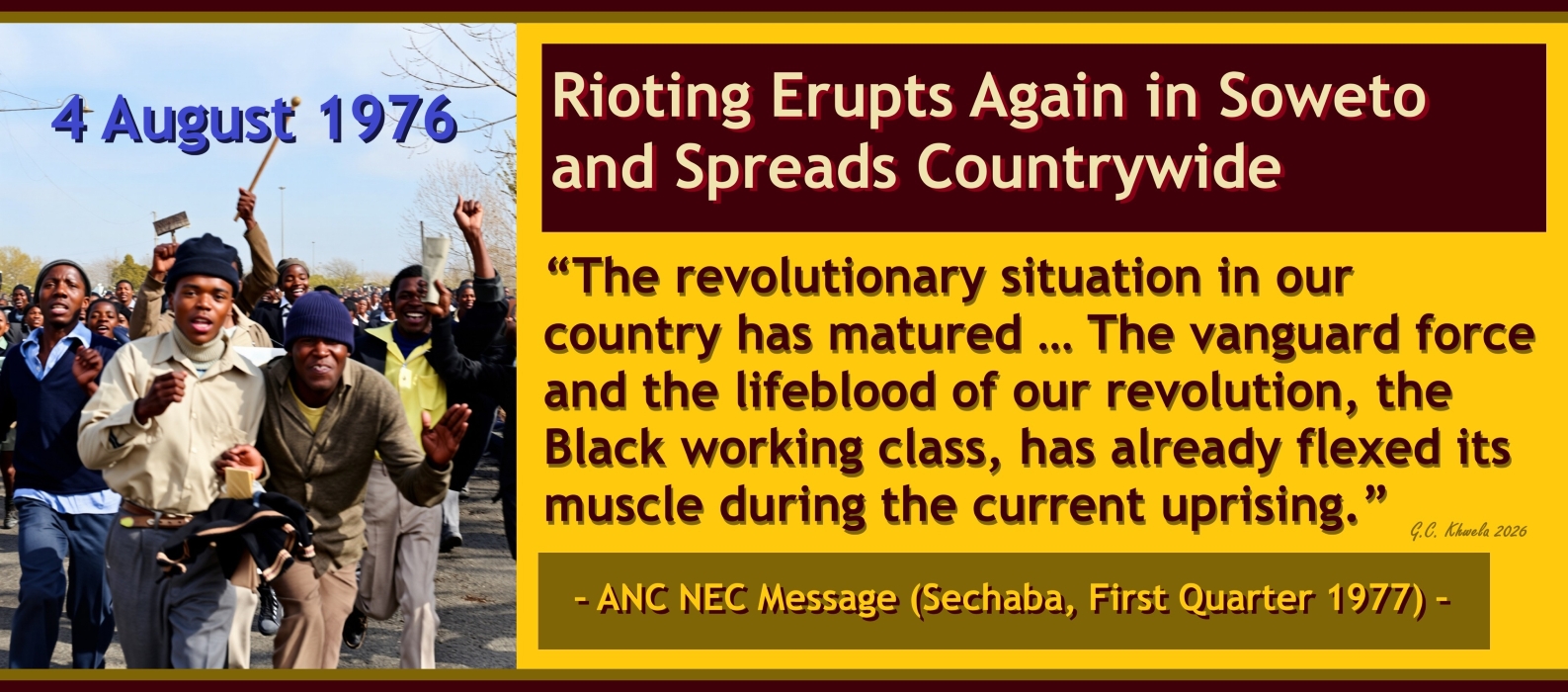
Rioting Erupts Again in Soweto and Spreads Countrywide
On 4 August 1976, riots erupted again in Soweto and spread to other townships in South Africa, as the country experienced a major resurgence of violence. This second wave of rioting was caused by a massive student-led march to demand the release of political detainees, which was paired with a coordinated worker stay-away. Organised by the newly formed Soweto Students’ Representative Council (SSRC) under the leadership of Tsietsi Mashinini, the demonstration shifted the focus from the initial school language policy to direct political defiance against the apartheid state.
Students organised a march of roughly 15,000 to 20,000 people intending to walk from Soweto to the John Vorster Square police headquarters in central Johannesburg to demand the freedom of jailed activists. The SSRC successfully convinced 80% to 85% of Soweto’s adult workforce to strike. Because parents and workers stayed home, the entire township was densely populated with adults when the military and police arrived. Apartheid security forces heavily blockaded the northeast boundary of Soweto, near New Canada, to prevent the marchers from reaching the city. Police fired teargas and live ammunition to disperse the crowd.
Enraged by the blockade and fresh casualties, protesters retaliated with widespread arson, targeting government administration offices, beer halls and vehicles, which quickly pulled adults into active clashes with the state. This secondary wave of unrest quickly expanded from Soweto to several other segregated Black townships across the country. The current resurgence marked a transition from a localised student strike into a broader, countrywide anti-apartheid rebellion supported by university students, community members and workers.
University of the Western Cape (UWC) students held mass boycotts in early August in solidarity with the Soweto students. Protesters set fire to the Hewat Training College in Athlone on 6 August 1976. Heavy clashes throughout August moved deep into Port Elizabeth and Cape Town, contributing heavily to the final death toll of over 575 individuals recorded by early 1977. Paramilitary police units deployed live ammunition, tear gas and heavily armed vehicles to crush the recurring demonstrations.
The uprising quickly escalated into a national rebellion, affecting at least 22 townships in the Transvaal, 16 areas in Cape Town, 4 townships in Port Elizabeth and multiple universities and rural towns across South Africa. The Cillié Commission of Inquiry later documented that nearly every major urban centre and black township experienced protests, arson or clashes with police between June 1976 and February 1977. The geographic spread of the unrest across South Africa included almost the entire Transvaal Province, and as the epicentre of the initial protests, the surrounding Witwatersrand area ignited almost immediately.
In the West Rand, mainly Kagiso, in Krugersdorp, and Alexandra township, north of Johannesburg, erupted into severe clashes just days after Soweto, resulting in multiple casualties. In Pretoria townships, heavy rioting and student boycotts spread to Mamelodi, Atteridgeville and Hammanskraal. In the East Rand, industrial areas, Tembisa, Katlehong, Vosloorus and Daveyton saw administrative buildings, beer halls and transport links targeted.
The Western and Eastern Cape became the second-most violent regions during the August and September escalations. Black and Coloured Townships were engaged in riots, which heavily impacted Langa, Nyanga, Gugulethu and Athlone. Mass boycotts and arson took place at the University of the Western Cape (UWC) and Hewat Training College. Clashes in Cape Town alone resulted in at least 92 deaths during the late winter of 1976. The Eastern Cape, a historic stronghold for the anti-apartheid Black Consciousness Movement, saw rapid mobilisation. Protests erupted in townships like New Brighton, KwaZakhele and Zwide, where at least 33 people were killed in August clashes. School boycotts and administrative burnings also spread to Mdantsane and Duncan Village.
While political violence was less widespread in Natal’s residential suburbs compared to Cape Town or Johannesburg, it severely affected academic institutions. The University of Zululand (Ongoye) saw students set fire to the university’s administration buildings and archives in solidarity with Soweto, forcing the campus to close early. Minor skirmishes and student stay-aways occurred in KwaMashu and Umlazi. The Minister of Justice, Jimmy Kruger, immediately reinstated a nationwide ban on all public meetings under the Riotous Assemblies Act. The emergency ban on assembly remained strictly in place until the end of August 1976.
This uprising and the nationwide rebellion it triggered was the most massive, sustained upsurge against the apartheid regime in 1976, as well as the largest South Africa had seen since the 1960 Sharpeville Massacre. It grew from a local march of up to 20,000 students on 16 June into a sprawling national movement. The 4 August 1976 upsurge effectively synthesised student resistance with adult worker stay-aways, completely halting economic activity in Johannesburg and Cape Town. No other civil unrest in 1976 came close to its geographic reach. It spread across four provinces, shutting down black universities, paralysing multiple industrial zones (the East and West Rand), and causing severe upheaval in the Western and Eastern Cape.
The sheer volume of state violence deployed was unprecedented for that decade. The official Cillié Commission eventually estimated 575 deaths by early 1977, though independent estimates suggest closer to 700 or more people were killed by paramilitary police forces during the year-long crisis. The upsurge triggered massive international condemnation, isolated the National Party government globally, and caused a rapid devaluation of the South African rand, marking a major turning point that permanently revitalised the anti-apartheid liberation struggle.
Following the 4 August 1976 nationwide uprising, the apartheid regime instituted a severe, multi-layered apparatus of legal, military and judicial repression designed to completely crush the leadership and momentum of the resistance. Beyond banning public assemblies, the government implemented several highly aggressive punitive measures. Jimmy Kruger quickly amended the newly passed Internal Security Act to introduce “preventive detention”. This law allowed the Minister of Justice and the Security Branch to arrest and imprison anyone deemed a threat to public order for up to 12 months at a time. The state stripped detainees of all legal recourse, removing the power of the courts to protect them.
In addition, the state ordered township hospital administrators to provide the police with lists of all patients admitted with bullet wounds so they could be arrested and prosecuted for rioting. To protect children from arrest, sympathetic doctors frequently risked their careers by falsifying medical records, documenting gunshot wounds as “abscesses”. The state abandoned standard age protections, arresting and prosecuting minors. By late 1976 and 1977, the state began sentencing children as young as 14 and 15 years old to hard labour on Robben Island – a maximum-security facility meant for adult political prisoners – under charges of sabotage.
Apartheid Minister of Justice Jimmy Kruger explicitly requested and received Cabinet approval to allow police to act with absolute aggression. Police were ordered to bypass conventional riot control, deploying automatic rifles, carbines and live ammunition directly into crowds. Police officers and state security agents were granted virtual immunity from prosecution, ensuring that no police officer was charged for the killings of township civilians.
The state systematically shut down schools across Soweto and other volatile townships, as the regime calculated that forcing students out of classrooms would destroy their ability to gather, organise and coordinate actions. Ultimately the state outlawed the leadership structures of the Black Consciousness Movement (BCM), the South African Students Movement (SASM), and eventually the Soweto Students’ Representative Council (SSRC), forcing hundreds of student leaders into exile or hiding.
In the wake of the state’s brutal response to the 4 August 1976 upsurge, civil society, the churches and the exiled national liberation movements reacted with unprecedented defiance, logistical coordination and a fundamental shift toward armed warfare. Rather than reprimanding their kids, parents and local professional bodies organised to protect students, legalising aid structures and raising bail money for detained youths. Civil society organisations shifted from localised school grievances to community-wide socio-economic strikes. By organising successful labour stay-aways, they managed to halt up to 85% of industrial labour across Johannesburg and Cape Town.
Activists operating under Black Consciousness Movement (BCM) principles re-channelled student trauma into political pride. They coordinated underground pamphlets to ensure that even with schools permanently closed, the networks of political resistance remained active. Parishes across the country defied police blockades. Places like the Regina Mundi Catholic Church in Soweto became staging grounds for mass political rallies, student medical triage units and literal physical shields against police gunfire.
Progressive clergy led by figures like Desmond Tutu and organisations like the South African Council of Churches (SACC) directly blamed the state’s policies for the bloodshed, providing funding for mass funerals and legal defences for arrested youth. The World Council of Churches (WCC) mobilised internationally, launching anti-racism programmes and actively lobbying foreign states to halt all trade and initiate total economic boycotts against the apartheid government.
The liberation movements in exile – primarily the African National Congress (ANC) and the Pan Africanist Congress (PAC) – received an exodus of thousands of young people fleeing South Africa. The ANC absorbed these recruits into educational facilities and its its military wing, Umkhonto we Sizwe (MK), sending them to obtain education in various countries and training camps across Tanzania, Angola and Zambia. The surge of highly motivated 1976 youth revitalised the armed struggle. By late 1977, newly trained guerrilla fighters began slipping back across South African borders to execute sabotage campaigns against infrastructure and state police.
Operating from London and Lusaka, ANC President Oliver Tambo capitalised on global outrage over the killings of children. Exiled missions successfully lobbied the UN Security Council to pass Resolution 392, officially condemning the apartheid regime and setting the stage for strict mandatory international arms embargoes. In the words of the United Nations Secretary General, Kurt Waldheim, “So long as apartheid remains, this Committee (The United Nations Special Committee Against Apartheid) will continue to play a crucial role in the endeavours of the United Nations to eliminate this evil”.
THE VANGUARD FORCE AND THE LIFEBLOOD OF OUR REVOLUTION, THE BLACK WORKING CLASS, HAS ALREADY FLEXED ITS MUSCLE!
Sources:
Wikipedia
South African History Online (SAHO).
Editorial, “The World Against Apartheid: International Seminar on the Eradication of Apartheid”, Sechaba, Vol. 10, Fourth Quarter 1976.
ANC NEC, “Message of the National Executive Committee of the ANC (SA)”, Sechaba, Vol. 11, First Quarter 1977.
International Commission of Jurists, “Detention of Children in South Africa: A Special Report Prepared by the International Commission of Jurists”, International Commission of Jurists (ICJ), Geneva, Switzerland, July 1978.
Gail M. Gerhart, “The 1976 Soweto Uprising”, Paper Presented to a Seminar of the Institute for Advanced Social Research, University of the Witwatersrand, 2 May 1994.
Malesela Steve Lebelo, “The True Heroes of Soweto Revolt”, The Sunday Independent, 12 June 2016.
Olav Fykse Tveit, “40 Years After the Student Uprising in Soweto, 16 June 1976”, World Council of Churches (WCC), 11 June 2016.
Tharollo Seatlholo, “Historical Distortions of the 1976 Black Power Movement”, Culture Review Magazine, 17 June 2023.
Castro Khwela
Good evening fellow Compatriots!🙏🏾✊🏾👊🏾
Discover more from CASTRO KHWELA
Subscribe to get the latest posts sent to your email.