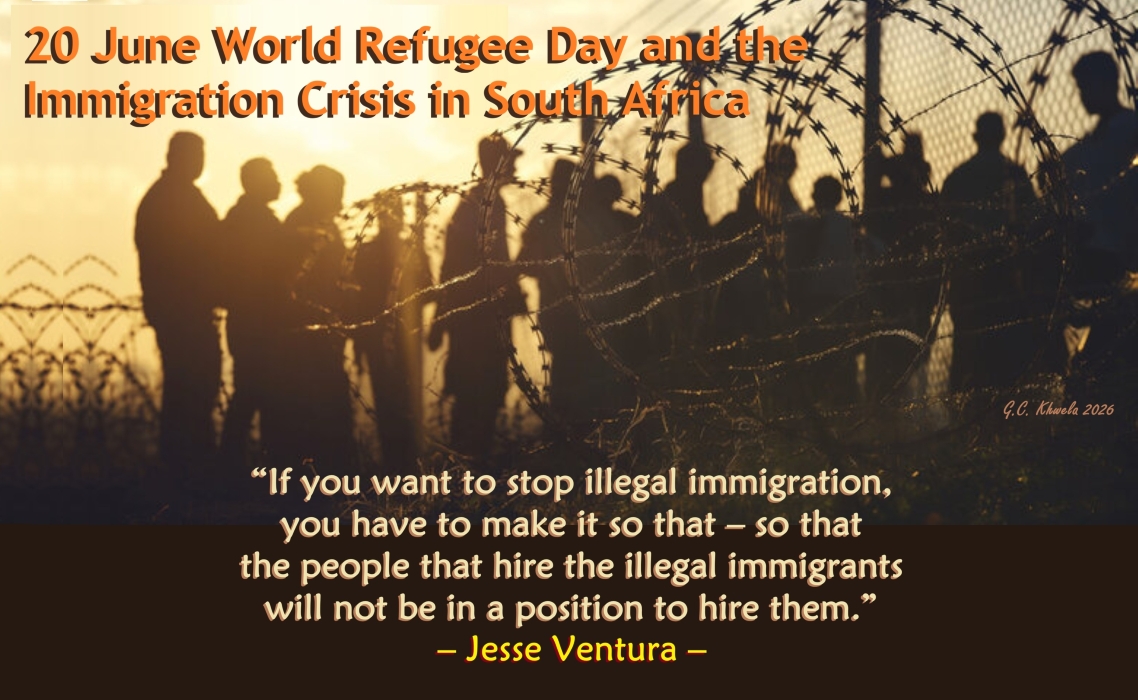
20 June World Refugee Day and the Immigration Crisis in South Africa
World Refugee Day is an international observance held annually on 20 June to honour the courage, strength and resilience of millions of people forced to flee their homelands due to conflict, persecution, violence or disaster. Designated by the United Nations (UN), the day serves as a global call to build empathy, raise awareness about the harsh realities of displacement, and advocate for refugees’ fundamental rights to safety and dignity. The day celebrates the immense fortitude of individuals who have lost everything but continue to rebuild their lives, bring diverse talents and enrich their host communities.
World Refugee Day underscores that seeking asylum is a fundamental human right. True protection means securing access to healthcare, education, legal documentation and safe working conditions. It shifts public perception from seeing refugees as a political burden or mere victims to recognising them as equals who deserve mutual accountability and shared support. The day serves as a critical moment for the UN High Commission for Refugees Agency (UNHCR) to release updated data on global displacement, holding world leaders accountable for addressing the ongoing crisis.
The United Nations General Assembly officially established World Refugee Day on 4 December 2000. The date, 20 June, was chosen to coincide with Africa Refugee Day, a pre-existing commemoration by the Organisation of African Unity (OAU – now the African Union). The first global event took place on 20 June 2001, marking the 50th anniversary of the 1951 Convention relating to the Status of Refugees.
In 2026, World Refugee Day carries extra weight as the international community marks the 75th anniversary of the Geneva Convention and the 1951 Refugee Convention. Operating under the urgent UN theme “Until Everyone Is Safe”, global humanitarian organisations like the Jesuit Refugee Service (JRS) and Caritas Internationalis are using this milestone to push back against border discrimination and defend the fundamental right to seek safety amid record-breaking global displacement numbers.
In the South African context, recognising World Refugee Day requires a precise balance between upholding international humanitarian obligations and safeguarding national security and economic stability. The day should not be used for generic platitudes, but rather as a highly targeted framework to clearly differentiate between legitimate, legally protected refugees and undocumented economic migrants. Amidst a landscape of rising social friction, high unemployment, and policy overhauls like the “Cabinet-approved White Paper on Citizenship, Immigration and Refugee Protection”, World Refugee Day in South Africa should be approached through particularly five distinct strategic prisms.
Government and civil society must use the day to educate communities on the legal definitions of non-citizens. Refugees, on the one hand, are legally protected individuals fleeing a well-founded fear of persecution, war or violence. South Africa is bound by the 1951 Refugee Convention to grant them asylum. On the other hand, undocumented or illegal migrants are individuals who bypass immigration checkpoints primarily for socio-economic reasons, without qualifying for political asylum. By clearly drawing this boundary, the state can foster public empathy for actual refugees while validating legitimate local concerns regarding unregulated borders.
Instead of traditional inner-city celebrations, the day should highlight the structural reforms by shifting the narrative to strict, efficient point-of-entry asylum processing, which would reassure South African citizens that the asylum system is being regulated fairly and transparently. With anti-migrant social deadlines stoking fears of violence, the day must serve as an active denunciation of xenophobic vigilantism. Law enforcement should use this time to reinforce the rule of law. However, rather than dismissing community anxieties, dialogues must honestly address localised strains on public infrastructure, healthcare and schools. It should emphasise that the root cause of these strains is often a broader failure in local service delivery and administrative governance, not the presence of vulnerable refugees.
True recognition of refugee rights means tackling the administrative crisis within the Department of Home Affairs. Corruption – such as officials selling fraudulent permits or exploiting asylum seekers during document renewals – actively undermines national security and fuels public distrust. World Refugee Day should be a benchmark for reporting on the anti-corruption crackdowns and technological integrations intended to clean up the immigration system.
South Africa should use the international stage of World Refugee Day to champion regional accountability. Public discourse should unpack the integration of the “First Safe Country Principle”, which holds that asylum seekers should seek protection in the first secure country they enter rather than passing through multiple safe nations to reach South Africa. This positions the country to advocate for bilateral agreements across the Southern African Development Community (SADC) to ensure that the humanitarian responsibility for displaced persons is shared equitably.
To avert a highly volatile humanitarian and security crisis linked to the 30 June 2026 deadline, immediate and decisive intervention is required from the state. The deadline, manufactured and weaponised online by civic groups like “March and March”, has no legal standing. However, it has already triggered door-to-door intimidation, the displacement of hundreds of migrants and targeted evacuations by neighbouring countries. The state apparatus has explicitly rejected the ultimatum, stating that immigration enforcement belongs solely to state institutions and agencies. To de-escalate this immediate flashpoint, several urgent actions must be taken before 30 June.
The National Joint Operational and Intelligence Structure (NATJOINTS) must immediately deploy law enforcement to identified hotspots, particularly in KwaZulu-Natal (Durban city centre), Johannesburg and nearby Gauteng trouble spots, and the Overberg region of the Western Cape. It must establish a highly visible police presence around foreign-owned spaza shops (ensure that they are completely shut down), informal markets and high-density residential areas and prevent pressure groups from conducting illegal “citizens’ arrests”, door-to-door documentation checks or forced business closures.
The volatile anti-foreigner sentiment is being heavily driven by deep digital disinformation, including AI-generated notices bearing the national coat of arms and violent videos featuring machetes. The SAPS Intelligence Division, cooperating with the State Security Agency and platforms like TikTok and Meta, must trace and arrest the coordinators of these viral scare campaigns under existing incitement and public violence laws. The intention should be to disrupt the coordinated alternative media networks that are creating artificial panic and driving mass displacement.
As part of the government’s newly announced 5-point strategy under “Operation New Broom”, the state must immediately operationalise its planned specialised migration courts and dedicate judicial infrastructure to immediately process, review and lawfully deport undocumented persons or adjudicate appeals. This must show frustrated citizens that the state is actively, legally and rapidly handling illegal immigration, thereby stripping pressure groups and movements of their “state inaction” narrative.
Thousands of migrants from Malawi, Mozambique, Zimbabwe, Nigeria and Ghana are already actively fleeing toward border posts out of fear. The Border Management Authority (BMA) must work alongside regional embassies to establish secure orderly repatriation corridors. The BMA must also ensure that those who choose to leave can do so safely, preventing bottlenecks, extortion or attacks at border crossings, while deploying advanced tools (drones/body cams) to stop illegal re-entry.
Pressure groups and movements are threatening to forcefully terminate the employment of foreign nationals on 30 June. The state must aggressively pre-empt this by taking over enforcement directly. The Department of Employment and Labour must launch instant workplace inspections, applying the stringent fines and jail terms threatened under the new Employment Services Amendment Bill for employers exploiting undocumented workers. This will reassure local communities that the government is clamping down on corporate immigration law violations, neutralising the economic triggers used by anti-migrant groups to mobilise unemployed youth.
Averting the immediate crisis while systematically resolving the broader immigration challenge requires decisive, proactive compliance actions from undocumented immigrants themselves, as well as deep diplomatic and administrative intervention from their home countries. Because the state has made it clear that Operation New Broom will rigorously enforce immigration laws through targeted workplace audits and the opening of specialised fast-track migration courts, there are explicit responsibilities expected from both parties to ensure the process remains peaceful, lawful and orderly.
To de-escalate the tensions leading up to and beyond the unofficial 30 June deadline, non-compliant or undocumented individuals are expected to take immediate steps toward regularisation or voluntary exit. Immigrants who entered the country outside legal channels and do not qualify for political asylum are encouraged to voluntarily return to their home countries before the state initiates forced, legal deportations. Rather than remaining hidden, undocumented nationals should actively approach their respective embassies or consulates within South Africa to acquire travel certificates, emergency documentation or formal assistance for an orderly departure.
When the Department of Employment and Labour, SAPS, or Home Affairs conduct spot checks or compliance audits, individuals must fully cooperate, provide accurate biometric details, and avoid using forged or corruptly acquired permits. Business operators using informal structures must abide by local municipal bylaws; they are expected to register businesses legally and cease operating without valid permits. The crisis cannot be solved by South Africa alone; neighbouring states and other countries of origin are expected to step up under principles of regional cooperation and burden-sharing.
Foreign governments – such as Malawi, Zimbabwe, Mozambique, Nigeria, Ghana, Pakistan and Bangladesh – must proactively establish and fund emergency logistics. This includes organising safe bus or flight transport to repatriate citizens who feel unsafe or want to leave voluntarily. Embassies in Pretoria must significantly accelerate the issuance of national passports, IDs and travel exit certificates to their citizens who are currently undocumented. This would prevent bottlenecks and ensure lawful exits. Home countries must establish domestic welfare programmes to receive, settle and reintegrate their returning citizens, ensuring they are not left destitute upon crossing back over the border.
SADC and other African governments are expected to address the internal governance failures, economic stagnation and security collapses that force their populations to migrate unlawfully in the first place. Neighbouring states must collaborate directly with South Africa’s Border Management Authority (BMA) to curb illicit human trafficking syndicates and strictly regulate the outward flow of citizens through unofficial and illegal border crossings.
It must be acknowledged by all and sundry that it is virtually impossible for all of these ambitious objectives and long-term structural measures to be fully achieved by the 30 June 2026 deadline. The deadline is only 10 days away. Deep, systemic immigration overhauls like rewriting policy, clearing massive Home Affairs backlogs and reforming regional SADC economics take years, not days.
However, the real objective for the state right now is not total resolution, but immediate crisis containment. To evaluate what can actually be achieved in the next 10 days versus what will fail, the situation must be split into two realities: What can be achieved by 30 June – the immediate deterrents – and what cannot be achieved by 30 June (the long-term backlogs).
The government can deploy rapid, highly visible tactical measures to maintain law and order and suppress pressure groups and anti-migration movements’ activities. NATJOINTS and SAPS can successfully flood known flashpoints with tactical units to physically prevent violence, protect property and block illegal pressure group operations. The Department of Employment and Labour can conduct highly publicised compliance blitzes at a few dozen high-profile businesses to visibly prove that the state is taking control of enforcement.
Cyber-intelligence units can also easily track, shut down and arrest key social media accounts driving the panic to disrupt the coordination of 30 June pressure groups and movements. The BMA and neighbouring embassies can successfully set up emergency transit hubs to manage the safe exit of the thousands of migrants who are already actively choosing to leave out of fear.
However, the structural and diplomatic crises will remain completely unresolved by the deadline due to long-term institutional failures. For example, the Department of Home Affairs cannot register, audit or process millions of undocumented migrants in 10 days. The administrative backlog is too massive. Neither South Africa nor foreign embassies have the immediate budget, buses or infrastructure to safely and legally deport hundreds of thousands of people in less than two weeks.
Setting up specialised migration courts requires physical infrastructure, judicial appointments and legal frameworks that cannot be operationalised at scale in a matter of days. In addition, foreign governments cannot magically fix their internal economic collapses or political instability by next week to stop the underlying drive for illegal migration.
Therefore, the 30 June deadline will not mark the end of South Africa’s immigration crisis. Instead, it will be a critical security test. If the state successfully deploys its police forces and maintains public order, the date will pass without major bloodshed, allowing long-term policies like Operation New Broom to be phased in over the coming weeks, months and years. If the state fails to show a decisive presence, it risks localised outbreaks of lawlessness and humanitarian displacement.
Sources:
Wikipedia.
South African History Online (SAHO).
JRS, “World Refugee Day 2026”, Jesuit Refugee Service, https://jrs.net/en/campaign/world-refugee-day/
SAHRC, “World Refugee Day Commemoration”, South African Human Rights Commission, 20 June 2007.
SA Government, “World Refugee Day”, South African Government Official Information Services, 20 June 2014.
ITUC, “World Refugee Day 2025: Dignity, Rights and Decent Work for All”, International Trade Union Confederation, 19 June 2025.
Department of Home Affairs, “Cabinet Approved Final Revised White Paper on Citizenship, Immigration and Refugee Protection”, South African Government, 26 March 2026.
Vicky Stark, “Foreign Nationals Live in Fear of March and March’s 30 June Deadline for Those Without Documents to Leave SA”, Eyewitness News (EWN), 26 May 2026.
Cyril Ramaphosa, “Address by President Cyril Ramaphosa on Migration”, The Presidency Republic of South Africa, 7 June 2026.
Lucy Fleming, “South Africa’s President Unveils Crackdown on Illegal Migration”, BBC Africa, 7 June 2026.
Luke Sinwell, et. al, “South Africa’s Anti Migrant Campaigns Use the Language of Democracy: Why That’s Dangerous”, The Conversation Africa, 8 June 2026.
SA Government, “Inter-Ministerial Committee on Migration Media Briefing”, South African Government Official Information Services, 14 June 2026.
Hope Ntanzi, “Ramaphosa Rejects Calls for Foreigners to Leave SA Before June 30”, Independent Online (IOL), 17 June 2026.
Nomsa Maseko and Marco Oriunto, “‘They Came with Machetes’ – Deadline Looms for Migrants to Leave South Africa”, BBC Africa, 17 June 2026.
Noah Gottschalk, “What the Latest Global Displacement Data from UNHCR Reveals”, HIAS, 18 June 2026
Aimée-Noël Mbiyozo, “Anti-Migrant Myths That Have Been Allowed to Fester in South Africa”, ISS Today, 19 June 2026.
Tendai Dube, “Social Media Posts Fuel Anti-Immigrant Tensions in South Africa”, NovaNews, 19 June 2026.
Hassan Mahomed, et. al., “Showing Solidarity with Refugees in South Africa”, Mail & Guardian, 20 June 2026.
Castro Khwela
Good morning fellow Compatriots!🙏🏾✊🏾👊🏾
Discover more from CASTRO KHWELA
Subscribe to get the latest posts sent to your email.