Congress Alliance Debates the Armed Struggle
On 2 July 1961, the night following the debate the African National Congress (ANC) had in Groutville, near Stanger, on the armed struggle, the meeting of the Congress Alliance Joint Executives took place in a beach house, also near Stanger. Nelson Mandela had arrived for the ANC National Working and Executive Committee meetings disguised as a chauffeur for Hymie and Hazel Rochman, in whose Johannesburg residence he used to sleep in the maid’s quarters, as a gardener, wearing coveralls. During this occasion, Mandela drove incognito to Natal in July to Stanger, to a sugar plantation belonging to Walter Singh, a close friend to Inkosi Albert Luthuli.
The National Executive Committee (NEC) meeting which ran late the previous night, 1 July 1961, under the chairmanship of Moses Kotane and Masabalala B. Yengwa, who was Luthuli’s close ally and the senior ANC leader in the province of Natal, was meant to provide guidance to the Congress Alliance meeting the following day, on 2 July 1961. Both Nelson Mandela and Walter Sisulu wanted to come to some conclusions at the ANC NEC meeting, particularly around the question of transforming the ANC into an order of command and implementation using violence. This position was strongly opposed by M.B. Yengwa on the basis that it would subject members of the organisation to unavoidable arrests.
Nevertheless, Mandela and his supporters made the case that the ANC should take the lead in order to stem the random violence that was occurring in the country. Others who were not certain about their position relating to the two opposing views, such as Johnny Makhathini, said the idea was that the ANC could only gain sovereignty that was lost – particularly during the cancellation of the three-day anti-republic strike by Mandela – through the armed struggle. According to Makhathini, the “armed struggle” would crucially assert that “South Africa is not a legitimate state”. Indeed, the disgraceful end of the 1961 three-day strike was generally perceived as a humiliating military defeat altogether.
Trying to reach a middle ground on the matter, Moses Kotane maintained that an organisation such as “the ANC did not have to announce that it had adopted violent methods”, according to a report by Walter Sisulu. This approach eased the tensions, since an agreement was reached that the ANC did not have to approve or associate itself with the armed struggle, gave Mandela the leeway to operate around the ANC.
The Congress Alliance meeting on this day, 2 July 1961, included delegates from the ANC, the SA Indian Congress (SAIC), the SA Congress of Trade Unions (SACTU), the Congress of Democrats (SACOD), the Coloured People’s Organisation (SACPO) and the Federation of South African Women (FEDSAW). It was chaired by President of the ANC, Inkosi Albert Luthuli, who mentioned the fact that the ANC had endorsed its Working Committee’s decision on violence the previous night: “Look we have already taken a decision in the ANC but I would like to request my colleagues that in spite of the fact that we’ve taken a decision, let’s start afresh as if we had taken no decision in the ANC”.
In the ensuing debate, J.N. Singh argued that “Non-violence has not failed us, we have failed non-violence”. What Singh was saying, practically was that if their cause was right, why couldn’t they orchestrate mass withdrawals of labour. Nelson Mandela responded that non-violence had in fact failed, because it had failed to stem state violence or change the heart of the oppressors. As the debate continued through the night into the early hours of the following morning, Yusuf Cachalia raised a concern, “Look, I appeal to you, let’s not take this decision. Let’s not decide to use violence. They will arrest us, they will throw us into jail, they will slaughter us.”
Responding to this concern, M.D. Naidoo retorted by referring in particular to some of his Comrades in the Indian Congress, “well you people are just afraid of militant action, that’s all. That’s why you are so articulate, you know, loquacious, you are afraid of militancy”. He concluded by saying: “Ah, you are afraid of going to jail that’s all!” The proponents of non-violence were livid at that moment, as pandemonium ensued and the discussions going back to square one.
Later, with an intervention by Moses Kotane, the proponents of the armed struggle were enabled to recover lost ground, as he said, referring to Mandela, “well, look, he has established the need for this organisation. I think the solution is that we should allow him to go and start it. But he must not involve us. The ANC is going to be busy applying the policy of non-violence which can only be changed by the National Executive; it can’t be changed by us. But he can go and start this organisation, and co-ordinate with other that are in the field. But we don’t want him to involve us. But as our member we will not discipline him because of the conditions, and we want him to keep on reporting.”
Ultimately, at about 07:00, as the dawn was approaching, the meeting endorsed the ANC’s decision of the previous night. Mandela’s main request to take the entire ANC toward a new chapter or phase was rejected, as the ANC did not abandon the strategy of non-violent struggle. The agreed resolution was based on Kotane’s suggestion, as it gave Mandela authority to build the military organ and join with whomever he wished in doing so. The envisaged military organ was not to be subjected to direct ANC control, as the ANC’s policy was to remain one of non-violence, which only National Conference could change.
The Congress Alliance maintained that it would not object to a vanguard violent corps, and no one was to condemn Mandela’s actions in building such a violent force, which, however, had to report to the ANC President Inkosi Albert Luthuli and the rest of the National Executive Committee. Following this Congress Alliance decision, Nelson Mandela and Joe Slovo met to discuss who they wanted join them in the “High Command” of the new military wing, as well as how they would organise regional commands and urban units. Mandela was representing the ANC’s NEC Working Committee and Slovo the South African Communist Party’s (SACP) Central Committee.
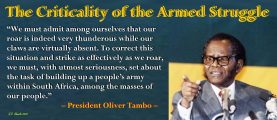
According to Mandela, “This was a fateful step. For fifty years, the ANC had treated non-violence as a core principle, beyond question or debate. Henceforth, the ANC would be a different kind of organisation. We were embarking on a new and more dangerous path, a path of organized violence, the results of which we did not and could not know.” Indeed it was a moment of historic significance: it was a result of a realisation by the people and their leaders that the times had changed and that the armed struggle in South Africa had become the main form of struggle since the racists closed all channels of peaceful settlement and negotiation, especially after the Sharpeville incident, where they murdered unarmed people and in the same month they banned the African National Congress.
Sources:
A. Lerumo, “Forms and Methods of Struggle the South African Democratic Revolution”, The African Communist, No. 9, April/May 1962.
Thula Simpson, “Umkhonto we Sizwe: The ANC’s Armed Struggle”, Penguin, 2016.
Nelson Mandela, “Long Walk to Freedom”, Abacus, 1994.
Paul S. Landau, “Spear: Mandela and the Revolutionaries”, Jacana, 2022.
Stephen Ellis, “External Mission: The ANC in Exile”, Jonathan Ball, 2012.
Castro Khwela
Good day fellow Compatriots!
Discover more from CASTRO KHWELA
Subscribe to get the latest posts sent to your email.