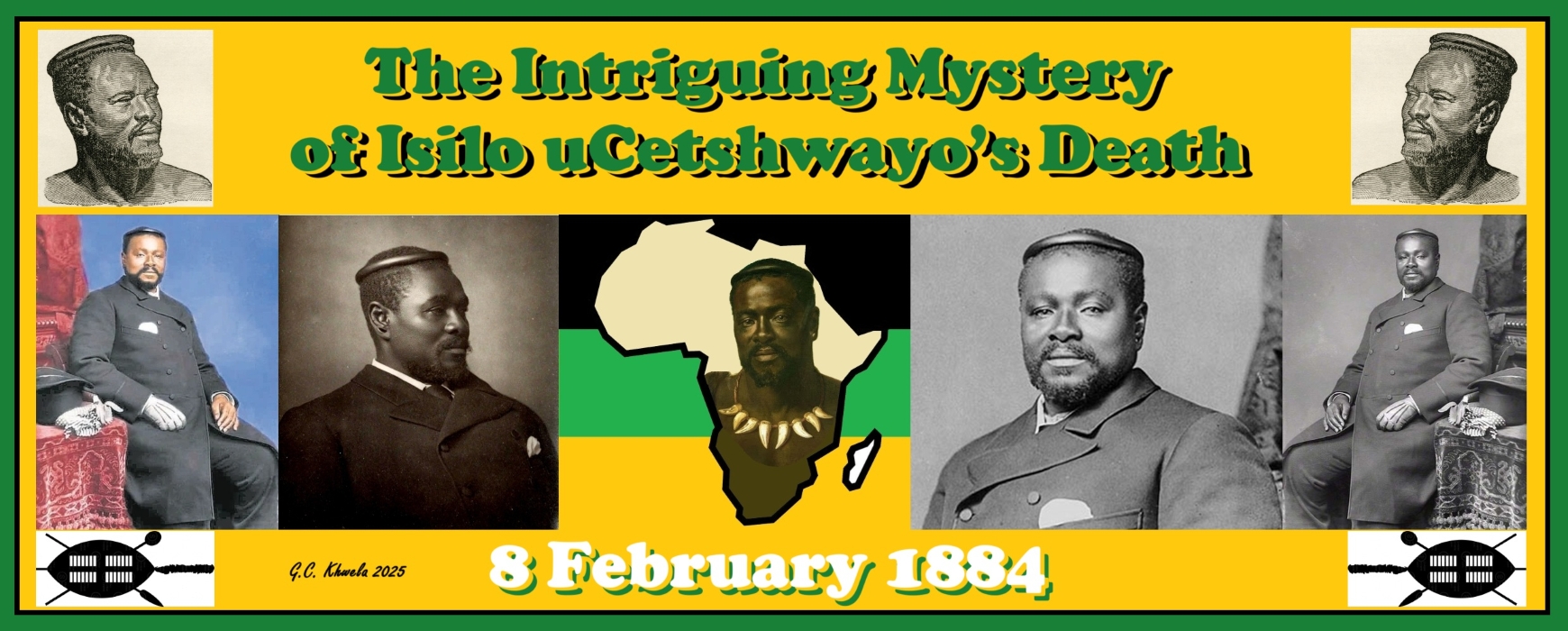
The Intriguing Mystery of Isilo uCetshwayo’s Death
On 8 February 1884, Isilo uCetshwayo kaMpande collapsed and died near Eshowe and the manner in which he died remained an intriguing mystery. The following day, on 9 February 1884, the medical examiner gave a report that he initially suspected poisoning, but no post-mortem was allowed by the late King’s retainers when Isilo uCetshwayo’s corpse was examined.
The “official” cause of death was eventually attributed to a heart attack, even though physicians from Cape Town and London, who had both previously examined Isilo uCetshwayo, differed in their opinions as to whether he had suffered from a congenital heart ailment or had died of other than natural causes. Many Zulus to this day believe that the last King to rule an independent Zulu kingdom was poisoned by his enemies and died a martyr.
Cetshwayo kaMpande was the king of the Zulu Kingdom from 1873 to 1879 and the Commander-in-Chief of the Zulu forces during the Anglo-Zulu War of 1879. Cetshwayo’s place of birth was his father’s kraal of Mlambongwenya, near Eshowe. He was born in 1826, during a very troubled period in the history of the Zulu kingdom. At time of his birth, Isilo uShaka kaSenzangakhona was wielding a very powerful command of the Zulu nation, with Cetshwayo’s father, Mpande kaSenzangakhona, being Shaka’s younger brother.
At that time, Isilo uShaka was in conflict with Soshangane, a leader of the Ndwandwe breakaway faction that had fled the Zulu kingdom and had established its kingdom near Delagoa Bay (now Maputo Bay, in Mozambique). Isilo uShaka tried several times to conquer Soshangane and his subjects, without success.
Mpande kaSenzangakhona became Isilo of the Zulus following his defeat of Isilo uDingane’s army in 1840. Shortly before he became king, Mpande had announced Cetshwayo as his heir, which was at an unusually early stage, because he was born of a wife, Ngqumbane, given to him by his brother, Dingane. Following isilo uDingane’s death, when Mpande took over the reins, he reneged on his previous pronouncement, and instead identified his favourite son, Mbuyazi, to be the heir of the Zulu kingdom.
This caused tension within the Zulu kingdom, resulting in one of bloodiest conflicts in Zulu history, the Battle of Ndondakusuka, in 1856. Cetshwayo defeated and killed in battle his younger brother Mbuyazi, Isilo uMpande’s favourite son. Almost all Mbuyazi’s followers were massacred in the aftermath of the battle, including five of Cetshwayo’s own brothers. Following this Cetshwayo became the ruler of the Zulu people, although he did not ascend to the throne, as his father was still alive. When Mpande died in 1872, Cetshwayo was installed as Isilo on 1 September 1873.
In 1878, Sir Henry Bartle Frere, British High Commissioner for the Cape Colony, sought to confederate the colony and thus began to demand reparations for Zulu border infractions, seeking to provoke the Zulu King. Since Cetshwayo kept calm to these provocations, Frere eventually issued an ultimatum that demanded that Cetshwayo disband his army, and his refusal led to war in 1879. After an initial decisive Zulu victory over the British at Battle of Isandlwana, and the failure of the Siege of Eshowe, the British retreated. Other British columns suffered two further defeats to Zulu armies in the field at the Battle of Intombe and the Battle of Hlobane. Later on, however, the British follow-up victories at Rorke’s Drift (eShiyane) and eNkambula prevented a total collapse of the British military positions.
On 4 July 1979, the British returned to Zululand with a far larger and better armed force, finally capturing the Zulu capital at the Battle of Ulundi. After Ulundi was taken and burnt, Cetshwayo was deposed, hunted down and captured. The Zulu monarchy was suppressed and Zululand was divided into autonomous areas. Cetshwayo’s possessions were seized, and he was sent into exile in Cape Town, and later to London. He returned to Zululand in 1883. By 1882, differences between two Zulu factions, the pro-Cetshwayo “uSuthu” and three rival chiefs led by uZibhebhu wakwaMandlakazi, erupted into a bloody civil war. In 1883, with the aid of Boer mercenaries, Inkosi uZibhebhu started a war contesting the succession.
On 22 July 1883, Zibhebhu attacked Cetshwayo’s new kraal in Ulundi, where Cetshwayo was wounded but escaped to the forest at iNkandla. After pleas from Sir Melmoth Osborne, the Resident Commissioner of Zululand, Cetshwayo moved to Eshowe, where he died a few months later, on 8 February 1884, aged 57. His son Dinuzulu, as heir to the throne, was proclaimed Isilo on 20 May 1884, and on 5 July 1884, the uSuthu faction, supported by a hundred mounted Boers, defeated uZibhebhu at Entshaneni, in the Lebombo Mountains.
Arguments still continue to persist that Cetshwayo was actually murdered by poisoning rather than dying of natural causes. However, the “official” version is that despite a prior attempt to assassinate him, it is possible that his death was caused by a heart attack, rather than the poisoning rumoured at the time.
Sources:
South African History Online (SAHO).
Wikipedia
Ian Knight, “Mistaken Identity: How King Cetshwayo Is Still Confused With His Brother Prince Ndabuko”.
Charles Ballard, “The Historical Image of King Cetshwayo of Zululand: A Centennial Comment”.
Jeff Guy, “The Destruction of the Zulu Kingdom” (London, 1979).
Jeff Guy, “Cetshwayo kaMpande c.1832-84” in Christopher Saunders (ed.), Black Leaders in Southern African History (London, 1979).
Castro Khwela
Good morning fellow Compatriots!
Discover more from CASTRO KHWELA
Subscribe to get the latest posts sent to your email.