Forty Years of the 1985 Botswana Massacre: The Victims were Very ‘Soft’ Targets
(Adapted from an Article by a Sechaba Special Correspondent, August 1985).
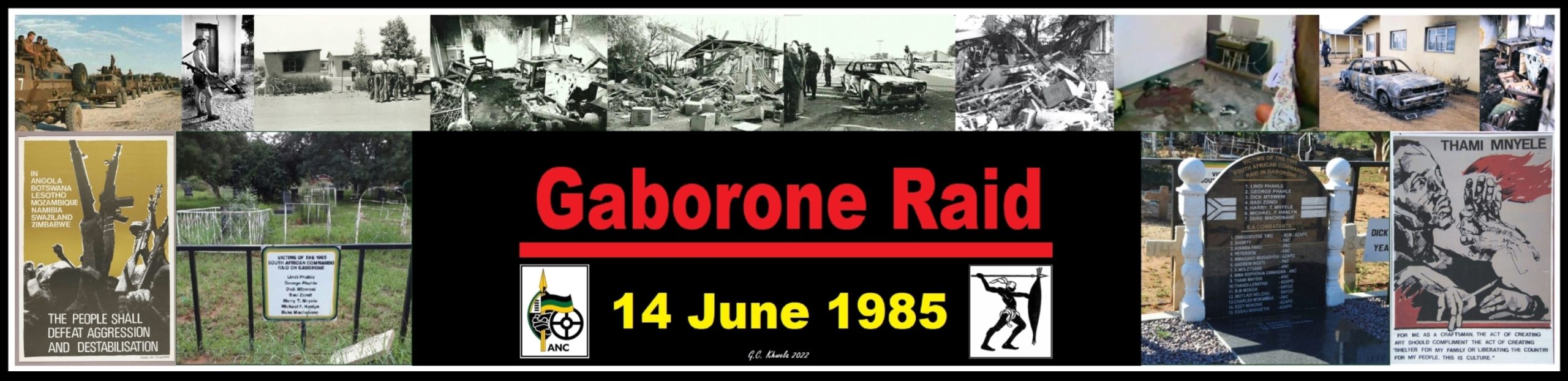
On the night of 14 June 1985, just two days before the 9th anniversary of the Soweto uprisings, and only two days before the opening of the African National Congress (ANC) Second National Consultative Conference, the apartheid terrorist threats became a reality. The Pretoria racist regime was, once again, telling the people in action that the only way to stop the bloodletting was to go to war. Stationing tanks at the Botswana border for back-up if required, Pretoria’s dogs of war came to Gaborone to kill.
Ten “ANC targets’, widely scattered, were attacked simultaneously with heavy artillery, machine guns and grenades. After the attacks, buildings were demolished with explosives; cars were burnt; every effort was made to ensure there were no survivors. Using loud-hailers, speaking in Afrikaans, English and Sotho, the apartheid South African forces of death instructed the people of Gaborone to stay indoors, keep their curtains drawn, and to switch their lights off. They then proceeded to carry out their bloody tasks.
General Constand Viljoen, Chief of the apartheid Army, declared the following morning: “We destroyed ten ANC military bases. I want to state clearly that the operation was not directed at the government of Botswana or its people, but at clearly identified ANC terrorists … The attack was a resounding success. It had become imperative to take the targets out and kill as many ANC executives as possible in the interests of peace and stability in southern Africa.”
But just who were these “ANC executives” killed by Pretoria’s executioners? Twelve people died that night – two Botswana citizens, one Somalian, one six-year-old child from Lesotho, and eight South Africans – only five of these were ANC members, none of them MK combatants. The viciousness of the attack is best conveyed through eye-witness accounts; reported herein: Five men in a white mini-bus encountered at about 1 a.m., a Botswana youth driving home from the Oasis Motel, a local nightspot a few miles from the SA border. “I thought they were the Botswana Defence Force, because they were putting on the same uniform … but they pointed a machine gun at me and started firing. They then threw a grenade at my car, so my car started burning. I hid under the seat and kept still so they thought I was dead”, he recounted from his hospital bed.
Duke Mashobane’s family was asleep when the lock on the back door of their tiny four-roomed house in the Nomatata area of Gaborone was blasted off. Their six-year-old nephew, Peter Mafoka, visiting from Lesotho, ran crying from the bedroom. Duke was sprayed with multiple rounds of machine gun fire at point blank range. His body sheltered his wife, Rose, who was allowed to escape, being told: “we’re not interested in women, only terrorists”. Clearly they saw the child as a potential terrorist, so they pumped six bullets into his small body.
It took several hours to extinguish the flames that engulfed the home of 71-year-old Dick “Mkhulu” Mtsweni. His body was burned to a cinder, and the acrid stench of charred flesh lingered in the air. His 60-year-old wife managed to crawl out of a back window despite gunshot wounds in the legs. Their 10-year-old grandchild escaped uninjured. At the home of George and Lindi Phahle, they came in shooting. George was to have left for Harare the previous evening, but had postponed his trip. A neighbour reported that about 20 SA commandos took part in this attack, shouting in Afrikaans: “Come out George … we’re going to get you, kaffir.”
They shot their way into the back room, firing at least 50 rounds – firing into walls, beds, cupboards. George and Lindi were hit again and again. George’s brother, Livy, a frail young musician, survived, only inches away from them. Lindi’s cousin, visiting from Johannesburg, died crouching in a cupboard for feeble protection. Levy said, “They just kept shooting, shooting,Hav laughing, cursing – asking ‘Are they all dead? Have we finished of the off the f- kaffirs’. Their bodies were kicked around, photographed – trophies from their blood sports.
Twenty-four-year-old Mike Hamlyn was a conscientious objector who had left SA in order not to serve in the apartheid South African Defence Force. A science student and a musician, he had just completed his course work at the University of Botswana. He died in a hail of bullets; the house was then blown up. Only ten days earlier Ahmed Geer, a Somali refugee, and his wife Roeli, had rented the front house from Mike. Both were Dutch citizens. Ahmed was killed; Roeli, eight months pregnant, escaped with severe bullet wound in the legs as the cupboard in which she hid was machine-gunned.
Eugenia Kobole and Gladys Kelapi, two young Botswana women in their early twenties, died when the servants’ quarters in which they lived was reduced to rubble by explosives. The head of one of them was blown 50 feet away, lodged in a window at the back of the main house. Two arms were found, three legs, chunks of flesh were strewn about the yard and hung from the trees. Thami Mnyele, a well-known South African artist, had his home and studio in Tlokweng. It was attacked shortly after 1 a.m., with tear-gas canisters thrown inside. Thami, fleeing, was shot in the back. Pretoria’s thugs entered the house, firing into silk-screens, easels, art supplies.
Tim Williams, suspicious of the queries made about his house, took his wife and three children to safety and returned to his home. When the attack was launched, he managed to escape, but the house was totally destroyed. The most powerful bomb was reserved for the official ANC residence, which was virtually completely demolished; its roof was blown off and only parts of two wall remained standing. But no one was there; so there no casualties. This was the third attack on South African refugees in Botswana since February 1985. When the house of Nat Serache, refugee journalist, was demolished by explosives, 16 neighbouring homes were damaged in the blast. No one was killed. In May, ANC and SACTU activist, Rogers Nkadimeng, was blown to pieces by a powerful car bomb.
Gaborone seethed with the anger and outrage expressed at this blatant act of wanton killing. The local population expressed support for the ANC and the bereaved in many ways – providing food, accommodation, transport. They turned out en masse to the funeral service held in the Gaborone National Stadium on 22 June 1985. Busloads of South Africans also travelled from various parts of the country to attend the service, including a large delegation from the South African Council of Churches (SACC).
The families of the victims came to mourn, to say farewell, but also to state clearly and unequivocally that they would not give up the struggle – their children would not have died in vain. Every facility was granted by the Botswana government and the Botswana Council of Churches pledged to make its priority the taking of the message to the people of Botswana what it meant to be a refugee from apartheid South Africa.
The victims of the Gaborone Massacre, the more than 500 people who died in the escalating conflict within South Africa over the last 9 months before the Gaborone raid, were very, very ‘soft’ targets indeed. Men, women and children, unarmed, unprotected, killed in sport, massacred in their sleep, tortured to death. The Second ANC National Consultative Conference was characterised as a Council of War, and in the escalating struggle to achieve freedom, the distinction between ‘hard’ and ‘soft’ targets was going to disappear. For even as the people buried their dead, the South African Broadcasting Corporation (SABC) and Pretoria’s spokesmen stated that they would hunt down and kill ANC executives and functionaries wherever they would be, in any corner of the globe.
This international terrorism was sanctioned, aided and abetted by Reagan’s policy of ‘constructive engagement’ and Thatcher’s feting of Botha. It needed to be countered by progressive mankind. The struggle of the people of South Africa for liberation was to be intensified at all costs. The people of South Africa, demonstrated readiness to pay the supreme sacrifice for the right to life, were acting as a united, invincible force to destroy the apartheid regime – the South African version of Nazism.
The ANC said in response, “The time has come when we should avenge our martyrs! Hambani Kahle, dear Comrades. We dip our revolutionary banner in salute to you, Cecil George Phahle, Lindi Maunde Phahle, Dick “Mkhulu” Mtsweni, Duke Mashobane, Mike Hamlyn, Thamsanqa Mnyele, Basie Zondi, and not least, Peter Mafoka. Your deaths will not be in vain!”
Source:
Special Correspondent, “The Botswana Massacre: The Victims were Very ‘Soft’ Targets”, Sechaba, August 1985.
Castro Khwela
Good evening fellow Compatriots!
Discover more from CASTRO KHWELA
Subscribe to get the latest posts sent to your email.