Forty Years of the Kabwe Conference: Pretoria Regime Alone in Africa
(Portions of the Political Report of the National Executive Committee to the National Consultative Conference, which was presented by the President of the African National Congress, Oliver Tambo, 17 June 1985, Kabwe, Zambia)
Pretoria Overrules Bantustan Leaders
“But, in fact, P.W. Botha inherited and continued the policies of his predecessor, carrying to their conclusion initiatives that Vorster had taken. One of these concerned the bantustans. When Angola and Mozambique attained their independence, the Pretoria regime decided to accelerate its plans with regard to the bantustans. In a so-called Summit Meeting in November 1973, the bantustan leaders had agreed that they would not accept ‘independence’. Three years later, in October 1976, Pretoria proclaimed the Transkei an independent State. Clearly, the paymaster had the power to change the minds of his employees as he wished. The Transkei was followed by Bophuthatswana in 1977.
“The Pretoria regime represented this process as one of decolonisation, and wanted the world to accept that the African majority was regaining its right to national self-determination. For our part, it was vitally necessary that we ensure that the international community should reject these bantustans as the mere extension of the apartheid system that they are.
“During its ‘détente’ offensive the Pretoria regime had used some of the bantustan leaders to try to open the doors for itself internationally. When he led a delegation of the South African regime to the United Nations two or three years earlier, Pik Botha had included Kaiser Matanzima. In those years, we successfully fought against the acceptance of these bantustan leaders as representatives of our people and got the international community to reject the entire ‘separate development’ programme. Similarly, we succeeded to ensure the rejection by the whole world of the so-called independent bantustans when Pretoria proclaimed them as such.
“This was a serious blow to the Pretoria regime. And yet Botha, who had ousted Vorster because of the ‘failures’ of the latter, continued with this policy, pushing Venda into so-called independence in 1979 as well as the Ciskei in 1981. After all, P. W. Botha had no other options.
Workers and “Influx Control”
“Vorster had also appointed the Wiehahn and Riekert Commissions to consider labour questions, including job reservation, influx control, trade union rights and so on. Both these commissions reported to the new racist Prime Minister who proceeded to accept recommendations for relaxation of job reservation to meet the requirements of the capitalist economy and for even tighter influx control.
“This was despite the fact that since 1978 Crossroads had become a national and international symbol of the policy of influx control and forced removals and a focus of the struggle to resist this policy. To this day, despite Vorster and despite Botha, Crossroads continues to stand firm, having served to inspire the whole effort for the formation of mass democratic community organisations. Further, having been forced to recognise the right of African workers to belong to trade unions, the Botha regime nonetheless legislated to impose further controls on the trade union movement to ensure that this movement does not emerge as an independent, democratic formation.
“It was also Vorster who, in 1977, announced the project to amend the racist constitution and to try to coopt sections of the black people through the creation of a tricameral parliament. In the same year, as Defence Minister under Vorster, P. W. Botha announced in public the so-called total strategy for the defence of the apartheid system.
“Perhaps more than anything else, the pronouncement of this posture, the admission that the apartheid regime needed to mobilise all available resources for the defence of white minority rule, signified the extent to which the racists felt that the initiative was slipping out of their hands. Responding to this situation, increasingly the focus of State policy centred on so-called ‘national security’, leading to the elaboration of measures for the management of the crisis in which the apartheid system was immersed.
Pretoria Regime Alone in Africa
“The extent of that crisis was made patently clear to the Botha regime when the component parties of the Patriotic Front won the elections in Zimbabwe in 1980, taking almost all the African seats. The desperate efforts of the Pretoria regime to keep the Smith regime in power had come to nothing. Equally, the last ditch attempts to avoid complete defeat by sponsoring a puppet regime, failed miserably.
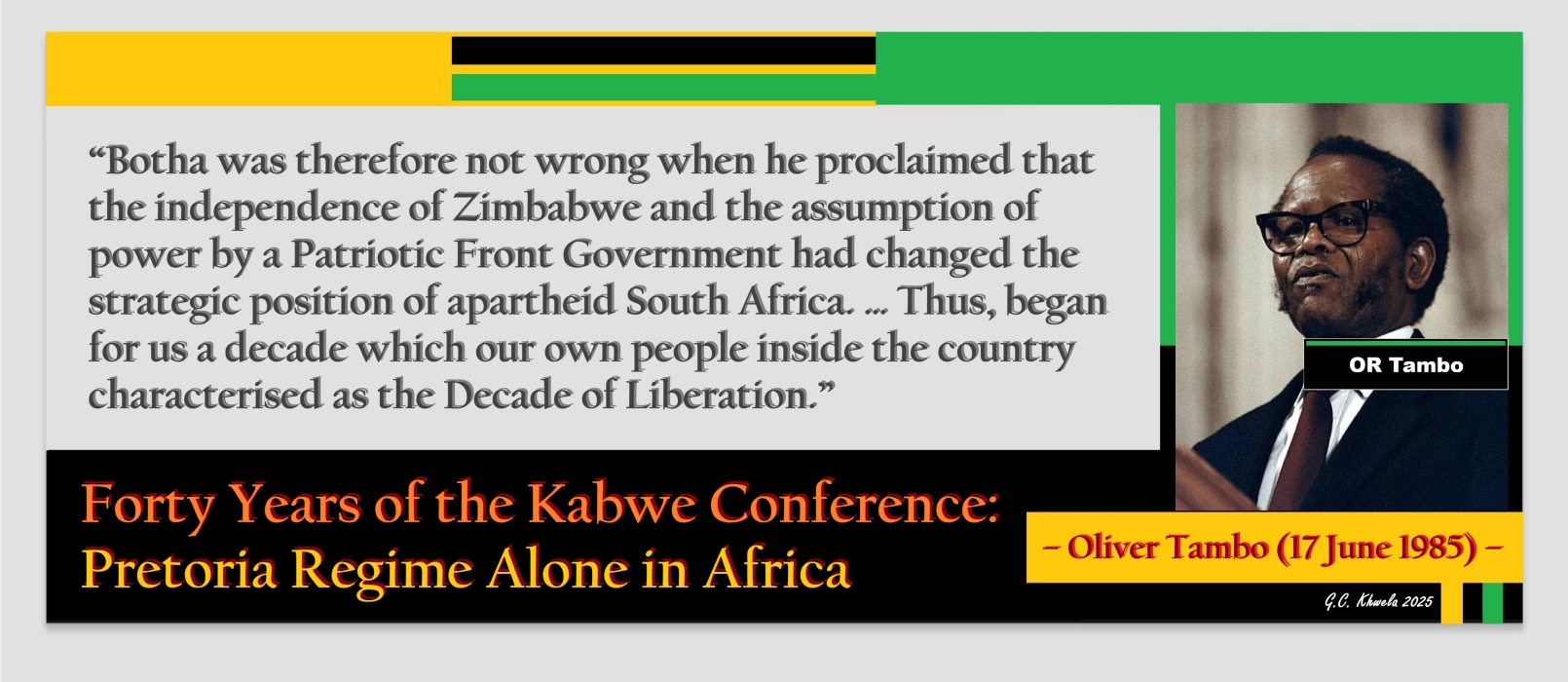
“Five years after FRELIMO and the MPLA had assumed power in their respective countries, events in our region had, once again, confirmed the inevitability of our own victory. The Pretoria regime remained the only one of its kind on the African continent. Botha was therefore not wrong when he proclaimed that the independence of Zimbabwe and the assumption of power by a Patriotic Front Government had changed the strategic position of apartheid South Africa. So frightened was he that he even announced that he would call a national conference representative of all the people of South Africa, both black and white, to consider the future of our country.
“The masses of our people responded to this announcement by demanding the release of Nelson Mandela and the rest of our leaders, stating unequivocally that if Botha wanted to discuss the solution of the problems of our country, then it was with these leaders that he should negotiate. The leadership of our movement, for its part, called on the people not to attend Botha’s conference. That was the last that anybody heard of this bold initiative, exactly because the racists knew that were they to proceed with it, they would have nobody to confer with.
“Thus, we can say that when the period we have described as one of Consolidation and Further Advance came to an end, ten years after the Morogoro Conference, nobody could doubt the ascendancy of our struggle.
“In 1980, one Dr. Chester Crocker, at that time no more than a university professor, said: ‘I would say (the whites in South Africa) don’t have a long period of time, that the current window of opportunity could be shorter than they realise… You mention large-scale revolutionary warfare. I would argue that the options are more likely to be in the area of urban rioting, of large scale strikes, perhaps general strikes, of passive resistance efforts and things of this nature, consumer boycotts; the South African State is weakest in that area.’
“Thus, began for us a decade which our own people inside the country characterised as the Decade of Liberation. If we may jump to more recent events, this week the United States Senate voted to repeal the Clark Amendment which the United States Congress had adopted ten years ago. That Amendment had prohibited any military involvement of the United States Government against the People’s Republic of Angola. We have now come to the point where powerful forces within the same United States Congress are willing and ready to free the hand of the Reagan Administration to engage in any military adventures against heroic Angola that it may choose.” (To be continued)
– Oliver Tambo (17 June 1985) –
Source:
Oliver Tambo, “The Eyes of Our People are Focussed on this Conference”, Sechaba, October 1985, pp. 2 – 9.
Castro Khwela
Good morning fellow Compatriots!
Discover more from CASTRO KHWELA
Subscribe to get the latest posts sent to your email.