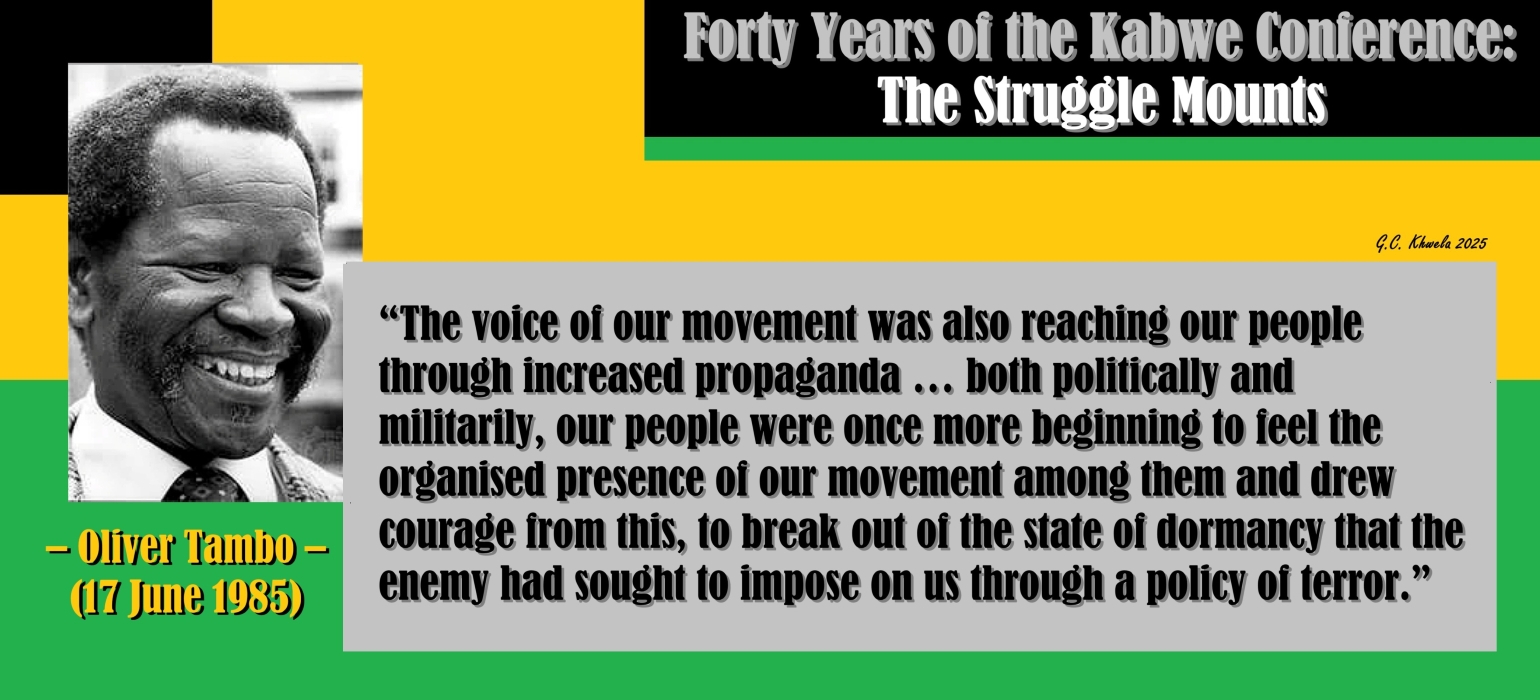
Forty Years of the Kabwe Conference: The Struggle Mounts
(Portions of the Political Report of the National Executive Committee to the National Consultative Conference, which was presented by the President of the African National Congress, Oliver Tambo, 17 June 1985, Kabwe, Zambia)
The Struggle Mounts
“The decision of the Morogoro Conference helped us to overcome many shortcomings and to gear our organisation to make a more effective contribution to the mounting struggle inside our country and the anti-imperialist offensive of the peoples internationally. For, indeed, as the world forces of reaction basked in a passing glow of superior strength in 1969, the revolutionary and democratic movement was engaged in ever-mounting struggles to wrest victory from the oppressors and the exploiters. Five years after our Conference, the situation in our country, in our region and in other parts of the world was very different.
“Already by 1969 the masses of our people had begun to stir, in the process of overcoming the reverses and relative lull imposed on us by the brutal counteroffensive that the enemy had unleashed and which had resulted not only in the banning of the ANC, but also in the Rivonia and others arrests, the assassination and execution of patriots and the systematic use of torture as an instrument of State power.
“In particular, the youth and the workers were once more taking up the cudgels, engaging in boycott and strike actions during 1972 and 1973. Student organisations and trade unions were formed which served as the means to arouse the people and mobilise them to attain the level of mass activity which we had last seen with the general strike of 1961 organised to oppose the establishment of a racist republic and to demand one that was representative of all the people of our country. Black consciousness became a fact of our political life during this period.
“In part, the resumed mass activity in our country was inspired by the stirring battles that our combatants had fought in Zimbabwe. Our successes in sending cadres of Umkhonto we Sizwe into the country through the machineries of the Revolutionary Council which had been established at the Morogoro Conference, raised the confidence of the masses of our people in their own ability to confront the apartheid regime successfully.
“At the same time, our organised contact with the people had improved. The voice of our movement was also reaching our people through increased propaganda, both written and through radio. In short, both politically and militarily, our people were once more beginning to feel the organised presence of our movement among them and drew courage from this, to break out of the state of dormancy that the enemy had sought to impose on us through a policy of terror.
International Developments
“Outside our country, on the eve of our conference at Morogoro, the international democratic struggle had erupted with particular intensity, especially in Western Europe and North America. In 1968, millions of people in these regions joined in mass struggles for the democratisation of their societies and in favour of a just world order.
“But as we have said, the counter-revolution succeeded in Chile in 1973. Salvador Allende was murdered, with hundreds of others. Thousands of others were imprisoned, tortured and driven into exile. With the coming to power of the Pinochet junta, the Vorster regime found an ally in South America. However, these events did not and could not change the fact that the progressive forces were advancing. In 1972, the Soviet Union and the United States had concluded a treaty limiting strategic nuclear weapons. This was an important victory of the world peace forces which had been engaged in struggle for decades to save humanity from a nuclear holocaust.
“In 1973, the Arab armies succeeded to inflict a major defeat on Zionist Israel for the first time in a quarter of a century, forcing United States imperialism to seek new measures to protect its client State in the Middle East. At the same time, the prestige of the African liberation movements had grown to such an extent that for the first time, in 1973, the OAU Summit voted to sit the liberation movements at all OAU meetings as observers.
“That advance within the OAU was also accompanied by the further improvement of our relations with the independent States of our region. In the years 1973-74, the ANC normalised its relations with the Governments of Botswana and Lesotho. This underlined the importance of the countries of our region in terms of their support for the cause of the liberation of our country.” (To be continued)
– Oliver Tambo (17 June 1985) –
Source:
Oliver Tambo, “The Eyes of Our People are Focussed on this Conference”, Sechaba, October 1985, pp. 2 – 9.
Castro Khwela
Good morning fellow Compatriots!🙏🏾✊🏾👊🏾
Discover more from CASTRO KHWELA
Subscribe to get the latest posts sent to your email.