Forty Years of the Kabwe Conference: Unity of Liberation Forces
(Portions of the Political Report of the National Executive Committee to the National Consultative Conference, which was presented by the President of the African National Congress, Oliver Tambo, 17 June 1985, Kabwe, Zambia)
A Need to Organise the Countryside
“Certain advances have been made with regard to the creation of a mass democratic movement in the bantustans, especially in the last twelve months. At the same time, it is true that, in the main, we have not succeeded to build this movement to the level of strength that is possible and necessary. We have not even succeeded to utilise fully the considerable experiences of such elders in our midst as Comrade Elijah Mampuru.
“We have to build a mass democratic movement in the countryside and in this process, separate any existing mass organisations from their diehard counter-revolutionary leaders, redirect them to the only correct path of revolutionary action by the people themselves and, for this purpose, solve the actual political problems posed by this population in terms of their organisation and activisation.
“Bound as we are historically to work for the greatest possible unity of the oppressed masses, and without forgetting that these masses are our reliable base, we have to deal with any personalities within these bantustans who display a democratic consciousness, however limited.
ANC: The People’s Own Organisation
“The storm that erupted as a result of our meeting with the Inkatha delegation in 1979 demonstrated the absolute need for a clear and common understanding and an acceptance of the basic strategic and tactical positions of our movement by the membership of the ANC as a whole, our allies, the broad democratic movement of our country and the masses of our people.
“It also became clear that, once more, whatever the ANC did was seen by the millions of our people as a matter of vital importance to their future and one over which they had a right and duty to intervene, to express an opinion, to influence. We had defeated the attempt of the apartheid regime to isolate us from our people and reasserted our position as the representative of these masses, recognised by them as such.
“This showed that in the period up to 1979, we had succeeded to vanquish the efforts of schools of political thought, different from our own, to resurrect the idea of a ‘Third Force’. This idea was pursued with the greatest vigour in the period following the Soweto Uprising. Our opponents sought to use the enormous contribution that our youth and students had made to the struggle, to ascribe the role to the students of a vanguard force in our struggle.
“On the basis of this wrong thesis, desperate attempts were made by elements in the USA, independent Africa and Western Europe, to form some youth political organisation specifically as a counterweight to our movement, taking advantage of the political immaturity of some of the young people who had battled the apartheid regime with such daring and courage. It was out of these manoeuvres that the so-called South African Youth Revolutionary Council was born. Attempts were even made to form an anti-ANC coalition composed of this SAYRCO, remnants of the BCM, the PAC, the Unity Movement and the Group of Eight, which we had expelled in 1975 when it adopted public positions which were completely at variance with the policy of our movement.
Unity of Liberation Forces
“Through struggle, in which we put to the fore our policy, strategy and tactics, while continuing to engage in action against the apartheid regime, at home and abroad, we defeated this attempt to create a ‘Third Force’. The majority of the youth who had left the country had, in any case, come into the ranks of the ANC as had the majority of the activists of the BCM. In this context, we should also say that as part of the process of consolidation and further advance, acting together with our youth inside the country, we had encouraged the establishment of a number of mass democratic organisations of the youth.
“It is also important to recall that many leading activists of the democratic movement were arrested and detained in 1977, following the banning of nearly a score of organisations. Since they were held together, these leaders had the opportunity to discuss the perspectives of our struggle. Thanks to the position taken by many of these, including leaders of the now-banned SASO, a majority view had emerged clearly in favour of the ANC as the authentic representative of our people.
“Thus by 1979, the end of the period we are discussing, the ANC enjoyed maximum political and organisational unity. Inside our country its prestige was high. There was no serious formation which could pose itself as an alternative, both politically and militarily. Its capacity inside the country to act, both politically and militarily, had increased.
“It was in this context that we declared 1979, the centenary of the Battle of Isandlwana, the Year of the Spear. In the light of the armed actions which we had resumed in 1977 which were having the political impact we desired, it seemed clear to us that we could and should take advantage of this centenary to popularise the armed struggle using political means. This would serve the purpose of further mobilising the masses of our people for increased involvement in the armed struggle and, by evoking the heroism of our forebears, help further to inspire our people to make the sacrifices that armed struggle necessarily entails.
Culture: A Weapon in the Struggle
“It is worth nothing here that on this occasion, activists inside the country used the weapon of culture to popularise the ideas of the Year of the Spear. This drew our attention to the importance of this medium of communication and to its value in the formation of our people and new men and women. Unfortunately, up to now, our leadership in particular has not paid sufficient attention to this question, to give it the importance it deserves. Among its tasks, Conference will have to attend to this issue.
“We also wanted to make certain that we oppose the enemy’s view of Isandlwana, and therefore our resistance to colonialism, with our own revolutionary view. Thus we would engage this enemy in political struggle, interpreting the centenary in the context of our national struggle and not of tribalism and the bantustans, which is what the apartheid regime was bound to do.
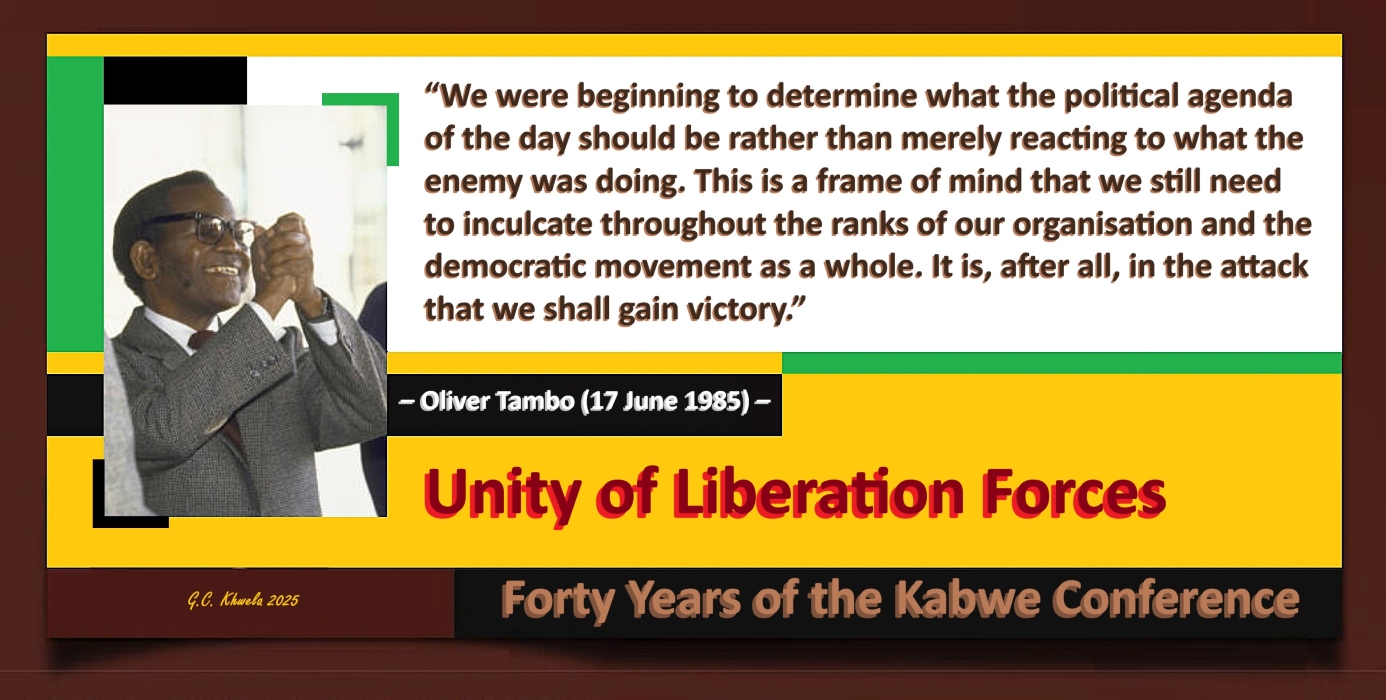
“This initiative was also important in the further development of our struggle in that it signified that we were beginning to pass over from the defensive to the offensive. We were beginning to determine what the political agenda of the day should be rather than merely reacting to what the enemy was doing. This is a frame of mind that we still need to inculcate throughout the ranks of our organisation and the democratic movement as a whole. It is, after all, in the attack that we shall gain victory.
“The period 1975–1979, which was so important in laying the basis for the rapid development of our struggle to date, was also one during which the crisis of the apartheid regime further deepened, resulting in the enemy having to adopt extraordinary measures to defend itself. Apart from the developments at home marked by the resurgence of our movement and of the mass political and the armed struggle, the balance of forces had shifted further against the apartheid system internationally.” (To be continued)
– Oliver Tambo (17 June 1985) –
Source:
Oliver Tambo, “The Eyes of Our People are Focussed on this Conference”, Sechaba, October 1985, pp. 2 – 9.
Castro Khwela
Good morning fellow Compatriots!
Discover more from CASTRO KHWELA
Subscribe to get the latest posts sent to your email.