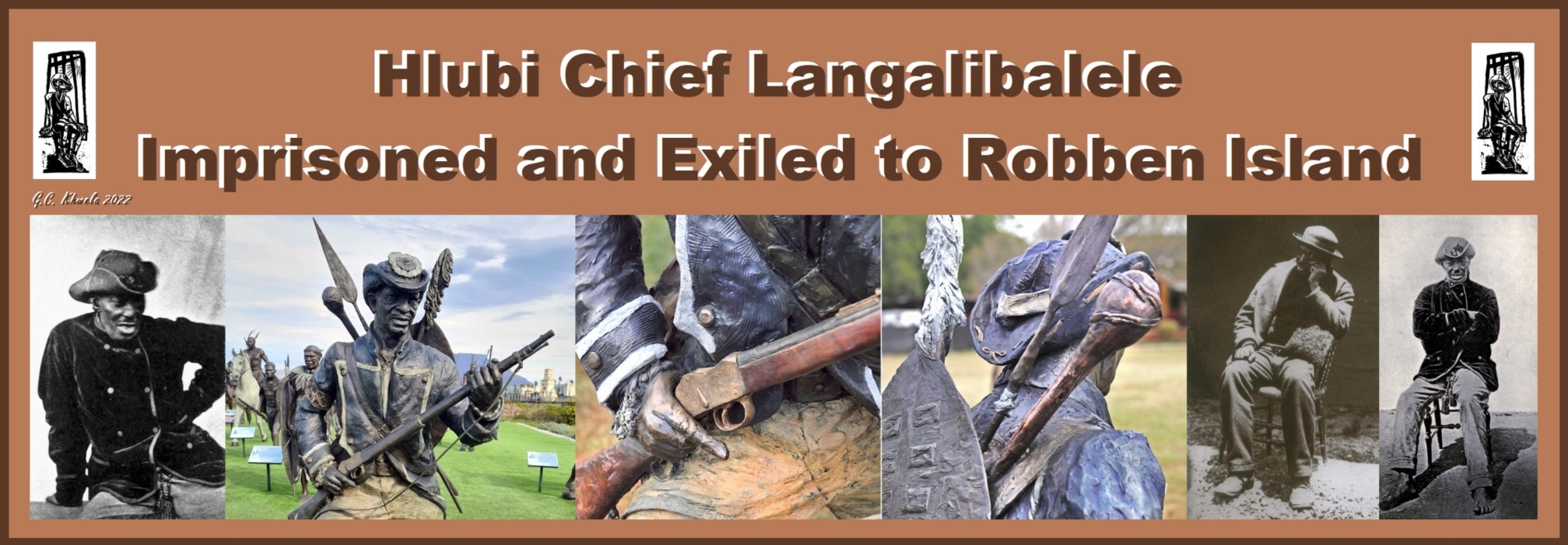
Hlubi Chief Langalibalele Imprisoned and Exiled to Robben Island
On 9 February 1874, considered to be in “rebellion” against the British Empire, the Hlubi Chief, Langalibalele, was imprisoned and exiled to Robben Island, after being captured following his flight to Basutoland. As a hereditary chief of the amaHlubi, Langalibalele inhabited the area near present day Estcourt in the Drakensberg foothills.
The reason for being deemed to be in “rebellion” was his refusal to register firearms that were owned by his people with the British colonial authorities. The Hlubi had received these firearms as a form of payment from the owners of diamond mines for the labour provided by Hlubi men who worked in the mines. Langalibalele was then summonsed to Pietermaritzburg for failure to register firearms belonging to his people. After refusing to go to Pietermaritzburg, a force was sent to capture King Langalibalele after he fled to Basutoland.
Langalibalele, which means “the blazing sun” (also known as Mthethwa, Langalibalele I KaMthimkhulu II, Mdingi kaJobe), was the second son of Mthimkhulu II, king of the amaHlubi, who was born on the eve of the arrival of European settlers in the Natal province, around 1814. Following the murder of his elder brother, Dlomo, by the Zulu Isilo Mpande, Langalibalele took over as King of amaHlubi in 1836. After being in conflict with the Zulu Isilo Mpande, for failing to heed his summonses to the Zulu Royal kraal, since the amaHlubi did not consider themselves subjects of the Zulu Kingdom, he fled with his people to the Colony of Natal in 1848.
Following negotiations in which Langalibalele exhibited considerable diplomacy, in December 1849, the amaHlubi, now reduced to 7 000 in number, were granted 364 km squared of good land on the banks of the Little Bushman’s River, between the newly established European settlement of Bushman’s River (Estcourt) and the Drakensberg. The British colonial administration had hoped that the amaHlubi would provide a buffer between the Khoisan and the settlers, thus protecting the settlers’ cattle from the Khoisan. Later, the area occupied by amaHlubi proved to be small and within a few years, the Hlubi settlement had expanded to more than 6000 km squared.
Anticipating increasing costs in running the huge British colonial empire, the British Government in the 1850s required that the colonies should be self-supporting in so far as was possible, resulting in various taxes being imposed on all residents, including the native populations. Subsequently, a hut tax and military levies were imposed on the native population that lived within the limits of the British colony. For instance, a marriage tax of £5 imposed by the colonial administration in 1873 caused much resentment among the amaHlubi.
As a result of the diamond rush of the 1870s, many of Langalibalele’s young men worked on the mines in Kimberley where they acquired a massive number of guns. In 1873 the colonial authorities of Natal, under John Macfarlane, then magistrate in Estcourt, ordered that Langalibalele hand in his people’s guns for registration. When Langalibalele refused, a stand-off ensued, resulting in a violent skirmish on the Bushman’s River Pass in which three of the colonial British troops were killed. Langalibalele fled across the mountains into Basutoland.
However, Langalibalele, was later captured, following the Basuto Chief Molapo handing him over, with five of his sons, to the British colonial force on 13 December 1873. Langalibalele was then sent to Pietermaritzburg, where he was put on trial by a “kangaroo court”, which consisted of substantial procedural irregularities. Lieutenant-Governor Sir Benjamin Pine punished the Hlubi by breaking up their location, confiscating their cattle, and on 9 February 1874 imprisoning Langalibalele on Robben Island.
Not long after Langalibalele arrived at Robben Island, information began to surface across southern Africa about the unfair nature of the Chief’s treatment. Liberals within the British empire began casting doubts about the fairness of the trial, including raising questions whether Langalibalele actually intended to rebel at all. The main outcry was led by the Bishop of Natal, John Colenso, who journeyed to England to plead Langalibalele’s case personally. Colenso ultimately succeeded in getting the case returned to the South African courts.
One of the advocates who championed Langalibalele’s case was John Ross, real name Charles Rawden Maclean, who wrote a letter to the editor of The Times contesting the legitimacy of the case. Then Minister of the Cape government and spokesman, John X. Merriman, publicly condemned the trial, which became known as the “Natal Prisoner’s Bill”, and demanded that it be considered illegitimate.
Eventually Langalibalele was returned to Natal, but he was confined under house arrest to the Swartkop location, near Pietermaritzburg. Following his release from Robben Island, he never regained his power as leader of the amaHlubi. The trouble with Chief Langalibalele of the amaHlubi, nicknamed “Long Belly” by the British, was that he was considered to be “recalcitrant”, resulting in the amaHlubi paying dearly for their “defiance”. Over a hundred were killed in a series of punitive attacks and their land and cattle were confiscated by the Natal colonial administration. Langalibalele died in 1889 and was buried at Ntabamhlope, 25 kilometres west of Estcourt.
One of the underlying causes of the Langalibalele “rebellion” was an inconsistent policy in the various British colonies towards the native populations and in particular the ownership of guns. In 2005 the amaHlubi people presented a Submission to the Commission on Traditional Leadership Disputes and Claims under the Framework Act to recognise Ingonyama Muziwenkosi ka Tatazela ka Siyephu ka Langalibalele, otherwise known as Langalibalele II as king of the amaHlubi. However, in 2010, the Nhlapo Commission found that since the amaHlubi had been dispersed before the colonial era, they did not have a claim to a kingship.
Nevertheless, Langalibalele was one of the first African activists to be banished to Robben Island, nearly a century before Nelson Mandela and numerous activists that were imprisoned there. In 1990, shortly after his own release from Robben Island, Nelson Mandela laid a wreath on his grave in recognition of Chief Langalibalele’s own internment in the Island prison.
Sources:
Wikipedia
South African History Online (SAHO)
David Saks, “Durnford, ‘Long Belly’ and the Farce at the Pass”, Military History Journal, Vol 14 No 2, December 2007.
Castro Khwela
Good day fellow Compatriots!
Discover more from CASTRO KHWELA
Subscribe to get the latest posts sent to your email.