On 14 January 1953, Josip Broz Tito became the president of the Socialist Federal Republic of Yugoslavia, thus becoming the Head of State of that country, concurrently as President of the League of Communists of Yugoslavia.
The 1946 constitution of Yugoslavia defined the government as headed by a president (commonly known as prime minister) as the highest administrative authority in the country. Tito served as Prime Minister during the entire period up to adoption of the 1953 constitution, which proclaimed the country to be a socialist republic and removed all previous references to a government and ministries.
Josip Broz Tito was born in Kumrovec in what was then the Austro-Hungarian empire. He was drafted into military service, wherein he distinguished himself, becoming the youngest Sergeant Major in the Austro-Hungarian Army of that time. After being seriously wounded and captured by the Russians during the First World War, Tito was sent to a work camp in the Ural Mountains.
He thereafter participated in some events of the Great October Socialist Revolution in 1917 and the subsequent Civil War. When he returned to the Balkans in 1920, he entered the newly established Kingdom of Yugoslavia, and joined the Communist Party of Yugoslavia. He rose through the ranks of the Party and by 1937 assumed de facto control over the party. Tito was formally elected the Party’s general secretary in 1939 and later its president, the title he held until his death.
During the Second World War, following the Nazi invasion of Yugoslavia, he led the most successful guerrilla movement in Eastern Europe, the “Partisans”, from 1941 to 1945. By the end of the war, the Partisans, took power in Yugoslavia, and Tito served as the Prime Minister. In 1945, under his leadership, Yugoslavia became a socialist state, which was eventually renamed the Socialist Federal Republic of Yugoslavia.
Despite being one of the founders of the Information Bureau of the Communist and Workers’ Parties, which was commonly known as Cominform, a co-ordination body of Marxist-Leninist parties in Europe, formed in the wake of the dissolution of the Communist International in 1943, he became the first Cominform member and the only leader in Joseph Stalin’s lifetime to defy Soviet hegemony in the Eastern Bloc.
Yugoslavia was expelled from the organisation in 1948 in what became known as the Tito-Stalin split, leading to Tito gaining further international attention as a co-founder of the Non-Aligned Movement (NAM), alongside Jawaharlal Nehru of India, Gamal Abdel Nasser of Egypt, Kwame Nkrumah of Ghana, and Achmed Sukarno of Indonesia..
Following its own socialist path, not being part of the Soviet-dominated Eastern bloc and a leader of the Non-Aligned Movement (NAM), Yugoslavia was one of the main supporters of the liberation movements in Southern Africa. Anti-colonialism became an integral part of Yugoslavia’s foreign policy, and the country took up Southern African issues when it became clear that Portugal and the white minority rulers in South Africa and Rhodesia tried to preserve power and the status quo.
Yugoslavia broke diplomatic ties with the apartheid regime, closed its consular office in Johannesburg in 1963, and established diplomatic relations with Portugal only after the Carnation Revolution in 1974, although there were contacts with the Portuguese Communist Party and the Portuguese National Liberation Front before the Revolution. Tito evoked the problem of Southern Africa during his speeches, whether on international gatherings or at the congresses of the League of Communists of Yugoslavia.
At the different NAM conferences the conflicts in Southern Africa were key issues, where member states were urged to break diplomatic ties with Portugal, to financially and militarily support the freedom fighters in the Portuguese colonial territories, in Rhodesia and South Africa, and not accept Southern Rhodesia’s independence if proclaimed under white minority rule, as well as isolate the racist regime in South Africa and boycott its goods.
In the early 1960s, Yugoslavia established relations with the liberation movements in Southern Africa and contacts were established and strengthened during multinational meetings such as NAM conferences, where liberation movements would send representatives, through the offices of liberation movements in free African countries, and through visits of liberation leaders to Yugoslavia.
Along with Yugoslav diplomatic, material, and military support to young independent states and liberation movements, the country granted scholarships to young people from the “Global South”. Accordingly, Yugoslavia responded to the need of the newly independent countries and national liberation movements for well-educated young people who could take the reins of the social and economic development within their respective countries.
Yugoslavia granted 7 900 scholarships for countries of the “Global South”, liberation movements and friendly parties between 1955 and 1984. Over 2 800 grantees from 90 countries, liberation movements, and friendly parties came to Yugoslavia during the period 1977– 1984 alone. The foreign students received educational and professional, including military, training on all levels and for short or long-term periods.
Starting from the early 1960s, educational aid also led young Southern Africans to Yugoslav schools and universities. Together with the Union of Soviet Socialist Republics (USSR), the then German Democratic Republic (GDR) and the former Yugoslavia catered for most of Umkhonto we Sizwe’s (MK’s) training needs, specifically in specialised areas.
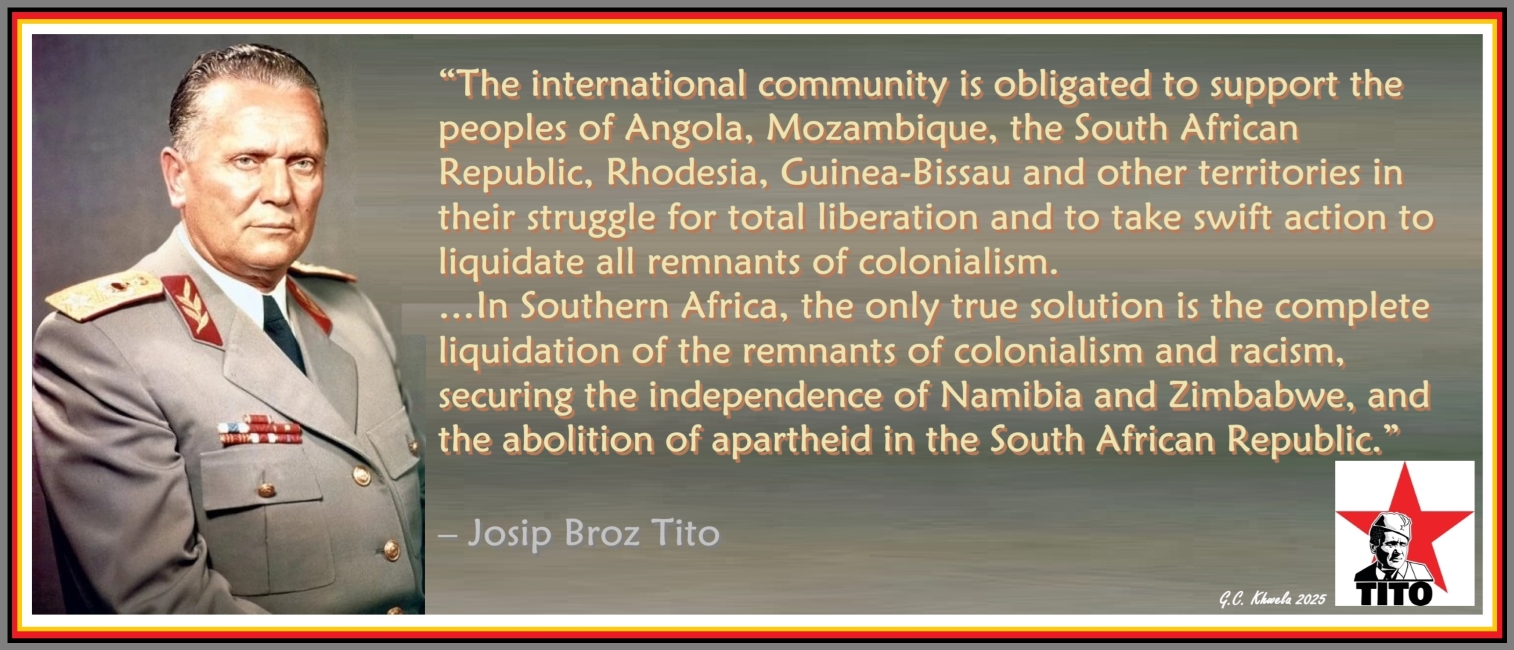
According to Tito, “the international community is obligated to support the peoples of Angola, Mozambique, the South African Republic, Rhodesia, Guinea-Bissau and other territories in their struggle for total liberation and to take swift action to liquidate all remnants of colonialism. …In Southern Africa, the only true solution is the complete liquidation of the remnants of colonialism and racism, securing the independence of Namibia and Zimbabwe, and the abolition of apartheid in the South African Republic.”
Castro Khwela
Good day fellow Compatriots!
Discover more from CASTRO KHWELA
Subscribe to get the latest posts sent to your email.