June 16 Detachment’s Training in Novo Catengue
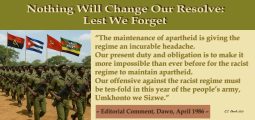
On 6 June 1977, an Umkhonto we Sizwe (MK) military parade took place in a camp called Novo Catengue, in Benguela, Angola. The new recruits were divided into four companies, each with a Cuban and an MK Commander, as well as an MK Commissar. Novo Catengue was opened by the African National Congress (ANC) in March 1977, inland from Benguela, which was located next to Angola’s main railway line in an abandoned building adapted to house the hundreds of recruits who were to be shaped into political soldiers by a corps of ANC commissars and Cuban instructors.
“It was estimated by Gwendolyn Sello, a member of the Angolan Health Team, that between the two camps and Luanda, there were about five hundred cadres, twenty-five of whom were female. At this early stage, the ANC relied on Cuban support and leadership in the camp and, consequently were also the beneficiaries of Cuban medical services. The ANC provided medical staff (Dr Peter Mfelang, Dr Novama Shangase, nurses Gwendolyn Sello and “nurse Alice”) to the camps and actively sought support for drugs and first aid supplies” (Armstrong).
The first group of MK soldiers in Novo Catengue were the “Mgwenya” group, who were veterans of the Luthuli Detachment, and constituted the core of MK during its first decade in exile and held the fort during the most difficult years of the ANC’s armed struggle. Most of them survived the trials and tribulations of exile, when most found it unbearable, and remained in the camps at Kongwa and Dar es Salaam in Tanzania for years. The Luthuli Detachment was an inspiration to the first batch of the June 16 Detachment as they were the living evidence that with conviction and political will, it was possible to survive.
Among the Political Instructors was Jack Simons, formerly of the University of Cape Town, and Mark Shope, the Veteran leader of the South African Congress of Trade Unions (SACTU). Both Shope and Simons were remembered by graduates of the camp with real affection. Novo Catengue was one of MK’s largest and most successful camps, the “University of the South”, known for its stimulating education programme. It was also at Novo Catengue where MK cadres were educated not only in the art of war, but also in politics and philosophy. Mark Shope, as the Camp Commissar, had been keen on political education. “Sons and daughters of the working class, good morning!” he would greet the soldiers every day.
The introduction of an enormous number of Commissars at Novo Catengue was an innovation by the ANC, as Commissars were seen as a critical in ensuring ideological control of the newcomers. Faced with an influx of raw recruits after 1976, the ANC appointed commissars throughout its units, and within a short time the commissars were overseeing the whole spectrum of ANC political life. The post of Army Commissar had existed in MK since the move into exile, but it had never been of major importance. Nevertheless, each unit and department, including cultural groups, acquired their own commissars.
Umkhonto we Sizwe “didn’t just lay emphasis on producing and reproducing guerrilla fighters”, commented Chris Hani. “Our feeling was that they must organise the people politically, and the people, if you like, would become the forest and the caves and the camouflage of the incipient guerrilla movement”.
Novo Catengue acquired the reputation of having developed a model People’s Army, where political training and development was impressive, where the cadres themselves were involved in solving problems and where discipline was ‘constructive’. Tambo had encouraged this approach in all the camps: “In building up our own popular army”, he explained to the troops “we aim … not only at the overthrow of the fascist regime, we aim also at building up a politically conscious and revolutionary army, conscious of its popular origin, unwavering in its democratic functions and guided by our revolutionary orientation.”
Jocelyn Alexander and JoAnn McGregor maintain that MK cadres – many of them products of the 1976 Soweto uprising – mirrored the great boom in the Zimbabwe People’s Revolutionary Army (ZIPRA) trainees (the armed wing of the Zimbabwe African People’s Union) in this same moment. Both arrived in the newly opened Angolan camps in their thousands. Early on, MK and ZIPRA cadres crossed paths in Luanda and in transit camps, one of the earliest of which was known as “Engineering”, though they went on to separate camps. For most MK cadres in the mixed residents at the Engineering Camp was an interesting experience, since the Cubans were ‘noisy’ and ‘lively’, while SWAPO (the South West African People’s Organisation) cadres were ‘reserved’, and the ZIPRA “machindras” loved to toyi-toyi and sing.
“The 1970s’ parallels in MK and ZIPRA’s expanding Angolan camps ends, however, with the story of the expansion itself. In late 1977, ZIPRA was sending thousands of soldiers into Rhodesia and was rapidly developing a formidable conventional capacity and ‘semi-liberated’ zones across a great swathe of northern Rhodesia. It would enter by far the most intense point of its war in 1978 and 1979, only for the fighting to end in a negotiated ceasefire in December 1979. … In the late 1970s, recruits fully expected a rapid return from exile to fight in South Africa, just as had the 1960s’ generation: as Ronnie Kasrils remembered, the Soweto generation headed into exile with a ‘single wish: To learn how to shoot, to get a gun and get back home to moer [finish] the Boers.’ It is against this backdrop of diverging wars that MK and ZIPRA encountered each other in the stories told by MK cadres” (Alexander and McGregor).
There was a huge contrast between the ZIPRA ‘survival course’ to the training that the MK cadres were exposed to in Novo Catengue. According to Manong “What became clear to us from the beginning was the fact that no politics was taught among the ranks of ZIPRA. Politics of the ANC kind, such as the principles enshrined in the Freedom Charter, were dismissed by ZIPRA commanders. Manong recalled – and reproduced in full – a toyi-toyi song, in which the refrain ‘kill the boer, the farmer’ and ‘kill, kill everybody’ expressed a political world at odds with what he had learned at Novo Catengue. In Angola, Manong held, “MK relied on political persuasion to instill discipline, while ZIPRA solely relied on force (goading trainees with butts of AK47s)”.
One of Manong’s comrades, unable to carry on toyi-toying, accused ZIPRA instructors of running a course “meant for mercenaries and not for revolutionaries: soldiers should be able to think and analyse”, not just run. The instructors chided him, “telling him that the survival course was not [the] United Nations or rather they were not Kurt Waldheim…, who was inclined to entertain political discussions”. ZIPRA believed, in that the ANC was “a microcosm of the United Nations – big talk and bravado with no visible and tangible actions to show on the ground”. Much as the ZIPRA cadres had revered the National Liberation Front (FLN) veterans who had first taught them the toyi-toyi in Algeria.
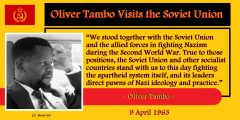
For ANC President Oliver Tambo, “A deeper understanding of the liberation movement, its history, context and theory of struggle laid firmer foundations for the security of the MK. The expansion of knowledge and the cultivation of critical thinking that rested on fundamental, humanist values such as those expressed in the Freedom Charter were, therefore, an asset, not a threat. Tambo was concerned not only to use ‘education as a weapon in the struggle’, but also to build an intelligentsia within the army itself. History and political theory were particularly important in developing politically informed cadres in the military. Their key task on their return was to wage a disciplined and conversant guerrilla operation, which would recruit and guide the community in which they found themselves. A grasp of the strategy of liberation as a whole, particularly what was relevant to South Africa, was crucial to the successful outcome of this process” (Callinicos)
Sources:
Wikipedia.
South African History Online (SAHO).
Jocelyn Alexander and JoAnn McGregor, “The Travelling Toyi-Toyi: Soldiers and the Politics of Drill”, Journal of Southern African Studies, Vol. 46, Issue 5, 2020.
African National Congress, “Further Submissions and Responses by the African National Congress to Questions Raised by the Commission for Truth and Reconciliation”, 12 May 1997.
Melissa Diane Armstrong, “The ANC’s Medical Trial Run: The Anti-Apartheid Medical Service in Exile, 1964 to 1990”, Ph. D Thesis, Carleton University, Ottawa, Ontario, 2017.
Gregory F. Houston, “Military bases and Camps of the Liberation Movement, 1961-1990”, Democracy, Governance, and Service Delivery (DGSD) Human Sciences Research Council (HSRC), 1 August 2013.
Maren Saeboe, “A State of Exile: The ANC and Umkhonto we Sizwe in Angola, 1976-1989”, Master of Arts Degree, University of Natal, Durban, December 2002.
Lynda Von den Steinen, “Soldiers in the Struggle: Aspects of the Experiences of Umkhonto we Siswe’s Rank and File Soldiers – The Soweto Generation and After”, Master of Arts Degree, University of Cape Town, 1999.
Luli Callinicos “Oliver Tambo and the Dilemma of the Camp Mutinies in Angola in the Eighties”, South African Historical Journal, Vol. 64 No. 3, 2012.
Stanley Manong, “If We Must Die: An Autobiography of a Former Commander of uMkhonto we Sizwe”, Nkululeko, 2015.
Thula Simpson, “Umkhonto we Sizwe: The ANC’s Armed Struggle”, Penguin, 2016.
Stephen Ellis, “External Mission: The ANC in Exile”, Jonathan Ball, 2012.
Hugh Macmillan, “The Lusaka Years: The ANC in Exile in Zambia, 1963 to 1994”, Jacana, 2013.
James Ngculu, “The Honour to Serve: Recollections of an Umkhonto Soldier”, David Philip, 2009.
Vusi Mavimbela, “Time is Not the Measure: A Memoir”, Real African, 2018.
Mandla J. Radebe, “The Lost Prince of the ANC: The Life and Times of Jabulani Nobleman ‘Mzala’ Nxumalo, 1955 – 1991”, Jacana, 2022.
Vladimir Shubin, “ANC: A View from Moscow”, Jacana, 2008.
Castro Khwela
Good evening fellow Compatriots!
Discover more from CASTRO KHWELA
Subscribe to get the latest posts sent to your email.