Preparing for Joint MK-ZIPRA and MK-FRELIMO Campaigns June 1967
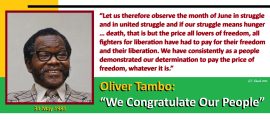
On 17 June 1967, in a little cottage situated on Dr Randeree’s plot in Lusaka, Umkhonto we Sizwe (MK) Commanders, Lawrence Phokanoka, Gladstone Mose, Justice Mpanza, Theophilus Mkaliphi, Julius Maliba, Tony Malume and Lennon Milane were in the company of Moses Kotane and Joe Modise, with African National Congress (ANC) Acting President, Oliver Tambo addressing them.
Tambo was saying that they were going to be sent back to South Africa, and they will be assisted by ZAPU (Zimbabwe African People’s Union) members in entering Rhodesia. This was in line with the Organisation of African Unity (OAU) Liberation Committee’s Standing Committee on Defence’s resolution adopted in a meeting on 14 – 18 April 1967 in the capital of Tanzania, Dar es Salaam. The resolution stemmed from the concern that “Nothing so far has been done by the A.N.C. in the form of an armed struggle”.
According to the report presented to the OAU Liberation Committee meeting, the ANC had requested a disbursement of material for the use of its personnel in East Africa, who were estimated to be around 300 militarily trained cadres. As a result, the report said that in the light of the organisation’s inactivity, the “Executive Secretariat considers that since their materials are not requested for the armed struggle in South Africa, it is not in a position to recommend the issuing of most of the materials requested by the Movement”.
When the Defence Committee of the Liberation Committee issued a report at the conclusion of the gathering on 18 April, the report said that concerning the ANC the meeting “took note of the difficulties which are facing the trained personnel of this movement to infiltrate in South Africa”. Accordingly, the meeting suggested that “the ANC leaders be requested to integrate their trained personnel into any fighting Liberation Movements in order to fight against the common enemy of Africa and to open their way to South Africa”.
For Tambo and the entire leadership, this suggestion was feasible. Tambo then went further to explain the context of the shift in focus from Botswana to Rhodesia, that in Botswana there were no people to assist or sympathetic organisations like ZAPU, and the country had a shortage of water. In Rhodesia they were to operate under ZIPRA (Zimbabwean People’s Revolutionary Army) command and if fighting took place, they were to go into combat under ZIPRA leadership. A combined ANC-ZAPU (MK-ZIPRA) group was to remain in Rhodesia while the remainder of the troops were to proceed to South Africa.
Along similar lines, another parallel project was conceived by a group of four MK cadres who were taken from Kongwa camp to Dar es Salaam, including Sandi Sijake, under the leadership of Josiah Jele. This was an interesting development, as the ANC had predicted that the apparent political calm in apartheid South Africa would inevitably be shattered, and that the central stronghold, the treasury and arsenal of Southern Africa, though being the last of the white supremacy bloc to be brought into the war, would not for long prove immune.
According to the ANC’s analysis, “Now, six months later, the calm has indeed been shattered. And there is no doubt that Africa’s involvement in armed struggle will soon transform the whole picture. A silent war, a series of often scattered engagements between white ‘security forces’ and African guerrillas, largely ignored by the rest of the world, becomes suddenly a very different matter when the central laager is attacked, and that laager the depository of hundreds of millions of pounds in foreign investments: when not one country, nor two or three are threatened – but the whole sub-continent.”
These developments could be seen in the public policy of the leadership of Zimbabwe and Namibia, which was then committed to armed struggle not as an adjunct of other methods, such as diplomatic agitation at the United Nations and among Afro-Asian states, but as the main instrument of liberation. ZAPU spelt out this change in a policy statement issued on 17 March 1967, which they regarded as Zimbabwe Day, by saying, “Our freedom and independence in Zimbabwe will not come from the corridors of Lancaster House nor through the fraudulent and hypocritical sanctions which are nothing but an insult to the dignity of the African people and the progressive world. It will come through a war of the Algeria type by the masses of Zimbabwe engaged in the fierce struggle against the British murderers.”
In fact, ZAPU specifically repudiated the notion that violence in Rhodesia was to be seen as an instrument for forcing Britain to act against the Smith regime but defined its struggle as against imperialism itself. During that time, the armed struggle in Zimbabwe was only a year and a half old, and strict censorship made sure that little news of it reached the people. However, in January 1967, the Minister of ‘Law and Order’ extended the ‘State of Emergency’, in the process, admitting that the past 12 months had seen an upsurge in armed resistance, in which 100 nationalist, who were all alleged to be ‘trained terrorists’, were killed.
Namibia became the last territory to launch military action – with the latest engagements being reported towards the end of 1966, though it appeared that at least one guerrilla training camp had been operating in Ovamboland for some months before that. After years of lobbying the international community to assume its responsibilities by defending the right of the South West African People to freedom, SWAPO (South West African People’s Organisation) told the UN Committee on Colonialism in Dar es Salaam in June, “We ourselves must create the conditions – within Namibia – which would bring freedom and independence to our people”. SWAPO reported the launching of an armed struggle and urged the “Afro-Asian nations and other friendly nations to come to our assistance without waiting to see whether Big Powers will do something.”
A new spirit was sweeping Southern Africa, which came along with an intensification of struggle in all the territories under white rule. In Mozambique, where since the outbreak of the war in 1964, large areas of two provinces, Cabo Delgado and Niassa, were already liberated areas under FRELIMO administration. FRELIMO was looking ahead to the development of armed struggle in all nine provinces, since according to one reporting, the Movement was counting more than 9 000 guerrillas in the field who were being trained in Mozambique itself. According to the same report, 800 000 Mozambicans had been freed, 3 500 Portugues soldiers were killed, 250 motor vehicles and 18 aeroplanes were destroyed.
In Angola, a war that was launched in the north of the country in 1962 was being fought in the more industrialised south under the leadership of the MPLA (People’s Movement for Angolan Liberation), and in the east Angolan freedom-fighters had gained control of the vital Benguela rail link between the Congo and east coast at Lobito.
In Zimbabwe, according to ZAPU, military engagements were frequent in the forests of the Zambezi valley near the Zambian border; in the rural areas, which were under white occupation, weapons were making their appearance from hidden caches; and in the Rhodesian army itself, African units had mutinied, some 245 African mutineers were detained in military camps. By June 1967, reports were testifying to the increasing professionalism of guerrilla forces, their growing confidence and hardening patriotism. “Not long ago”, a Johannesburg journalist wrote in evident amazement, “a cornered terrorist would have surrendered. Today, he will fight to the end.”
None of these developments escaped the attention of the fascists of Pretoria, and in spite of their bombast, they were showing signs of panic already. According to the apartheid Deputy Minister for Police, 2 000 young Africans left the Republic of South Africa for training in the past couple of years, 900 of them from Ovamboland in South West Africa; and most of those were ready to return. Some were reported to have been arrested in South Africa. The trial of 37 Namibians was underway in Pretoria, under the “Terrorism Act”, which amended the Suppression of Communist Act, to make “terrorism” a specific crime like sabotage, punishable by a minimum sentence of 5 years imprisonment and a maximum sentence of death.
All the signs, in short, were pointing to a mounting crisis in the sub-continent. Over the years, the white supremacist government were planning their strategy together in an unholy alliance around apartheid. Reports were abound regarding intervention by South African troops in Rhodesia, Angola and Mozambique. In response, the liberation movements were showing a growing unity of purpose and they too saw their struggle as one – as FRELIMO President Eduardo Mondlane told the UN Seminar, in Lusaka, that the struggle “will have to involve the obliteration not only of the political system of colonialism as such, but also those elements in the present economic structures in Southern Africa which buttress the social position of the white man, be he Portugues, British or Boer.”
Revolutionary movements throughout the area were seeing a common enemy in a single imperialism – it was not insignificant, for instance, that members of the Basutoland Congress Party, citizens of apartheid’s seemingly tamed hostage state, Lesotho, were being charged in Johannesburg with incitement to sabotage by derailing South African trains. For a unity was being forged among the liberation forces that was historically of the greatest importance. No one imagined that the defeat of imperialism in Southern Africa would be quick and easy. The realisation was awesome, not ecstatic. All that could be confidently said, was that the final phase in the struggle against white supremacy and imperialist domination in Southern Africa had begun in earnest.
The confrontation that was developing in Southern Africa between imperialism and liberation was anticipated to have consequences for the whole world. In the words of Oliver Tambo, the ANC’s Deputy President, “What could have been settled in the past by a few, through calm and peaceful discussion, must now be resolved by the oppressed masses in widespread armed conflict. In terms of the situation in Southern Africa, this development must be seen for what it truly is: the beginning of a racial war in Africa, which will rapidly escalate into an international confrontation of measureless dimensions.”
Sources:
Wikipedia.
South African History Online.
Editorial, “The Final Phase”, Sechaba, Vol. 1 No. 10, October 1967.
Thula Simpson, “Umkhonto we Sizwe: The ANC’s Armed Struggle”, Penguin, 2016.
Castro Khwela
Good evening fellow Compatriots!
Discover more from CASTRO KHWELA
Subscribe to get the latest posts sent to your email.