Lessons of Our People’s War: Political Preparation
(An adaptation of Part 2 and 3 of the articles penned by Khumalo Migwe – Jabulani “Mzala” Nxumalo – on the on-going debate regarding the focus of Umkhonto we Sizwe on driving the armed struggle towards a completely developed people’s war, February 1982).
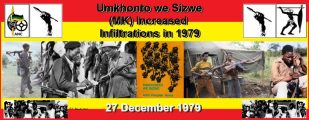
On December 16, 1961, backed by the ANC (African National Congress) and the Communist Party, a new organisation made its appearance in South Africa: Umkhonto we Sizwe. A Manifesto that accompanied dramatic sabotage actions against the economic installations of the enemy, including a bomb attack inside the union buildings in Pretoria (the Administrative Headquarters of the Boer regime) said:
“THE PEOPLE’S PATIENCE IS NOT ENDLESS. THE TIME COMES IN THE LIFE OF ANY NATION WHEN THERE REMAINS ONLY TWO CHOICES: SUBMIT OR FIGHT. THAT TIME HAS COME TO SOUTH AFRICA.”
OBJECTIVE CONDITIONS
As already documented in most writings on guerrilla warfare, from Lenin to Che Guevara, from Amilcar Cabral to the Nicaraguan experience, armed struggle of guerrilla war becomes feasible only if:
a) There is disillusionment with the prospect of achieving liberation by traditional peaceful processes because the objective conditions blatantly bar the way to change;
b) there is readiness to respond to the strategy of armed struggle with all the enormous sacrifices which this involves;
c) there is in existence an experienced and dedicated political leadership capable of gaining the organised allegiance of the people for armed struggle and which has the ability to carry out the painstaking process of planning, preparation and overall conduct of armed operations; and
d) that there exist favourable conditions locally and internationally.
In South Africa, the defeat of Bambatha in 1906 was followed by fifty or so years which were punctuated by struggles involving tactics like general strikes, sit-ins and other mass acts of defiance. The importance of this period as a prelude to the decision to embark on armed struggle cannot be underestimated.
By the end of the fifties, it was obvious that a showdown was impending between the Pretoria Boers and the oppressed black majority. The great series of militant non-violent struggles had succeeded in rousing and mobilising the people’s militancy behind the Congress banner as never before, but neither these heroic campaigns nor the world condemnation of apartheid succeeded in forcing out a single concession from the racist power which merely reacted by doubling its machinery and methods of terror.
Michael Harmel writes: “It became increasingly clear to the masses and their leaders that new methods, a new approach, was need in the fight against the fascist-colonialist regime. The violent struggles of the rural people, especially in Pondoland, unarmed or ill-armed as they were, had shown the way” (Fifty Fighting Years).
PREPARATION FOR ARMED STRUGGLE
The necessity for the change of political tactics was not obvious to everybody, particularly since the African National Congress had almost established a tradition of non-violence, a tradition that caused its leaders like Albert Luthuli to be awarded the famous Nobel Peace Prize. So it was vital for the leadership of MK (Umkhonto we Sizwe) first of all to demonstrate to the whole population that the break had been made with the traditional peaceful forms of struggle; and the Sabotage Campaign was an earnest indication of our seriousness in the pursuit of this new strategy. In other words, it was not yet the implantation of the guerrilla war as such, but only a prelude to it.
The preparation for armed struggle is one of the most painstaking tasks a liberation movement can be faced with. Often than not the urge to take up arms and carry on military operations in desperation, hoping that the masses would join in spontaneously, has led to serious setbacks. A few people taking to arms do not equal a revolution, unless the decisive masses of the people are already in motion of struggle towards revolutionary objectives, and the armed action is related to it, as a feature of it.
Let us take a look at the example of how armed actions alone do not necessarily inspire people to take up arms: With the defeat of the Republican government in 1939, the Spanish Communist Party sought to develop guerrilla warfare against the fascist Franco regime. Guerrilla warfare was intensified particularly between 1944 and 1949 when 5 381 guerrilla operations were carried out. However, these failed to stimulate the hoped for revolt on a mass scale, or even the creation of a broad front of unity behind the struggle.
It is therefore not enough to base the decision for armed struggle on the manifestations of the advanced sections of the population only; even with them, support should not be assumed but should be concretely ascertained. Writing on the experience of the PAIGC (African Party for the Independence of Guinea and Cape Verde) in Guinea Bissau, Gerald Chaliand says:
“First of all, contrary to the theory of the foco, and above all contrary to the mechanical application of this theory in a number of Latin American countries (Peru, 1962; Ecuador, 1962; Columbia, 1961; Paraguay, 1962; Argentina, 1964), the PAIGC got underway only after a protracted phase of preparatory political work undertaken in view of special conditions obtaining in Guinea.”
Preparation for armed struggle thus means political preparation, i.e. the political mobilisation of the masses around their concrete grievances and prepare them to be ready to support and reinforce their combatants. This political preparation cannot be bypassed, it is particularly important to the success of the armed struggle because, as all guerrillas have testified, guerrilla war means unparalleled hardship, years of cruelty, bloodshed, hunger and unimaginable privation not only for the combatants but for the general population in the struggle as well; and this is a sacrifice only the convinced and resolute can make.
When the decision for commencing armed actions is taken, leaders move from more than mere subjective military considerations; they should always take a responsible attitude towards the people who are the ones that feel on their backs the results of the mistakes of those who would claim to lead them. In a fair criticism of Regis Debray’s writings and his contention of the universality of the foco theory as well as his misunderstanding of the background to the Cuban armed struggle, Jack Woddis correctly warns against subjectivism in taking a decision for armed struggle, pointing out to those who would like to pantomise other guerrilla struggles that such pantomime has too often ended not in laughter but in tragedy and tears.
Those who have attempted, on the basis of a shallow understanding of the Cuban revolution, to imitate Fidel Castro by going up to the mountains to start armed struggle and who did not succeed, failed to appreciate that one of the main reasons for the success of Fidel was that much political work had been done by the other political parties, particularly the Popular Socialist Party of Cuba, in the years preceding the Sierra Maestra days.
On the other hand, experience has also shown that this phase of political preparation, once the objective factors favouring the initiation of armed struggle are present, amounts to nothing more than psychological preparation of the masses. The tendency to see it as an end to itself, as so often happens in the cycle of social reformists, is a manifestation of a metaphysical understanding of the relationship between the political and military work in the struggle.
Preparatory work means the training of political cadres who should go to the masses, disguised as ordinary civilians and carry out political work, establishing which sectors of the population are the most potent in developing the armed struggle. It is vital for such political cadres to conduct an on-the-spot mobilisation, to discuss with the people on the basis of an individual man or household. This political mobilisation tactic, which was the main one in Vietnam, accomplished what a banner or a leaflet cannot do.
In the context of South Africa, it means that political cadres are sent back into the country first of all to survive, then to make reconnaissance as to who is who in the fight for liberation, to discuss with them how the Freedom Charter presents the alternative to the apartheid system of oppression, and to draw such people to a concrete realisation that the democracy envisaged in the Freedom Charter can never be achieved through the begging of the Nationalist Party of the Boers, but by armed struggle.
It means that such propagandists and agitators suddenly appear in buses, trains, cinemas, churches, meetings, etc. talking to the people about the need to support armed struggle by giving the guerrillas shelter, food, information about spies and the enemy forces within their ranks, and to disappear as suddenly as they had appeared.
Political preparatory work can be likened to the fertilisation of the field before the ploughing process. The crops that come from the field, that is, the revolutionary units that get established in any locality depend very much on the degree to which the fertilizer was used. Of course, this analogy is not absolutely accurate because political work unlike real fertilising of the field, continues constantly.
The significance of political work among the masses is further underlined by the necessity to develop political leadership at grassroot level. No strategy of revolution will supersede the one that transfers the liberation initiative from the few leaders in exile, to the local leadership within the country. The struggle cannot be conducted by remote control; as Amilcar Cabral said: “One cannot cook the rice outside the pot.” The fundamental task of the exiled leadership is to develop grassroot political as well as military leadership in the real theatre of the struggle.
It is this grassroot leadership that sustains the anti-racist and anti-imperialist campaigns that are initiated by the movement; it is them who advise on the correct strategies and tactics to defeat the enemy: they select the best targets for combat actions and supply the most accurate data on the mood of the people, the best elements among them, the informers and administrative stooges, etc. – in short, they provide the dynamic link in the liberation equation, without them the struggle is doomed. (To be continued)
Source:
Khumalo Migwe, “Lessons of Our People’s War”, Dawn – Monthly Journal of Umkhonto we Sizwe, Vol. 6, No. 3, March 1982.
Castro Khwela
Good morning fellow Compatriots!
Discover more from CASTRO KHWELA
Subscribe to get the latest posts sent to your email.