
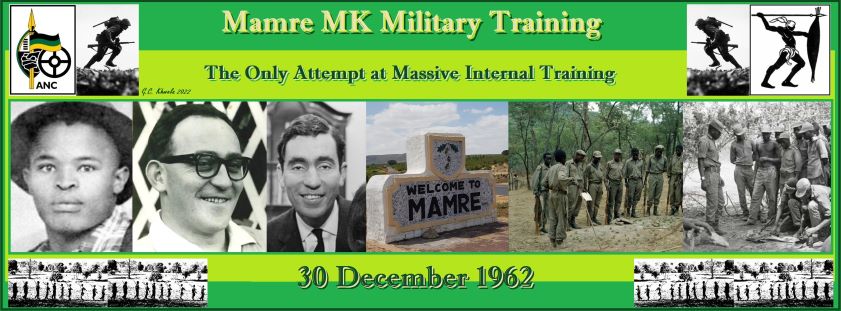
On 30 December 1962, the lorry that brought the Umkhonto we Sizwe (MK) recruits to Mamre for military training arrived to collect them, as they got at the back in the company of Denis Goldberg, who informed them that they may have another opportunity for another picnic.
As the lorry was driving the recruits were singing a song, “Amajoni” (meaning “We are soldiers”). When they were dropped off at Langa, they formed themselves into a platoon and began to march into the township, while one of them was beating time on a paraffin tin.
The group was put together on 26 December 1962, where they all met at Mowbray station in Cape Town, under Looksmart Ngudle, who was wearing a soldier’s overcoat, a beret and a military-type backpack over his shoulders. Ngudle then instructed them to mount on a lorry that was waiting nearby.
When another group of six arrived, they also got on board the lorry, and altogether they made a group of twenty-three youths. A few minutes later, a white man who was wearing spectacles arrived, whom Ngudle introduced as a one of their comrades, Denis Goldberg.
During that time, while Goldberg was greeting them, each of the youngsters was given a blanket, a plate, a spoon and a rug. The lorry then took off, stopping at Cardiff Marney’s house in Lansdowne, where five youngsters were picked up, and the lorry was loaded with four tents and a motor-car engine.
Leaving Lansdowne, the lorry went to a forested farm, in an area known as Louwskloof, in Mamre, north of Cape Town, where Goldberg instructed them to offload the tents. Later on, after the ground was cleared and the tents were erected, the recruits were lined up in rows of five, which Goldberg began to address in English, while Ngudle was interpreting in IsiXhosa.
According to Goldberg, the camp was to be run along strict military lines, where they were to be taught to stand at attention, to march and close combat, and how to operate petrol engines, field telephones and duplicating machines, how to read a compass, perform first aid and how to make electrical circuits for bombs, which were essential for the revolution.
Goldberg then formed them into two lines and informed them that there would be sergeants appointed for each tent. The Group consisted of nineteen Africans, seven so-called coloureds and one white man.
On the morning of 29 December 1962, three days into their first MK training, Cardiff Marney went to buy some food at a nearby store. This alerted the local community of the group’s presence.
During the course of the day, an official from the Mamre Moravian Mission Station arrived at the camp and informed the group that they were camping on trust land without permission. After Goldberg apologised, the official accepted and left.
Later that day, while Cardiff Marney was delivering a lecture on the operation of a petrol engine, another white man arrived at the camp, and was introduced as Albie Sachs. Sachs was there to deliver a lecture of the history of South Africa, how the riches of the country were being controlled by a minority and the need to gain control of the mines. He then gave a perspective on how the struggle was being waged from a Congress Movement perspective.
Unfortunately, word about the camp had spread throughout the West Coast, and later on that day a large contingent of apartheid police arrived at the camp led by Detective Sergeant Johannes van Wyk. Goldberg was then called aside for questioning. After the questioning, Goldberg called all the recruits together and ordered them to go to their respective tents.
In the tents, Van Wyk began to take their names and addresses and ordered the other policemen to search them, and thereafter, he informed all the recruits to begin packing or be arrested. The commanding team of Ngudle, Goldberg, Sachs and Marney also advised the group to begin packing. The following day, 30 December 1962, the group left the camp as the only group of MK recruits to be trained inside the South Africa.
What is important to note is that besides the military aspects of the training at the Mamre camp, emphasis was on political education, thus ensuring an understanding among the trainees that they were engaged in a political struggle for liberation.
This was characteristic of all MK training throughout its historical development, even in the various camps in exile, as it was critical to understand that since its inception, Umkhonto we Sizwe (MK) was a revolutionary, indeed a political, army. MK was established to fight against apartheid, colonialism and imperialism, when other forms of resistance had been outlawed or were rendered ineffective.
The young Mamre recruits continued to march, singing, “Mkhulu lomsebenzi ufuna amajoni enkululeko!” (“This is a mammoth task that requires warriors for freedom!”)
Castro Khwela
Good day fellow Compatriots!
Discover more from CASTRO KHWELA
Subscribe to get the latest posts sent to your email.
Amandla Comrades are through leadership long live the spirit of MK long life Comrades are doing great to revile all the struggle history so our new generations should know about it salute Comanders