
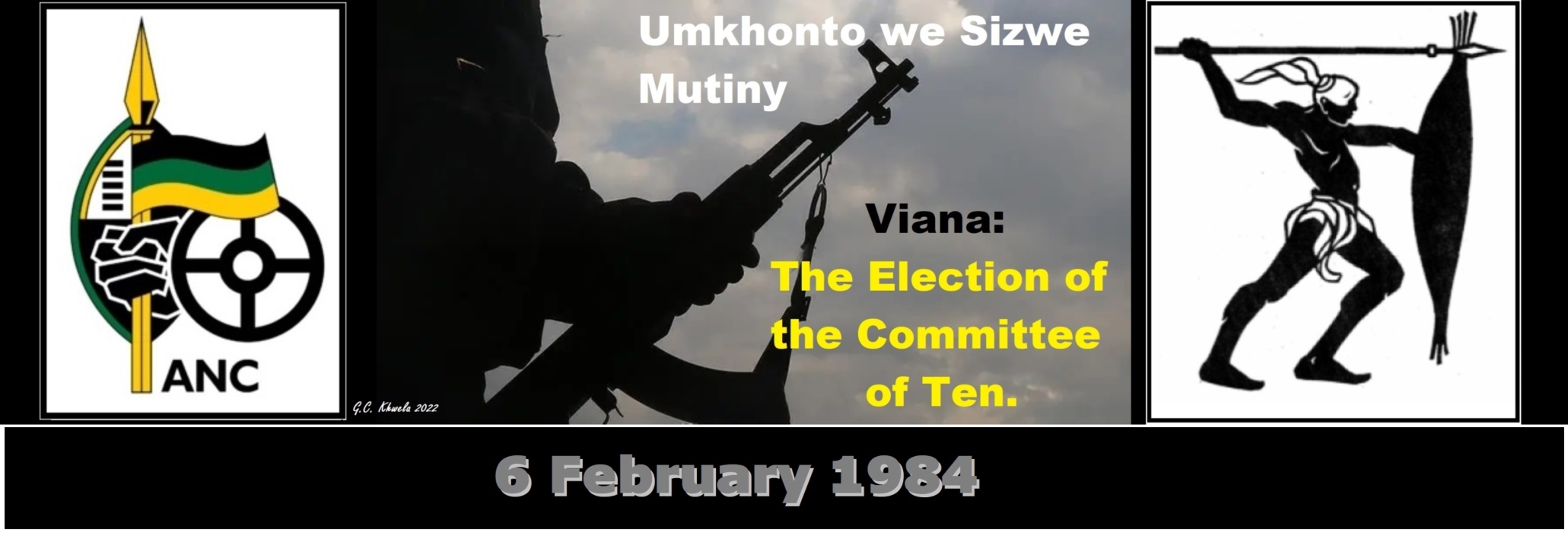
On the afternoon of Monday, 6 February 1984, a general meeting of cadres was held around the swimming pool in Viana Transit Camp, outside the capital of Angola, Luanda, which was joined by a group of Umkhonto we Sizwe (MK) guerrillas who had travelled from a facility called the “Plot”, also near Luanda.
The general meeting was a result of a visit by the MK Regional Commander in Angola, Timothy Mokoena (aka “Bra T”), the day before, in the company of Edwin Mabitse, the Regional Commissar, and “Comrade Captain Lentsoe”, the Regional Chief of Security. The cadres in the camp were told to prepare for a meeting with the regional leadership on Tuesday.
One of the cadres from the “Plot”, Zaba Maledza, addressed the general meeting. By his estimate there were about a thousand people there. The huge number was because of the cadres that had arrived by train and trucks from Cacuso to Viana in the beginning of February, who were firing shots into the air, as a form of protest towards the ANC (African National Congress) leadership to attend to the desperate problems facing the organisation.
The group in Cacuso was further swelled by other units from Musafa. Upon their arrival in Viana, the Commander of the camp, “Pro”, ordered them to disarm because the Angolans did not want to deal with an MK revolt on the doorstep of their capital. Some of the cadres began to disarm upon hearing this order, but many refused.
At the meeting, Maledza told them that any intensification of the armed struggle required the election of a new leadership. According to Maledza, they couldn’t simply be sent back to fight in the Eastern Front, as the operations had to be properly planned and executed. After supper, the meeting continued in the camp’s main hall, and it ran until midnight. During the meeting, a “Committee of Ten” was elected to present the grievances of the cadres to the leadership at the following day’s engagement.
This Committee consisted of Zaba Maledza, who had been trained at a Party School in Moscow and specialised in propaganda; Moss Thema, a Political Commissar who was a graduate of the Lenin School in Moscow; Kate Mhlongo, a young and eloquent student activist who had been deployed to Radio Freedom; Sidwell Moroka, the District Chief of Staff in Luanda, a member of the Security Department in Lusaka and a former bodyguard of President Tambo; and Khotso Morena, a mature pioneer of the June 16 Detachment.
Other members of the Committee included Jabu Mofolo, a product of the Party School who had been deployed as Commissar of the Amandla Cultural Ensemble; Sipho Mathebula, a product of the Commander’s Course in Moscow and a former Battalion Commander at the Eastern Front; Bongani Matwa, a graduate of the Party School, who was a Political Instructor and Political Commissar; Grace Mofokeng, a mature lady, who was a verbose story-teller, also deployed to Radio Freedom; and Simon Botha, one of the dedicated cadres.
Before the meeting broke up, the chief demands were noted, which included a call for a national conference to be convened to discuss the movement’s direction; a request for the leadership to reconsider whether fighting in the Angolan Civil War was in the movement’s best interests; a demand that the ANC immediately disband the Security Department and investigate abuses perpetrated by it; a review of the Cadre Policy to establish the real causes for the armed struggle to appear not to be progressing; and the resolution of the question of delays or stagnation in the deployment to the home front.
Dissatisfaction and tension among cadres in the camps were a result of several factors that had consolidated to produce an untenable situation, particularly difficult social conditions as well as the arrogance of certain commanding and security personnel. What made matter worse was the difficulty with the deployment of cadres within the country, especially since MK operated differently as compared to other guerrilla movements in the region, and indeed globally.
The deployment of MK combatants against the UNITA (National Union for the Total Independence of Angola) insurgency, which was seeking to destabilise the Angolan government, appeared to be a diversion by the leadership from being sent to fight at home. It was rather difficult for most of the cadres to understand that they had to undertake such military operations in order to clear areas around their own MK camps.
According to James Ngculu, “There was at this time tension in all the camps in Angola, as well as among ANC members outside Angola. Some people understood the reasons for the mutiny but felt that open revolt was unacceptable. …The atmosphere was full of contradiction – there was excitement as well as panic.” (“The Honour to Serve: Recollections of an Umkhonto Soldier”, p. 169).
Sources:
Thula Simpson, “Umkhonto we Sizwe: The ANC’s Armed Struggle”
Stephen Ellis, “External Mission: The ANC in Exile”
Paul Trewhela, “Inside Quadro: Uncovering the Exile History of the ANC and SWAPO”
African National Congress, “ANC Statement to the Truth and Reconciliation Commission”
James Ngculu, “The Honour to Serve: Recollections of an Umkhonto Soldier”
Castro Khwela
Good day fellow Compatriots!
Discover more from CASTRO KHWELA
Subscribe to get the latest posts sent to your email.

Great stuff Commandant.🖤💚💛✊