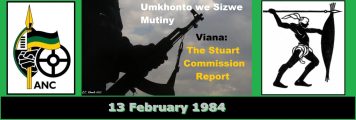
MK Mutiny in Viana – The Leadership Intervenes
On 7 February 1984, Chris Hani, Andrew Masondo, Joe Modise and two members of the Organisation of African Unity’s (OAU) Liberation Committee arrived at Viana Transit Camp, outside the capital of Angola, Luanda, in the company of the People’s Armed Forces for the Liberation of Angola (FAPLA) Army contingent. All camp members were called to a meeting in the camp’s main hall.
As Hani was addressing them, Masondo was sitting on a panel table in front staring wide-eyed and open-mouthed at those assembled. Hani denounced the mutiny and its demands as an adventure by disgruntled elements and mentioned that the African National Congress (ANC) was an organisation of the people of South Africa, while the mutineers were not even a drop in the ocean. The ANC could do without them. He then called on all those who were committed to serve the ANC to move out of the hall. All the guerrillas exited the hall as instructed. A short while later they were all ordered to re-enter the hall and Hani resumed talking expressing relief that they were all still Umkhonto we Sizwe (MK) cadres. He then said he was going to report the good news to the leadership in Lusaka.
The urgent arrival of the leadership in Viana followed several incidences that had occurred in the camp, particularly the one that occurred on the morning of 7 February 1984, whereby FAPLA armoured personnel carriers (APCs) of the Angolan Presidential Guard (the Grafannil Garrison Regiment) approached the Viana camp at around 02:00 in the morning. The combat bell was rung and cadres ran from their bivouacs with their armaments into the trenches surrounding the camp’s perimeter. As the Angolans entered the camp, they shot dead one of the MK cadres, Babsy Mlangeni, and later also killed another, Solly Sibeko.
One of the APCs started offloading FAPLA soldiers, who were having their backs to the hiding MK cadres, and because of the dark, were not aware of their presence. At dawn, some of the Angolan soldiers entered the camp and after some time realised that all the MK cadres were in the trenches. The Commander then shouted in Portuguese that the guerrillas should come out of the trenches or they would be immediately killed. One of the cadres asked why should they come out, and upon hearing this, the Commander took out a grenade and was preparing to throw it. At this point, one of the cadres aimed his RPG-7 rocket launcher at the APC and opened fire. Other cadres in the trenches began firing, but well above the heads of the Angolans, who began to run disarray, as a result.
The exchange of fire disrupted the FAPLA Commander and he spontaneously released the grenade, which exploded three or four metres from the trench. Meanwhile the driver of the APC tried to turn the vehicle around and immediately got killed by the salvo of rocket fire. As the MK cadres began fleeing from their trench and running deeper into the bush, they were pursued by the FAPLA soldiers, who were firing at them. The MK cadres managed to join some of their colleagues in one of the trenches around the camp, to which many of them had fled to when the Angolan soldiers arrived. Together all the MK guerrillas in the trenches began returning fire on the pursuing Angolans.
When the Angolans finally realised that they were encircled by MK cadres in the various trenches with their guns trained on them, they begged the MK guerrillas not to shoot them. Shortly thereafter, Callaghan Chama (real name Robert Vusumuzi Shange), a guerrilla Company Commander, shouted “Cease fire!” from one of the firing positions, before climbing out of a trench to call for peace. Finally, following and an adherence to a ceasefire by all forces, negotiations began to take place between the MK Committee of Ten and Lt Colonel Antonio dos Santos Franca (“Ndalo”), who was the National Chief of Staff of FAPLA and Commander of the Grafannil Garrison Regiment, and his Commissar, Major Sebastiao.
Negotiations were undertaken by members of the Committee of Ten, some whom had been summoned from Luanda and the “Plot” by the Committee’s Convenor, Bongani Matwa. Those involved in the negotiations included Zaba Maledza, Secretary of the Committee of Ten, Sidwell Moroka, Luanda District Commander, Moss Thema, former Camp Commissar, and Sipho Mathebula, who was Battalion Commander in the Eastern Front. Lt Colonel dos Santos Franca (“Ndalo”) told Moss Thema and Sipho Mathebula, who were fluent in Portuguese, that the President of the ANC, Oliver Tambo, had requested Angolan President Dos Santos to intervene and disarm MK soldiers at all costs, since they were defying the MK command structure.
According to Lt Colonel dos Santos Franca (“Ndalo”), ANC President Tambo had told President Dos Santos that the MK command structure had lost control and did not have the capacity to disarm the rebellious forces. The Angolan state could not afford to have a marauding army in their country shooting at random. Therefore, the mission of FAPLA was to disarm MK soldiers at all costs. The Committee of Ten agreed that they did not want bloodshed, and they then requested FAPLA to be an arbiter, a neutral force that would disarm all MK soldiers and keep the guns until, they, as ANC members could resolve their problems internally.
The Committee of Ten then convened all MK cadres, which were inclusive of all the Detachments at Viana, and persuaded them to surrender their guns to FAPLA, as a neutral force. Virtually all the cadres voluntarily surrendered their armaments to FAPLA. However, to their shock, Lt Colonel dos Santos Franca (“Ndalo”) then handed the guns over to MK security at Viana Camp. This, according to one of the Committee of Ten members, marked a breakdown of trust between the Committee of Ten and the FAPLA command. The MK soldiers then became nervous that they had been sold out.
Later, on the same day, the leadership of the ANC and MK, as well as two members of the OAU Liberation Committee, arrived at Viana Transit Camp in the company of a FAPLA Army contingent to address the cadres. This, however, was not the end of the MK mutiny, as it later continued in other Angolan camps.
Sources:
Thula Simpson, “Umkhonto we Sizwe: The ANC’s Armed Struggle”
Stephen Ellis, “External Mission: The ANC in Exile”
Paul Trewhela, “Inside Quadro: Uncovering the Exile History of the ANC and SWAPO”
James Ngculu, “The Honour to Serve: Recollections of an Umkhonto Soldier”
Individual submissions and engagements with certain members of the Committee of Ten.
Castro Khwela
Good morning fellow Compatriots!
Discover more from CASTRO KHWELA
Subscribe to get the latest posts sent to your email.