MK Natal Urban Machinery Operatives Betrayed
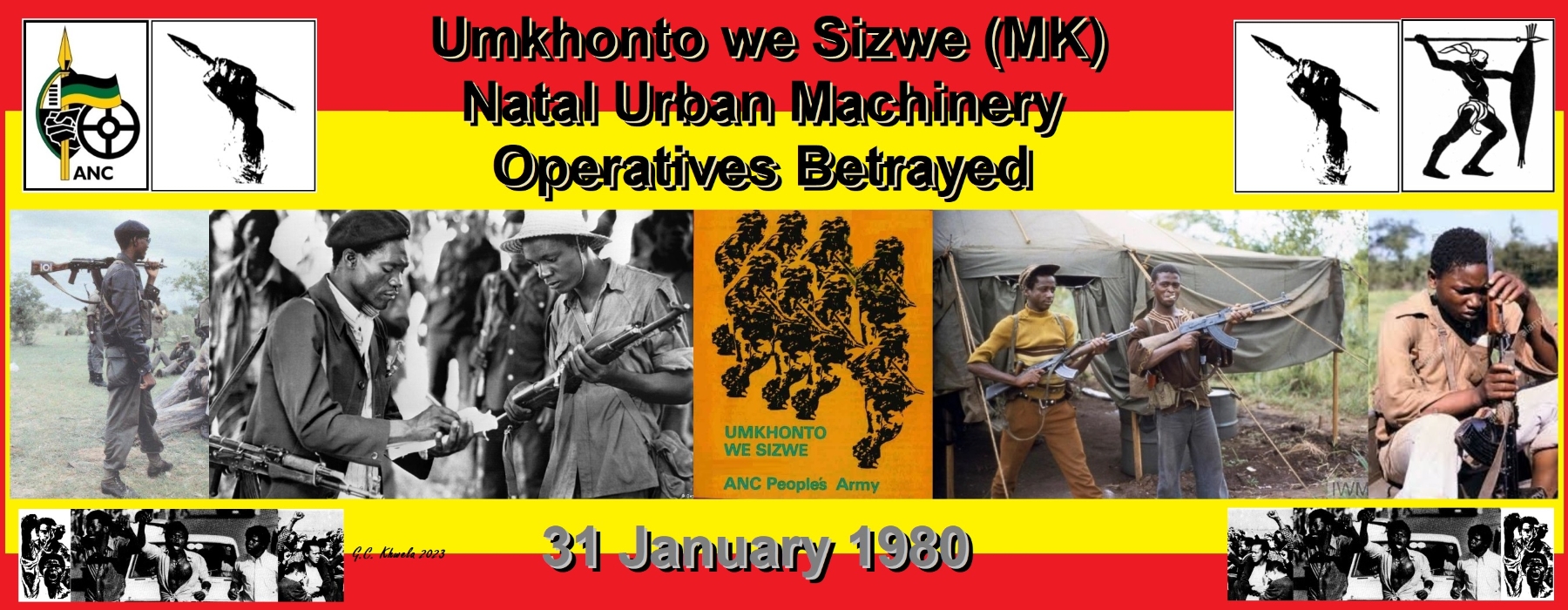
On 31 January 1980, Grant Shezi and Jeremia Radebe of the Umkhonto we Sizwe (MK) Natal Urban Machinery approached Inanda Seminary, north of Durban, for a meeting with the contact person that the Commander of the Machinery, Zweli Nyanda, referred to in their briefing in Matola, Mozambique.
During the meeting, on 14 January 1980, Nyanda informed Shezi and Radebe that upon their entry into South Africa they were not to touch the Dead Letter Boxes (DLBs) of buried weapons and explosives until they had contacted their link man at the Inanda Seminary, near Durban. Their mission was to conduct demolition operations in the area, and they had to determine the appropriate dates after making sure that the weapons and explosives were thoroughly checked and verified on a weekly basis. They were also expected to await further instructions from their contact in Durban.
Before Shezi and Radebe left Matola, Nyanda gave them R140 and R160 respectively, and conveyed to them a final message that they were to go to Umbumbulu and St Wendolins, in Marianhill, to explore those areas for possibilities of bushes and forests near important urban centres. On 23 January 1980, Shezi and Radebe left Matola in a green Volkswagen being driven by a so-called Coloured person with the name of Edward Lawrence (aka “Fear”, “Leonard” or “Ralph” – real name Cyril Raymonds). Lawrence took them to the border of Mozambique and Swaziland, where they then crossed into South Africa.
On 31 January, when Shezi and Radebe approached Inanda Seminary, they recognised Joseph Zakile Zulu (real name “Bhekizitha Steven Mbanda”), who had been recently appointed as MK’s Southern Natal (Urban) Commander. While Zulu, Shezi and Radebe were busy greeting each other, Shezi looked up and noticed that they were surrounded by apartheid policemen. Zulu had entered South Africa from Swaziland on 9 December 1979 to serve as MK commander for the urban areas of southern Natal. What Shezi and Radebe did not know, and perhaps even the MK Natal Urban Machinery in exile, was that Zulu had on Saturday, 15 December 1979, walked into the Security Branch offices in Loop Street, Pietermaritzburg, to surrender himself.
Joseph Zakile Zulu (aka “Jackson Sithungu”) was one of the first African National Congress (ANC) and MK operatives to become an “Askari”, when he joined Vlakplaas in 1980 alongside Jeff Bosigo, Peter Kgoadi, Thabo Makgage, Piet Mogoai, Gladstone Mose, Joe Mamasela, Brian Ngqulunga and Ernest Ramatlala. Zulu came from the Camperdown district of Natal, and joined the ANC in 1977, while he was training to be a teacher. He received his military training in Novo Catengue in Angola. After betraying Shezi and Radebe, he was used as a state witness in April 1980 in the Soekmekaar and Silverton Trials, in which nine MK guerrillas were charged with high treason, murder, attempted murder and robbery.
Zulu appeared on the witness stand as Joseph Zakile Zulu, where he claimed that he was against violence, the killing of innocent people. When he was asked to why he defected to join the apartheid security police, he maintained that his defection was a voluntary act that had nothing to do with any inducements from the police.
According to other askaris, such as Almond Nofomela and Delilah Rekisa, Zulu was one of the most trusted askaris in Vlakplaas, trusted by all his commanders from Colonel Johan Viktor, Captain Dirk Coetzee and Colonel Eugene De Kock. However, when he was confronted about being the most trusted, he maintained that he was never trusted in Vlakplaas, “I was a guard there. I was not inside” (Jacob Dlamini). When Joe Pillay, a South African freedom fighter who was abducted from Swaziland by the apartheid Security Branch in February 1981, testified at the Truth and Reconciliation Commission (TRC) hearing, he claimed that Zulu assaulted him severely while he was detained at Vlakplaas.
According to Luli Callinicos, “Once they (the ‘Askaris’) had betrayed the movement, there was no return, and the regime was able to develop a destabilising programme using collaborators in a variety of ways. A number were deployed to the camps, where they were instructed to embark on specific projects, such as poisoning the food, sabotaging equipment, and generally using camp hardships to stir up discontent. They were able to provide information about the location of bases, the names of key individuals in MK and the whereabouts of ANC premises. It was such intelligence that led to the massacres, ambushes and assassinations and to the arrest, torture and imprisonment of cadres, as well as the destruction of the Novo Catengue camp.”
The Truth and Reconciliation Commission (TRC) Report, Volume 2, maintained that “the first Matola raid of January 1981 was planned by section A of the security police, headed by Colonel (later General) Jac Buchner and assisted by Major (later Brigadier) Callie Steijn of MI (Military Intelligence). Much of their intelligence was derived from interrogated detainees. One of these was Mr Steven Mashamba (actually believed to be Mbanda), who afterwards became an ‘askari’.” It is unclear what happened to Steven Mbanda (aka “Joseph Zakile Zulu” or “Jackson Sithungu”) in a post-apartheid South Africa, as he never applied for amnesty and is barely mentioned in the TRC Reports.
Sources:
Truth and Reconciliation Commission, “Truth and Reconciliation Commission of South Africa Report, Volume 2”, Truth and Reconciliation Commission, 29 October 1998.
Truth and Reconciliation Commission, “Amnesty Hearings: Recall of Eugene Alexander De Kock”, TRC Amnesty Committee, 8 September 1999.
Luli Callinicos, “Oliver Tambo: Beyond Engeli Mountains”, David Philip, 2004.
Jacob Dlamini, “Askari: A Story of Collaboration and Betrayal in the Anti-apartheid Struggle”, Jacana, 2014.
Stanley Manong, “If We Must Die: An Autobiography of a Former Commander of Umkhonto we Sizwe”, Nkululeko, 2015.
Thula Simpson, “Umkhonto we Sizwe: The ANC’s Armed Struggle”, Penguin, 2016.
Robin Binckes, “Vlakplaas: Apartheid Death Squads 1979–1994”, Pen and Sword Books, 2018.
Castro Khwela
Good day fellow Compatriots!
Discover more from CASTRO KHWELA
Subscribe to get the latest posts sent to your email.