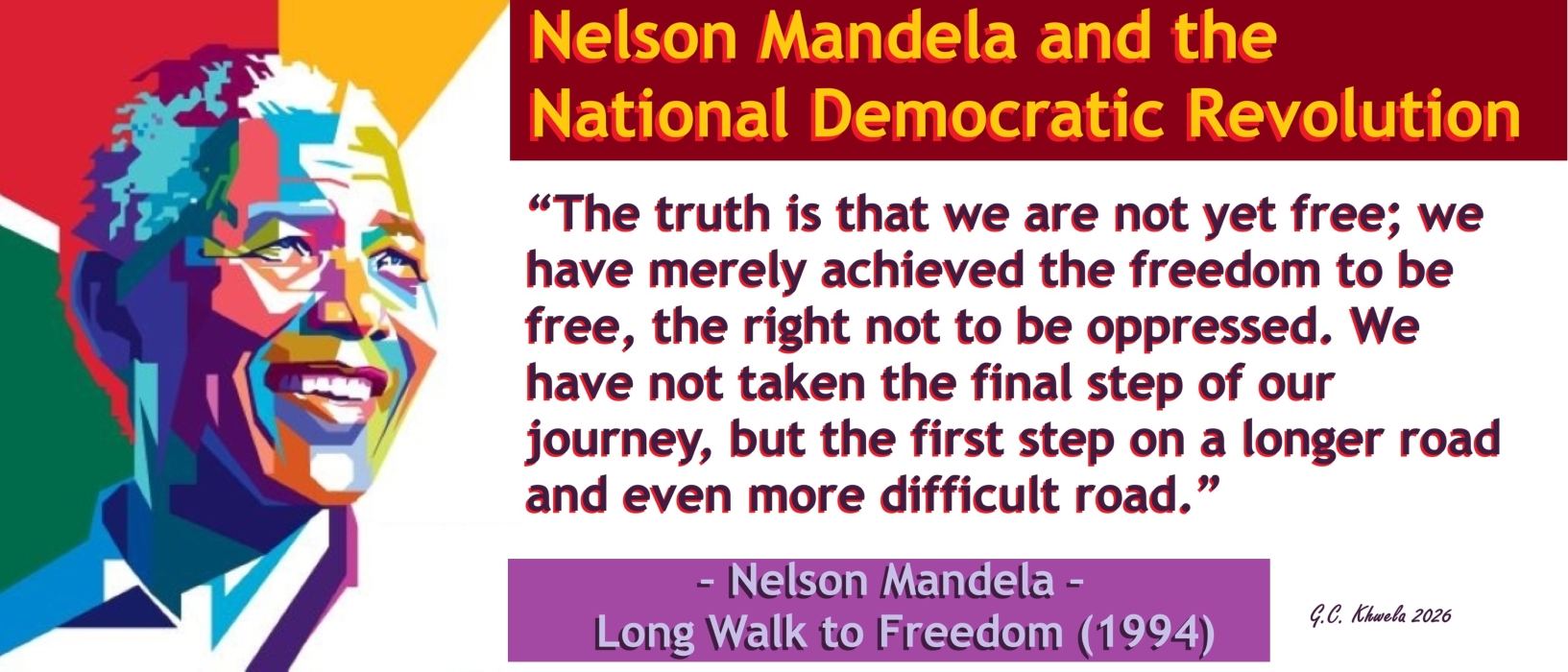
Nelson Mandela and the National Democratic Revolution
The National Democratic Revolution (NDR) is the foundational ideological framework of the African National Congress (ANC) and its Tripartite Alliance partners, designed to transform South Africa from an apartheid state into a non-racial, non-sexist, democratic and prosperous society. Nelson Mandela served as both the strategic spearhead and the primary architect of this revolution, shifting it from a national mass struggle to armed resistance, and ultimately steering it into a constitutional democracy.
The National Democratic Revolution (NDR) originated from a Marxist-Leninist analysis of South Africa as a “Colonialism of a Special Type” (CST), formulated alongside the South African Communist Party (SACP), and this colonialism being transformed through a particular process. It posits that South Africa’s transformation requires a two-phase process: Overthrowing racial oppression to establish a national democratic state based on universal franchise; and using state power to restructure the economy, tackle poverty and correct systemic racial disparities.
Mandela co-founded the ANC Youth League in 1944, steering the party away from polite petitions toward the militant mass action of the 1949 Programme of Action and the 1952 Defiance Campaign. He became an instrumental factor in the development of the Freedom Charter, which culminated in the Congress of the People in 1955, which adopted the Charter as the bedrock Congress Alliance. Following the 1960 Sharpeville Massacre and subsequent banning of political parties, Mandela and his comrades concluded that peaceful protest was futile. He co-founded Umkhonto we Sizwe (MK) in 1961, launching a sabotage campaign to force the apartheid state to negotiate. Upon his release from prison in 1990, Mandela translated decades of underground struggle into the negotiations framework, culminating in the historic April 1994 democratic elections.
After the elections, Mandela’s government adopted market-friendly, capitalist economic policies to reassure global investors that the country’s was not deviating from the existing path of development. Left-wing critics and SACP fundamentalists argued that Mandela’s adoption of market-friendly economic policies stalled the economic phase of the NDR. This has left monopoly capital and land ownership disproportionately in white hands. Critics from liberal institutions, on the other hand, argued that the NDR’s focus on using state power to completely transform society created a “utopian blueprint”. They contended that it risked weakening institutional checks and balances. Despite these ongoing ideological debates, Mandela’s life remained the defining execution of the NDR’s primary goal: breaking the back of white minority rule to secure a unified, constitutional democracy.
In essence, this means that while Nelson Mandela successfully achieved the first political phase of the revolution, South Africa remains deeply divided over how it should achieve the second socio-economic phase. Mandela successfully met the primary, non-negotiable goal of the National Democratic Revolution (NDR). He played a major role in dismantling white minority rule, ended legal apartheid and established a unified, peaceful democracy where every citizen has the right to vote under a progressive constitution. While political power shifted, economic power did not.
Because Mandela’s government adopted market-friendly, capitalist economic policies to reassure global investors, critics from the Left argue that structural racism was left intact. As a result, the country’s wealth, land and major industries remain disproportionately controlled by the white minority, leaving the socio-economic goals of the NDR unfulfilled. Critics believe the democratic state must use aggressive, interventionist power to forcibly redistribute wealth and land to the black majority. Whereas the Liberals, as well as other conservative elements that were intent to preserve their apartheid inheritance, believe that giving the state this much power risks destroying the economy, overriding property rights, and weakening the independent courts and constitutional checks that protect citizens.
As a champion of the National Democratic Revolution (NDR), Nelson Mandela believed that political freedom was meaningless without complete economic emancipation for the black majority. To overcome racial economic disparities, Mandela believed the new democratic state had to actively de-racialise the economy, dismantle the corporate monopolies built during apartheid, and lift the black majority out of poverty. However, his vision had shifted dramatically over time from a radical, socialist approach to a pragmatic, market-led strategy. In his famous 1964 Rivonia Trial Speech, Mandela firmly supported the ANC’s Freedom Charter, arguing that mining, banking and monopoly industries had to be nationalised to prevent apartheid wealth structures from continuing.
After his release from prison in 1990 and the concomitant global shifts, such as the collapse of the Soviet Union, Mandela realised that aggressive nationalisation would cause massive capital flight. He pivoted towards the belief that the state must collaborate with existing white-owned corporate monopolies, incentivising them to integrate black South Africans rather than seizing their assets. Mandela’s primary vehicle for economic redress became the Reconstruction and Development Programme (RDP) launched in 1994. He believed the state had a direct duty to dismantle the geography of apartheid by building social housing, expanding electrification, laying clean water pipelines and providing healthcare for the poor. He famously declared that overcoming poverty is an act of justice, not charity.
Mandela frequently pointed out that the apartheid state purposefully used laws like the Bantu Education Act to deny skills to black South Africans, keeping them trapped as cheap labour. He believed the most sustainable way to break racial income disparity was to use state funds to build a non-racial education system and fund advanced skills development for black workers, allowing them to participate competitively in the modern global economy. Mandela advocated for early forms of Black Economic Empowerment (BEE) and Affirmative Action. He believed the state needed to implement legislative frameworks to ensure corporate boardrooms and business ownership reflected the demographics of the country, transitioning the black majority from being mere labourers into owners and executives.
Nelson Mandela’s attendance at the January 1992 World Economic Forum (WEF) annual meeting in Davos, Switzerland, was the ultimate turning point that shattered his long-held belief in state-driven socio-economic development and reshaped his final economic views. He arrived in Davos fully prepared to defend the ANC’s Freedom Charter, which explicitly advocated for the restructuring of South Africa’s banks, mines and monopoly industries. However, his intensive interactions with global corporate executives and international political figures changed his perspective entirely.
Mandela sat down with international business leaders who listened to his arguments for restructuring politely, but then directly outlined the real-world consequences. They made it clear that if an ANC-led government seized private assets or state-controlled major corporations, foreign capital would completely flee South Africa. Mandela realised that he could not rebuild a post-apartheid economy if the country was entirely isolated from global financial markets. His conversations with communist and socialist world leaders at the forum – specifically Li Peng (the Premier of China) and delegates from Vietnam – proved to be the most influential.
When Mandela detailed his plans to restructure South Africa’s industries, Li Peng bluntly told him that China had tried full state control and it did not work. He explained that even communist nations were actively privatising state enterprises and introducing capitalist market structures to survive. Mandela famously realised that if China was abandoning strict state control, the ANC could not afford to adopt it. On arrival at Davos, members of Mandela’s economic delegation – including future South African Reserve Bank Governor Tito Mboweni – reviewed his prepared speech and decided that a hardline nationalisation stance was inappropriate for the audience.
They then quickly pivoted the message. Instead of proposing state takeovers, they framed the ANC’s future objectives around using a stable economy to fund social infrastructure, housing, education and water, and fostering the creation of a black business class. Mandela returned home from Switzerland radically transformed. He famously told his ANC colleagues: “Chaps, we have to choose. We either keep nationalisation and get no investment, or we modify our own attitude and get investment.” This Davos conversion effectively buried the ANC’s mixed economic agenda. It paved the way for the Mandela administration to eventually adopt the investor-friendly, fiscally conservative Growth, Employment, and Redistribution (GEAR) policy in 1996, cementing South Africa’s place within the global capitalist economy.
Nelson Mandela and his key advisors genuinely believed that the conservative Growth, Employment and Redistribution (GEAR) policy was the only viable mechanism to achieve long-term racial economic redress. However, they did not see GEAR as a replacement for the social goals of the revolution. Instead, they viewed it as a necessary economic foundation – a strategic detour required to stabilise a bankrupt state so that redistribution could actually be funded. Their rationale and beliefs broke down into several specific assumptions. When Mandela took over power, he inherited an economy crippled by decades of apartheid corruption, international sanctions, high national debt and a plummeting rand.
Mandela and his economic team realised that the state could not redistribute wealth it did not have. They believed that fiscal discipline, lowering inflation and reducing the state deficit would create a stable environment that would naturally attract foreign direct investment (FDI). The delegation believed that the title of the policy itself – Growth, Employment and Redistribution – was a sequential roadmap. Instead of the state seizing assets to hand to the poor, GEAR aimed to grow the private sector so it could create millions of new jobs. They believed that expanding employment was the most sustainable way to lift the black majority out of poverty and break the racial income gaps inherited from apartheid.
It is not erroneous to say that Mandela was deeply terrified of South Africa falling into a debt crisis that would force the country to accept a structural adjustment bailout from the International Monetary Fund (IMF) or the World Bank. By voluntarily adopting a strict, conservative fiscal policy, Mandela believed South Africa could retain its political independence. He famously declared GEAR “non-negotiable”, believing that keeping the country’s macroeconomics stable protected the democratic state’s sovereignty from foreign lenders.
While Mandela and his team believed GEAR would trigger a massive wave of economic redress, the policy fundamentally underdelivered on its social promises. Despite the ANC government meeting its targets for cutting inflation and reducing the state deficit, the global and domestic private sector did not respond with the expected wave of investment and job creation. Trade unions and the SACP argued that GEAR’s fiscal austerity and privatisation of services directly harmed the black working class, stalling the economic phase of the National Democratic Revolution (NDR) and entrenching apartheid-era inequality.
Ultimately, Mandela believed GEAR was a bitter but necessary pill. He trusted that by playing by global capitalist rules, the resulting economic growth would provide the financial engine needed to permanently dismantle the legacy of apartheid. According to Mandela’s honest analysis, “The truth is that we are not yet free; we have merely achieved the freedom to be free, the right not to be oppressed. We have not taken the final step of our journey, but the first step on a longer road and even more difficult road. For to be free is not merely to cast off one’s chains, but to live in a way that respects and enhances the freedom of others. The true test of our devotion to freedom is just beginning.”
Sources:
Wikipedia.
South African History Online (SAHO).
Nelson Mandela, “Long Walk to Freedom”, Abacus, 1994.
Nelson Mandela, “Address by Nelson Mandela at the 85th Anniversary Celebration of the African National Congress (ANC) at Botshabelo Stadium”, South African Government Information Website, 12 January 1997.
Judith Christine Streak, “The Gear Legacy: Did Gear Fail or Move South Africa Forward in Development?”, Development Southern Africa, Vol. 21, No. 2, June 2004.
Alan Hirsch, “Season of hope: Economic Reform under Mandela and Mbeki”, International Development Research Centre (IDRC), 2005.
Nelson Mandela, “Address by Nelson Mandela for the “Make Poverty History” Campaign, London – United Kingdom”, South African Government Information Website, 3 February 2005.
Padraig O’Malley, “The National Democratic Revolution”, O’Malley: The Heart of Hope, Nelson Mandela Foundation, https://omalley.nelsonmandela.org/index.php/site/q/03lv02424/04lv02730/05lv03005/06lv03132/07lv03148/08lv03154.htm
Nelson Mandela, “Nelson Mandela’s 1999 Davos Address”, World Economic Forum: Geographies in Depth, 6 December 2013.
Andrew Ross Sorkin, “How Mandela Shifted Views on Freedom of Markets”, The New York Times, 9 December 2013.
John Campbell, “Nelson Mandela and Capitalism”, Council on Foreign Relations (CFR), 10 December 2013.
IBW21, “Mandela’s Economic Legacy Threatened by S. Africa’s Inequality”, The Institute of the Black World 21st Century (IBW21), 11 December 2013.
SABC News, “Madibanomics – Assessing the Economic Legacy of Nelson Mandela”, South African Broadcasting Corporation (SABC), 28 January 2014.
Anis Mahomed Karodia, “Nelson Mandela 1918 – 2013 A Tribute by the Regent Business School, Durban, South Africa”, Arabian Journal of Business and Management Review (OMAN Chapter) Vol. 3, No.7, February 2014
Aneta Křičková, “Reconstruction and Development Programme as a Tool of Socio-economic Transformation in South Africa”, Modern Africa: Politics, History and Society, Vol. 3, Issue 1, 2015.
S.J. Mosala, J.C.M. Venter & E.G. Bain, “South Africa’s Economic Transformation since 1994: What Influence has the National Democratic Revolution (NDR) Had?”, The Review of Black Political Economy, Vol. 44, Issue. 3-4, 1 January 2017.
Tamaryn Africa, Songezo Ndlendle and Gabriella Steyn, “Nelson Mandela: Economic Impact Outlined”, Independent Online (IOL), 18 July 2017.
S.J. Mosala, J.C.M. Venter & E.G. Bain, “The National Democratic Revolution (NDR) in South Africa: An Ideological Journey”, KOERS – Bulletin for Christian Scholarship, Vol. 84, No. 1, 2019.
Padraig O’Malley, “A Socialist Approach to the Consolidation and Deepening of the National Democratic Revolution”, O’Malley: The Heart of Hope, Nelson Mandela Foundation, https://omalley.nelsonmandela.org/index.php/site/q/03lv02424/04lv02730/05lv03005/06lv03006/07lv03128/08lv03130.htm
SACP, “Is the ANC Leading a National Democratic Revolution, Or Managing Capitalism?”, South African Communist Party, https://www.sacp.org.za/content/anc-leading-national-democratic-revolution-or-managing-capitalism-0
Joshua Truter, “The National Democratic Revolution: A ‘Utopian’ Blueprint for South Africa”, Master of Arts: Political Science, Stellenbosch University, March 2023.
ANC, “50th National Conference: Policy Documents Strategy and Tactics – as Amended by Conference, African National Congress, 20 December 1997, https://www.anc1912.org.za/50th-national-conference-strategy-and-tactics-of-the-african-national-congress/
United Nations, “Nelson Mandela International Day: 18 July”, https://www.un.org/en/events/mandeladay/legacy.shtml
Yolanda Mhlungu, “Mandela’s Legacy Does Not Exonerate Our Generation”, Mail & Guardian, 17 July 2026.
Castro Khwela
Good day fellow Compatriots!🙏🏾✊🏾👊🏾
Discover more from CASTRO KHWELA
Subscribe to get the latest posts sent to your email.