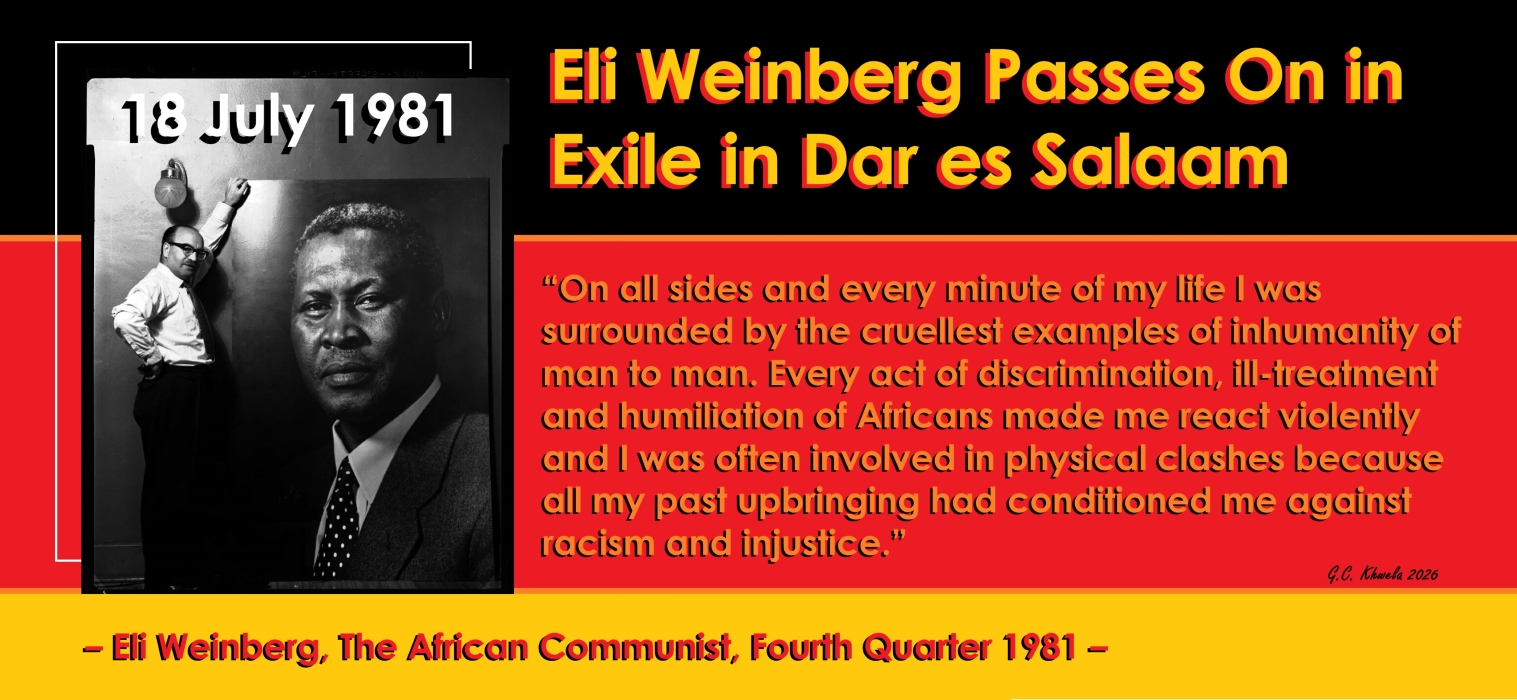
Eli Weinberg Passes On in Exile in Dar es Salaam
Exactly 45 years ago, on 18 July 1981, Eli Weinberg passed on in exile in Dar es Salaam, Tanzania. Eli Weinberg was a Latvian-born Jewish immigrant, prominent trade unionist, and foundational photo-documentarian who became a major figure in the South African liberation struggle. He is best remembered for using his camera as a strategic weapon to expose the brutality of apartheid to the world. Working as a professional photographer, Weinberg captured some of the most defining moments of anti-apartheid resistance. He documented historic events like the 1956 Treason Trial, the Congress of the People, mass protests and pass-book burnings.
Eli Weinberg was born in 1908 in the port of Libau, in Latvia on the Baltic Sea. He experienced the First World War and the October Revolution of 1917 as a child, and this led to his socialist political development. During the First World War, he was separated from his family. He became a waif and a stray – this idiomatically refers to being homeless, abandoned or neglected – wandering with a mascot of Cossack soldiers who took him around. Later, he became attracted to Communism, and as a Jew, he was opposed to all forms of racism. Weinberg’s mother, his sister and other members of his family were murdered in a Nazi concentration camp.
At the age of 16, he joined a trade union and soon became deeply involved in its activities. In 1928, he was imprisoned during a general strike in protest against proposed anti-trade union legislation. This was his first experience of prison life. Due to political developments in Latvia, he left the country and on 9 December 1929 he arrived in Cape Town. After arriving in South Africa in 1929, he co-founded the African Garment Workers’ Union in Cape Town and aligned himself deeply with working-class struggles. Weinberg stayed in South Africa until 1976 and considered himself a South African. However, he was repeatedly refused citizenship as a result of his trade union and political activities.
In 1932, Weinberg joined the then legal Communist Party of South Africa (CPSA) and from 1933 to 1953, he became active in the trade union movement in Cape Town, Port Elizabeth and Johannesburg. In August 1937, Eli Weinberg married Ray Alexander, who was also a trade unionist, as at the time, Eli was the acting Secretary to the local committee of the South African Trades and Labour Council. However, the marriage did not last long, as they divorced on 2 May 1940.
In 1950, Weinberg became one of many persons ‘listed’ in terms of the Suppression of Communism Act. From 1953, he lived under a succession of banning orders. In 1960, he was detained for three months during the State of Emergency and again in September 1964 he was arrested together with Bram Fischer and imprisoned for seven months. His application for bail was turned down, as he was found guilty of being a member of the Central Committee of the underground South African Communist Party (SACP), and was sentenced to five years imprisonment.
As an avid photographer, his photographs were regularly published in progressive, independent weekly newspapers such as the ‘New Age’, ‘The Guardian’, ‘Advance’, ‘Clarion’ and ‘Spark’. These images bypassed state censorship, providing international audiences with undeniable evidence of state oppression. Weinberg’s interest in photography had begun in 1926, when he worked part time as an assistant in a friend’s studio. He spent his first months in South Africa working as a professional photographer, and during the next twenty years he exhibited and published his work. Because of his close, trusted relationships within the liberation movement, he captured rare and intimate portraits of top leaders like Nelson Mandela, Walter Sisulu, Oliver Tambo and Chief Albert Luthuli before they were imprisoned, exiled or passed on.
Even during the period of his house arrest he continued to run a successful studio. Unfortunately, the bulk of his work was destroyed due to the fact that he was unable to take his negatives with him when he left the country. Most of Weinberg’s work was shot on assignment for ‘New Age’ newspaper, which was an independent and progressive weekly that supported the ANC. He was also awarded a silver medal at the New York World Fair in 1964 for a colour slide of a group of Basotho women in the Maluti Mountains in 1962. The slide was one of 150 000 entries from 58 countries submitted. He was still under a banning order and was unable to attend the presentation ceremony.
Because apartheid laws strictly restricted Black South Africans from accessing formal training or photographic equipment, Weinberg’s studio served as a rare, informal academy for underground media. Alongside Weinberg, other key progressive photojournalists of that generation – such as Jurgen Schadeberg at Drum Magazine – collaborated to mentor and empower the first major wave of disenfranchised Black visual storytellers, which included legends like Ernest Cole, Bob Gosani and Peter Magubane.
He was also instrumental in training a number of Black photographers, including Joe Gqabi, who was subsequently imprisoned on Robben Island for 12 years and later went into exile where he was assassinated. Gqabi learned darkroom and camera techniques from Weinberg before using those skills for political journalism. He later became a highly influential ANC leader, spent 12 years imprisoned on Robben Island, and was tragically assassinated by apartheid operatives while in exile in Zimbabwe in 1981.
In the early 1960s, Weinberg, together with others, was responsible for putting up posters announcing that the military wing of the ANC, Umkhonto we Sizwe (MK), had been formed and was now in existence during the night of 16 December 1961, when the first MK acts of sabotage took place in the country. Weinberg’s constant defiance made him a prime target for the apartheid regime. He faced consecutive banning orders starting in 1953. Following the 1960 Sharpeville massacre, he was detained for three months with his activist wife Violet, and their daughter Sheila. In 1964, he was sentenced to five years of imprisonment for his underground political activities.
Following his release in April 1970, he was served with a banning order which restricted him to his house, apart from his daily reports to the police station. The African National Congress (ANC) instructed him to flee into exile during the 1976 Soweto Uprisings. He lived out his final years in Dar es Salaam, Tanzania, where he published his seminal photo collection, “A Portrait of the People”, before passing away in 1981. During his five to six years in exile in Dar es Salaam, Tanzania (from late 1976 until his death in July 1981), Eli Weinberg remained highly active as an underground political organiser, trade union administrator, and historical archivist for the anti-apartheid movement.
Weinberg took on the vital role of Administrative Secretary for the South African Congress of Trade Unions (SACTU) in exile. He used his lifelong experience in trade unions to help coordinate international solidarity, manage labour resistance strategies, and channel support back to workers inside South Africa. Alongside his wife Violet and fellow activist Mac Maharaj, Weinberg occupied a senior leadership position within the exiled SACP structures based in Dar es Salaam. They managed communications and logistics between the exiled liberation movement and underground cells operating back home.
Because he had to flee South Africa illegally under ANC instructions following the 1976 Soweto Uprisings, he was forced to leave the vast majority of his photographic negatives behind, many of which were subsequently destroyed by the state. Despite this devastating loss, he spent his years in Tanzania meticulously gathering surviving prints of his work. In 1981, he successfully published his seminal book, “Portrait of a People: A Personal Photographic Record of the South African Liberation Struggle”, ensuring the visual history of the movement was preserved globally.
Dar es Salaam was a major transit hub for thousands of young South Africans fleeing the country after the 1976 uprisings. Weinberg worked closely with these new recruits, providing political education, historical context, and guidance as they integrated into the ANC’s external structures. Narrating the history of the struggle, since the Communist Party championed the call for an ‘Independent Native Republic’, he told them:
“Today the slogan of the ‘Independent Native Republic’ has found its clear echo in the Freedom Charter, adopted by a representative Congress of the People in 1955. And even though the 1950 attack on the Party was followed ten years later by the ban on the African National Congress, the racists have failed completely to smash the national liberation movement. Today the struggle is supplemented by the heroic actions of Umkhonto we Sizwe, the armed wing of the African National Congress, in which many members of the South African Communist Party were playing an active and heroic role.”
Sources:
South African History Online (SAHO).
Eli Weinberg, “Portrait of a People: A Personal Photographic Record of the South African Liberation Struggle”, International Defence Aid Fund for South Africa, 1981.
Obituary, “Eli Weinberg”, Sechaba, September Issue, 1981.
Eli Weinberg, “Why I am a Member of the Communist Party”, The African Communist, no. 87, Fourth Quarter, 1981.
Staff Reporter, “Pictures of Unsung Heroes from the Past”, Mail & Guardian, 16 September 1994.
Gordon Metz, “Eli Weinberg: ‘Photographer of the People’”, UWC-Robben Island Mayibuye Archives, 1995.
SACP, “Eli Weinberg, 1908-1981”, South African Communist Party, https://www.sacp.org.za/content/eli-weinberg
Gary Minkley and Ciraj Rassool, “Photography with a Difference: Leon Levson’s Camera Studies and Photographic Exhibitions of Native Life in South Africa, 1947-1950”, Kronos, Vol.31, No.1, 2005.
Thomas, Kylie, “History of Photography in Apartheid South Africa”, in Thomas Spear (Ed.), “Oxford Research Encyclopedia of African History”, Oxford Academic, 27 Feb. 2017.
Padraig O’Malley, “16 Sep 2003: Weinberg, Sheila”, O’Malley: The Heart of Hope, Nelson Mandela Foundation, https://omalley.nelsonmandela.org/index.php/site/q/03lv03445/04lv03833/05lv03891/06lv03906.htm
Castro Khwela
Good morning fellow Compatriots!🙏🏾✊🏾👊🏾
Discover more from CASTRO KHWELA
Subscribe to get the latest posts sent to your email.