Nelson Mandela’s Statement from the Dock
On 21 April 1964, newspapers were selling like hot cakes following Nelson Mandela’s statement from the dock at the Pretoria Supreme Court the previous day, during the Rivonia Trial, where both racially-divided galleries of the court were packed. The sitting was also attended by Leslie Minford, consul-general of the United Kingdom, and John Miles, counsellor of the United States embassy.
On 20 April, Bram Fischer, QC, informed Judge President Quartus de Wet that the defence was to commence with a statement from the dock by Accused No. 1, who personally took part in the establishment of Umkhonto we Sizwe (MK). Mandela was expected to inform the Court about the beginnings of the organisation, and of its history up to August, when he was arrested. Percy Yutar, the State Prosecutor, informed the accused that he should be apprised of the fact that a statement from the dock did not carry the same weight as evidence under oath, though he was sure that the accused, as a legal practitioner himself, was aware of this. Accused No. 1, Mandela gestured that he was indeed aware of this.
Articulating his statement, Mandela identified the anti-republic stay-at-home of May 1961, and the state’s reaction to it, as the “casus belli”. He said the strike was planned to be peaceful, and careful instructions were conveyed to organisers and members to avoid violence. Despite this, “The government’s answer was to introduce new and harsher laws, to mobilise its armed forces, and to send Saracens (armoured fighting vehicles), armed vehicles and soldiers into the townships in a massive show of force designed to intimidate the people. This was an indication that the government had decided to rule by force alone, and this decision was a milestone on the road to Umkhonto.”
Mandela denied that “Umkhonto was responsible for a number of acts which clearly fell outside the policy of the organisation, but which have been charged in the indictment against us. I do not know what justification there was for these acts, or who committed them, but to demonstrate that they could not have been authorised or committed by Umkhonto, I want to refer briefly to the roots and policy of the organisation. I have already mentioned that I was one of the persons who helped to form Umkhonto. I, and the others who started the organisation, did so for two reasons. Firstly, we believed that as a result of Government policy, violence by the African people had become inevitable, and that unless responsible leadership was given to canalise and control the feelings of our people, there would be outbreaks of terrorism which would produce an intensity of bitterness and hostility between the various races of the country which is not produced even by war.”
“Secondly”, Mandela continued, “we felt that without sabotage there would be no way open to the African people to succeed in their struggle against the principle of white supremacy. All lawful modes of expressing opposition to this principle had been closed by legislation, and we were placed in a position in which we had either to accept a permanent state of inferiority, or to defy the Government. We chose to defy the Government. We first broke the law in a way which avoided any recourse to violence; when this form was legislated against, and when the Government resorted to a show of force to crush opposition to its policies, only then did we decide to answer violence with violence.”
According to Mandela, “At the beginning of June 1961, after a long and anxious assessment of the South African situation, I, and some colleagues, came to the conclusion that as violence in this country was inevitable, it would be unrealistic and wrong for African leaders to continue preaching peace and non-violence at a time when the Government met our peaceful demands with force. This conclusion, My Lord, was not easily arrived at. It was when all, only when all else had failed, when all channels of peaceful protest had been barred to us, that the decision was made to embark on violent forms of struggle, and to form Umkhonto we Sizwe.”
“We did so not because we desired such a course, but solely because the Government had left us with no other choice. In the Manifesto of Umkhonto published on the 16th of December 61, we said, I quote: “The time comes in the life of any nation when there remain only two choices – submit or fight. That time has now come to South Africa. We shall not submit and we have no choice but to hit back by all means in our power in defence of our people, our future, and our freedom.”
“We of Umkhonto we Sizwe have always sought to achieve liberation without bloodshed and civil clash. We hope, even at this late hour, that our first actions will awaken everyone to a realisation of the disastrous situation to which Nationalist policy is leading. We hope that we will bring the Government and its supporters to their senses before it is too late, so that both the Government and its policies can be changed before matters reach the desperate state of civil war.”
Regarding what the liberation movement was fighting for, towards the end his address Mandela said: “Above all, we want equal political rights, because without them our disabilities will be permanent”. He further indicated that white fears over granting the vote to the African majority “cannot be allowed to stand in the way of the only solution which will guarantee racial harmony and freedom for all”. With regard to communism, Mandela reiterated that “Shortly after Umkhonto was constituted, I was informed by some of its members that the Communist Party would support Umkhonto, and this then occurred. At a later stage the support was made openly.”
“I believe that communists have always played an active role in the fight by colonial countries for their freedom, because the short-term objects of communism would always correspond with the long-term objects of freedom movements. Thus communists, My Lord, have played an important role in the freedom struggles fought in countries such as Malaya, Algeria, and Indonesia, yet none of these states today are communist countries. … This pattern of co-operation between communists and non-communists has been repeated in the National Liberation Movement of South Africa.”
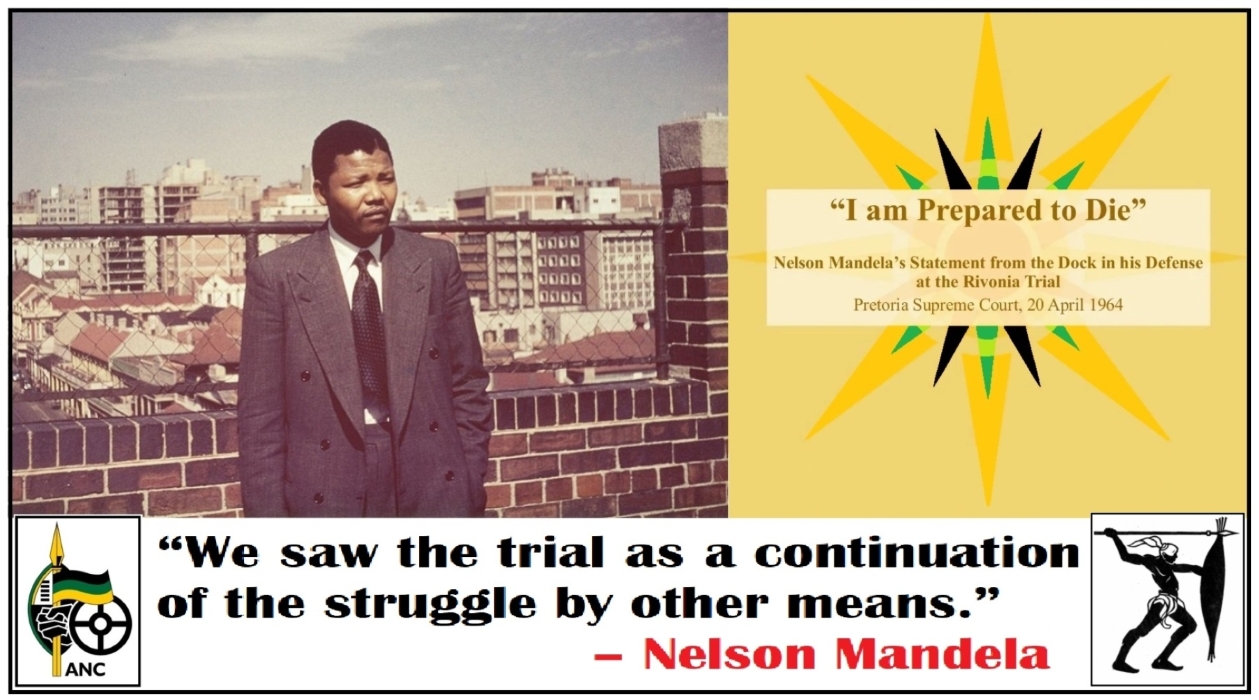
At the end of his four-hour speech Mandela said: “During my lifetime I have dedicated myself to this struggle of the African people. I have fought against white domination, and I have fought against black domination. I have cherished the ideal of a democratic and free society in which all persons live together in harmony and with equal opportunities. It is an ideal which I hope to live for and to achieve. But if needs be, it is an ideal for which I am prepared to die.”
According to Mandela, right from the start of the trial, they had made it clear that they intended to use the trial not as a test of the law, but as a platform for exposing their beliefs. They were not going to deny, for example, that they were responsible for acts of sabotage and they were less concerned with getting off or lessening their punishment, but with making the trial strengthen the cause for which they were all struggling – at whatever cost to themselves. “We saw the trial as a continuation of the struggle by other means.” – Nelson Mandela
Sources:
Wikipedia.
South African History Online (SAHO)
Thula Simpson, “Umkhonto we Sizwe: The ANC’s Armed Struggle”, Penguin, 2016.
Nelson Mandela, “Long Walk to Freedom”, Abacus, 1994.
Nelson Mandela, “Prepared-to-die-20-April-1964-speech-final”, Nelson Mandela Foundation.
Castro Khwela
Good day fellow Compatriots!
Discover more from CASTRO KHWELA
Subscribe to get the latest posts sent to your email.