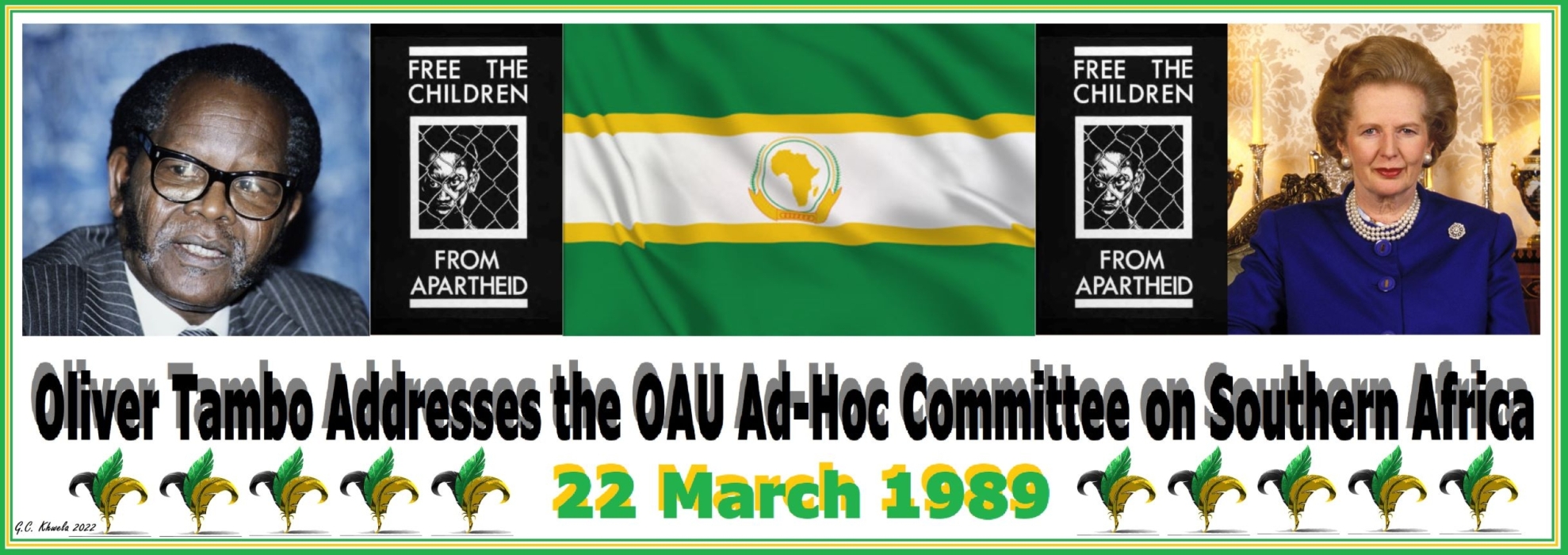
Oliver Tambo Addressing the OAU Ad-Hoc Committee on Southern Africa
On 22 March 1989, addressing a one-day meeting of the Organisation of African Unity’s (OAU) Ad-Hoc Committee on Southern, Oliver Tambo made a move on the African National Congress’s (ANC) behalf in response to Pik Botha’s and Margaret Thatcher’s utterances on Negotiations. Tambo urged the OAU to adopt “a strategy that would involve a kind of Resolution 435 for South Africa, which would enable Africa to take the initiative and not respond to strategies of those who had defended (apartheid) South Africa at every turn” (Xinhua, 22 March 1989). Tambo cited the advantage of the United Nations Security Council Resolution 435 as serving to create an apt framework for the resolution of the Namibian conflict.
What had propelled Tambo to react in this manner were the once-stable international currents that were beginning to shift and deleteriously putting pressure on the resolution of the southern African conflicts. For example, on 14 March 1989, responding to a journalist at a press briefing in Moscow, the Soviet Foreign Ministry spokesperson, Gennady Gerasimov, repudiated Soviet support for armed struggle in South Africa. “What armed struggle? How can one support something which doesn’t exist?” (Guardian, 18 March 1989).
At a Novosti Press roundtable in Moscow the following day (New York Times, 16 March 1989), Soviet Head of the Department of African Countries, Yuri Yukalov, mentioned that “We would prefer a political settlement and want apartheid to be dealt with by political means”. He further went on to warn that “any solution through military means will be shortlived” and that “We do not want to emphasize the need to enlarge the armed struggle. South Africa should not be destroyed. It should also be spoken to not only through threats or pounding our fist on the table. There should be dialogue”.
On 15 March 1989, speaking to reporters in London, following his meeting with the British Prime Minister, Margaret Thatcher, apartheid South African Foreign Minister, Pik Botha, referred to the great significance of the shift in Soviet Policy. “The season of employing violence is over, it’s gone”, he averred, since in the new international climate “terrorism is not going to be used any more to achieve political objectives, and the organisations that embark on this might as well pack up. They are in for a surprise”. When another journalist pointed out that the ANC felt otherwise, Botha responded that “The season is out, whether they like it or not, and there is no way you can continue along a certain course when the tide has turned and the tide has turned. Moscow is not interested in using these tools any longer to further its interests in various regions of the world” (SAPA, 15 March 1989).
Regarding Nelson Mandela, Botha indicated the following: “Make no mistake, the South African government fully realises that Mr Mandela inside prison or in restricted living conditions is doing us far more damage. The problem is how to do it, that his release is not accompanied by an upsurge in violence that leads to bloodshed and the re-arrest of Mr Mandela and other people. The issue is not whether he ought to be released – I think we have already decided he ought to be released. The position is how to do it in such a way that there is no risk” (BBC, 17 March 1989).
The following day, British Prime Minister Margaret Thatcher informed the British Houses of Parliament that she told Pik Botha when she met him that Nelson Mandela must be released. According to Thatcher, if Mandela was released, “We believe then the atmosphere would change completely and it would be possible to get negotiations started between the government of South Africa and black South Africans and the Coloured people of South Africa. I think that a number of people in South Africa in very high places take the same view. They have not yet been able to bring it about. But I remain optimistic that before very long they will be able to do so, because it is vital that voluntary negotiations get started” (The Independent, 17 March 1989).
Responding to Thatcher, Oliver Tambo reiterated that, “Our target is not negotiations, it is the end of the apartheid system. There can be no compromise about that.” Addressing the Ordinary Congress of the Socialist International in Stockholm, Sweden, on 20 June 1989 (Sechaba, August 1989), Tambo reiterated his assertion that “Negotiations are not an end in themselves; they can be a means to the realisation of our objectives, but they must involve the genuine representatives of the South African people and can succeed only when it is possible for all parties to enter into discussions on the basis of equality and with agreement on the objectives to be achieved. The ANC has over decades expressed its preference for a resolution of our country’s problems through these means, but our repeated calls have always been shunned.”
Quoting the late Prime Minister of Sweden, Olof Palme, Tambo emphasised that “The truth is that apartheid in South Africa cannot be reformed as the regime is trying to assert in its advertising campaigns. A system like apartheid cannot be reformed, it can only be destroyed” (Sechaba, August 1989). According to Tambo, “The struggle of the people of South Africa is not directed towards amending the apartheid system, but at destroying it. Liberation must entail a shift of power relations such that all South Africans can engage in the political process on the basis of full equality, and collectively shape society, establish the institutions of government and adjudicate on how the resources of our country and the product of our labour should be used for the common good.”
Supporting Oliver Tambo’s assertions, the South African Communist Party (SACP) in the Editorial Notes of The African Communist (No. 117, Second Quarter 1989), made remarks to the effect that “This is not the time for the international community to relax its pressure on the South African regime. On the contrary, with the regime ever more shaky in its grasp of power, paralysed by uncertainties over all its policies, on the defensive, ideologically bankrupt – this is a time for mounting a new offensive against the apartheid edifice. Given the right combination of circumstances, it can be brought tumbling to the ground.”
Sources:
Xinhua, “ANC Leader Dismisses South Africa’s Reform Pledge”, Xinhua, 9 February 1989.
Guardian, “Moscow Shifts Grounds on Anti-Apartheid Struggle”, Guardian, 18 March 1989.
New York Times, “Soviets, In Shift, Press for Accord in South Africa”, New York Times, 16 March 1989.
SAPA, “Pik Botha on Margaret Thatcher and South Africa Negotiations”, South African Press Association, 15 March 1989.
BBC, “Pik Botha on Mandela and South Africa Negotiations”, British Broadcasting Corporation, 17 March 1989.
The Independent, “Thatcher Expects Mandela to be Free Soon”, The Independent, 17 March 1989.
Oliver Tambo, “President Tambo on Negotiations”, Sechaba, August 1989.
Editorial Notes, “No Reform in South Africa”, The African Communist, No. 117, Second Quarter 1989.
Thula Simpson, “Umkhonto we Sizwe: The ANC’s Armed Struggle”, Penguin, 2016.
Castro Khwela
Good evening fellow Compatriots!
Discover more from CASTRO KHWELA
Subscribe to get the latest posts sent to your email.