
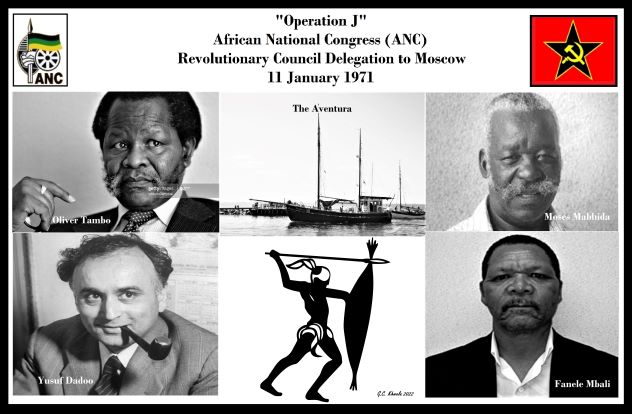
On 11 January 1971, Oliver Tambo, Yusuf Dadoo, Moses Mabhida and Fanele Mbali met a group of Soviet politicians, army generals and navy admirals. The meeting took place in a boardroom in the Soviet Union. Fanele Mbali had been recalled to Moscow in connection with the plans of the African National Congress (ANC) to launch a seaborne invasion of South Africa, which was a longstanding Umkhonto we Sizwe (MK) objective.
Landings along the South African coastline were envisaged in Operation Mayibuye, which were featured in the early plans for guerrilla warfare, and had been discussed by Joe Slovo in Moscow in July-August 1967, and by Oliver Tambo, Ben Turok and Joe Slovo in 1969. The Revolutionary Council wished to revive the idea, as large-scale infiltration of trained fighters into South Africa proved unsuccessful overland. Therefore, the ANC leadership again concentrated attention on finding a sea route.
At the meeting in the Soviet boardroom, a member of the Soviet Team asked the ANC delegation as to what was new that they wanted to bring to the ongoing talks regarding a naval infiltration. Yusuf Dadoo stood up and said, “Our response will come from the youngest member of our delegation, Lammy Booi. He was trained in navigation and this operation will be his to execute if it is approved. He will address this meeting in the Russian language.” Dadoo then sat down and Fanele Mbali (aka “Lammy Booi”) stood up and began to address the meeting. When Mbali finished his address, he received a round of applause from the Soviets.
A tall Soviet admiral stood up and mentioned that he knew Lammy. He was the one who put him through his accreditation process when he completed his navigation course in Baku in 1967. He also mentioned that he knows Lammy’s political outlook and that he was a product of Soviet training, and accordingly was convinced that he was the right choice.
Mbali left South Africa on 8 January 1962, through Botswana, to Dar es Salaam, in Tanzania. They then travelled, as a group, to London and on to the Soviet Union, where their academic studies were to start at the University of Lamanosov. Mbali and other members of the group graduated in August 1966. After graduating, Mbali returned to Dar es Salaam where he joined MK at the suggestion of Boitumelo Phakedi. He, however, needed to return to the USSR for further training.
Subsequently, in 1967, Mbali and Koos Segola were selected from the group, sent to Baku (capital of Azerbaijani), for a six month training in sea navigation and clandestine landing. He became the commander for training in clandestine landings for the vessel, “Aventura”, as this was his expertise.
After persistent requests from the ANC and the South African Communist Party (SACP) leadership, the Soviet side, originally sceptical, agreed to support the plan for “Operation J”, but warned against any unprepared and hasty actions.
It was then agreed that, in the first instance, some “organisers” would be trained, as well as personnel who would study on site the possibilities of a coastal landing. Depending on the results of such a reconnaissance, the Soviet side would be prepared to assist in acquiring a vessel, supplying the necessary equipment, including radio and training the landing party.
The challenges in “Operation J” concerned not only training and equipment, but finding a country that would be ready to serve as a base for the operation. Naturally, among the independent African countries, Tanzanian ports were closest to South Africa, but Tanzania relations with the ANC were at a low ebb. Fortunately, the new government of Somalia, which came to power in October 1969 as a result of a military coup, under Siad Barre, was a strong supporter of the ANC and offered to help.
During preparations for the expedition, ANC cadres received some specialised training at the naval base in Baku, and the importance the top ANC leadership attached to this project was indicated by the fact that Oliver Tambo visited the naval base in Baku to ensure that the preparations went according to plan.
In his analysis as Commander-in-Chief of Umkhonto we Sizwe (MK), Tambo ‘s recommendations were that the ‘Operation J’ command structure should “Send one, two or possibly three people for a short reconnaissance in terrain for two or three weeks. Examine whether bigger group can survive. The small advance group selected”, wrote Oliver Tambo, “should be regarded ‘first and foremost’ as ‘politically conscious, politically trained persons, under the political direction of a political commissar’”.
Anyone who was to be selected for such reconnaissance work should take age and occupation into account, as well as fill Tambo’s criteria of having a knowledge of the operational area, the language, local politics and individual contacts. In fact, Tambo felt that he, himself, was an ideal candidate for ‘Operation J’.
Castro Khwela
Good day fellow Compatriots!
Discover more from CASTRO KHWELA
Subscribe to get the latest posts sent to your email.


Thank you for umhabulo keep up good work with reliable information