Revisiting Frantz Fanon: Colonialism and Revolution
(Review of two books by the Martinique and Algerian revolutionary, the late Frantz Fanon, by A. Langa, The African Communist, No. 25, Second Quarter 1966)
“… imperialism is not defeated when the national flag is unfurled and the nationalist government moves into State House. … Colonialism and imperialism have not paid their score when they remove their flags and their police from our territories”.
– Frantz Fanon “The Wretched of the Earth”, 1961 –
REVOLUTION IS A GREAT CATALYST. It transforms vague motives and emotions into thoughts, policies, programmes; it pushes ideas towards the acid test of revolutionary action. For the vacillating, the undecided, revolution is a hard master-the revolutionaries have only one question to ask of him: are you my brother, or are you my foe?
In the revolution to which Frantz Fanon was so brutally introduced, it was perhaps easier to choose. In Algeria, there were none of the refinements, the masks, the subtleties, which reaction uses to cover its actions. The visible enemy of the Algerian people’s revolution was the para, the policeman, the colon, the beast of the O.A.S. (“Secret Army Organisation”). The invisible enemies, too, were well known to the Algerian people – the Paris government, the metropolitan banks and oil monopolies, the absentee landlords, the whole structure and might of French imperialism. The entire people was at war with the foreign oppressor, stripping imperialism of the thin veneer of civilization to which it aspired, and revealing it in all its savagery.
Fanon, born in Martinique, came from France to work as a psychiatrist in a hospital to which was brought the human debris of colonial repression – the revolutionaries (those ‘lucky’ enough not to have been murdered by the French forces) driven mad by torture, the women unbalanced by being raped by French soldiers, the peasants driven to paranoia by the bestiality of the French army, the policemen so besotted with blood-lust that they were torturing their own wives and children when no prisoners were immediately available.
If Frantz Fanon’s writings·(“The Wretched of the Earth” and “Studies in a Dying Colonialism”) had been confined to cataloguing these horrors, he would have done a great service to Algeria and to the cause of national liberation. But what he left behind at his premature death from leukaemia in 1961 is much more than a clinical record of the psychoses of revolution. He has written an acute analysis of the political forces in colonial society, of the problems of mass political organization and the fostering of a level of patriotic national consciousness sufficiently high to enable the people to throw out their oppressor.
Fanon has much to say, too, to Africans in 1966, in the time of a massive and co-ordinated neo-colonialist counter-offensive which aims, by the use of the African puppet instead of the colonial governor, to snuff out the flame of genuine African freedom for ever. The reader may disagree, as some reviewers have done, with individual statements and ideas. But there can be no doubt that the over-all picture Fanon draws, and the penetrating psychological insights he gives us, have the unmistakable, at times uncomfortable, ring of truth.
Fanon experienced the struggle for liberation in its most advanced stage, that of armed revolution, and perhaps for that reason he is too undiscriminating in singling out all the leaders of African countries who came to power by non-violent means, as actual or potential traitors to the cause of national liberation. Again and again, Fanon hammers at those who have duped the people, and who now betray their trust:
“The people who for years on end have seen this leader and heard him speak, who from a distance in a kind of dream have followed his contests with the colonial power, spontaneously put their trust in this patriot. Before independence, the leader generally embodies the aspirations of the people for independence, political liberty and national dignity. But as soon as independence is declared, far from embodying in concrete form the needs of the people in what touches bread, land, and the restoration of the country to the sacred hands of the people, the leader will reveal his inner purpose: to become the general president of that company of profiteers impatient for their returns which constitutes the national bourgeoisie.”
Harsh words, and richly deserved by so many ‘nationalist’ leaders. Here are none of the contemporary myths about ‘classless’ African society. Fanon knows full well that, for many of the emerging national bourgeoisie in Africa, independence means taking political and economic power from the imperialists – not to build a better life for the masses of the people, but to line their own pockets as quickly and as thoroughly as possible. And, if the cause of their own enrichment can best be served by bowing and scraping to the foreign masters, that, too, is in order.
Sadly, the list of those who have not justified the people’s trust is long enough: Senghor, Balewa, M’ba, Houphouet-Boigny and many others. But there are also many who might be said to come from the sort of ‘elite’ of which Fanon speaks, and yet who have played an honourable part in Africa’s struggle for liberation – one need only mention Nyerere. Nkrumah, Sekou Toure, Modibo Keita, Ben Bella and Massamba-Debat.
But this is really to quibble over inessentials, for there can be no doubt that Frantz Fanon would be first to recognize the injustice of tarring all these leaders with the same brush. What he is really showing us, in his forthright way. is the vigilance necessary if Africa is to attain its democratic heritage.
Besides emphasizing the necessity of revolutionary vigilance, to ensure that the masses did not free themselves from colonialism only to be ground under the heel of an emerging bourgeoisie, Fanon argues that it is essential that the entirepeople, peasants and subsistence farmers in outlying areas as well as the urban working class and intelligentsia, is mobilized for the task of building the new nation. Now it is a fact, acknowledged in many African countries, that the mass organizations which led the people to independence did not always succeed in penetrating into areas far away from the major towns, where traditional society, even today, has not surrendered to the new national consciousness. The reasons for this are many.
Invariably, confronted with the growing might of the independence movement and the organized working class, the colonialists desperately turned to reactionary chiefs and headmen in the countryside, playing up regional, tribal and religious hostilities, feverishly encouraging hostility towards ‘those townsmen who care nothing for us’, recruiting policemen and soldiers from backward districts to shoot down strikers and demonstrators, and generally doing their utmost to turn the peasants away from the goal of independence. In other cases, even after independence unscrupulous traditional leaders, fearing the new spirit of nationalism as a threat to their position, have used any and every means to sow discord and deflect their people from the chance of a better life.
The fostering of a truly national consciousness, undivided by tribal, religious or regional loyalties, and founded on a militant, anti-imperialist ideology, Fanon emphasizes as the pre-condition for true liberation. Both the government machine and the mass political organizations of the people must be mobilized to this end.
“The setting up early in the days of independence of regional organizations and officials who have full authority to do everything in their power to awaken such a region, to bring life to it and to hasten the growth of consciousness in it is a necessity from which there is no escape for a country that wishes to progress.”
“In an under-developed country, the party ought to be organized in such a fashion that it is not simply content with having contacts with the masses. The party should be the direct expression of the masses. The party is not an administration responsible for transmitting government orders; it is the energetic spokesman and incorruptible defender of the masses. In order to arrive at this conception of the party, we must above all rid ourselves of the very Western, very bourgeois and therefore contemptuous altitude that the masses are incapable of governing themselves.”
“In fact, experience proves that the masses understand perfectly the most complicated problems. … It is from the base that forces mount up which supply the summit with its dynamic, and make it possible dialectically for it to leap ahead. The nation does not exist except in a programme which has been worked out by revolutionary leaders and taken up with the full understanding and enthusiasm of the masses.”
Fanon’s analysis of the nature of the task of achieving complete national independence rests on solid foundations. He repeats, forcefully, what we know to be true: that imperialism is not defeated when the national flag is unfurled and the nationalist government moves into State House. But he goes further than that. Too many African countries, he says, have unthinkingly taken over Western institutions, Western ways of doing things, Western ideas, which are objectively inimical to African progress. Insidiously, these influences can corrupt new countries and deflect them from progressive courses, separate the leaders from the masses, and open the way for the imperialist reoccupation, in fact if not in form, of Africa.
“Colonialism and imperialism have not paid their score when they remove their flags and their police from our territories”. We have only to look around us to see the truth of that statement, not only in the domination of Africa’s economy, in one way or another, by the imperialist powers, not only in the oceans of imperialist propaganda which try to engulf our continent, but in far more subtle, yet equally effective ways. The Western idea of the army as a separate caste for example, with its own privileges and powers, has clearly wrought great damage in Africa.
Kwame Nkrumah would have done well to heed this advice of Fanon’s: “Care must be taken to avoid turning the army into an autonomous body which sooner or later, finding itself idle and without any definite mission, will go into politics and threaten the government. Drawing-room generals, by dint of haunting the corridors of government departments, come to dream of manifestos. The only way to avoid this menace is to educate the army politically, in other words truly to nationalize it.”
Fanon states flatly that there is really no choice for the underdeveloped nations but to take the path of socialism.
“The capitalist regime … cannot leave us free to perform our work at home, nor our duty in the world. Capitalist exploitation and cartels and monopolies are the enemies of under-developed countries. On the other hand the choice of a socialist regime, a regime which is completely orientated towards the people as a whole and based on the principle that man is the most precious of all possessions, will allow us to go forward more quickly and more harmoniously, and thus make impossible that caricature of society where all economic and political power is held in the hands of a few who regard the nation as a whole with scorn and contempt.”
In many ways, Fanon’s works. and in particular the ‘theoretical’ sections of “The Wretched of the Earth”, defy description or ordinary analysis. Time and again, the watchful reader will come across seemingly contradictory statements, imprecisions, and seeming exaggerations. Parts of the book are a strange mixture of broad theoretical generalizations about colonialism, the struggle for liberation. and the nature of nationalism, and on the other hand detailed examination of particular problems of national reconstruction, mass struggle and political organization, with specific examples mainly from the Algerian war of liberation. Why, too, do we have in one volume “The Wretched of the Earth” extensive case histories of psychiatric disturbances alongside writings on colonialism, nationalism and revolution?
The reason for these ‘faults’ is easily discovered. These books were not written in the seclusion of a university or a library, but literally forged on the battleground of revolution. Most of the chapters, one can imagine, were written under considerable pressure, while Fanon was working for the F.L.N. (National Liberation Front), first in Algeria, then in Ghana. But this is their strength as well as their weakness. The vividness and power which the immediacy of his experience gives to his writing is not at all weakened by minor errors of fact or judgement.
Fanon does not rely on emotionalism or fiery words – indeed, his writing is almost conversational. And yet these books are overwhelmingly powerful in their effect. Few writings by revolutionaries anywhere equal Fanon in telling us of the raw realities of colonial domination, of the crushing poverty of the peasants and the jobless on the edges of the big colonial towns, of the dark thoughts which come to obsess oppressor and oppressed, and of the incomparable triumph of the moment when the entire people rises in unity to throw out the foreigner.
Fanon’s doubt about the integrity of nationalist governments which come to power by peaceful means is, for Marxists and all African patriots, perhaps the most controversial aspect of his thought. It is explicable that one who learnt in the hard school of the Algerian Revolution should reject the notion of peaceful transition, as far as the imperialist-dominated developing countries are concerned. There are many who will disagree with him, and they may very well be right. But so far, there has been no under-developed country which has completely thrown off the shackles of imperialism by exclusively nonviolent means.
In fairness to Frantz Fanon, he has yet to be proved wrong. At the same time, there can be no doubt that in many African countries where a comparatively peaceful transition to independence took place, the people are making significant progress in consolidating their freedom and building economies strong and diverse enough to withstand imperialist financial manoeuvring.
One could go on almost indefinitely, analysing Fanon’s propositions, examining his theories on revolutionary violence, on national consciousness, on the importance of national culture. But perhaps all that is necessary is to summarize the points to which Fanon returns, again and again, urging Africans to take heed and act, lest the great African ideals of freedom, unity and progress turn into empty words:
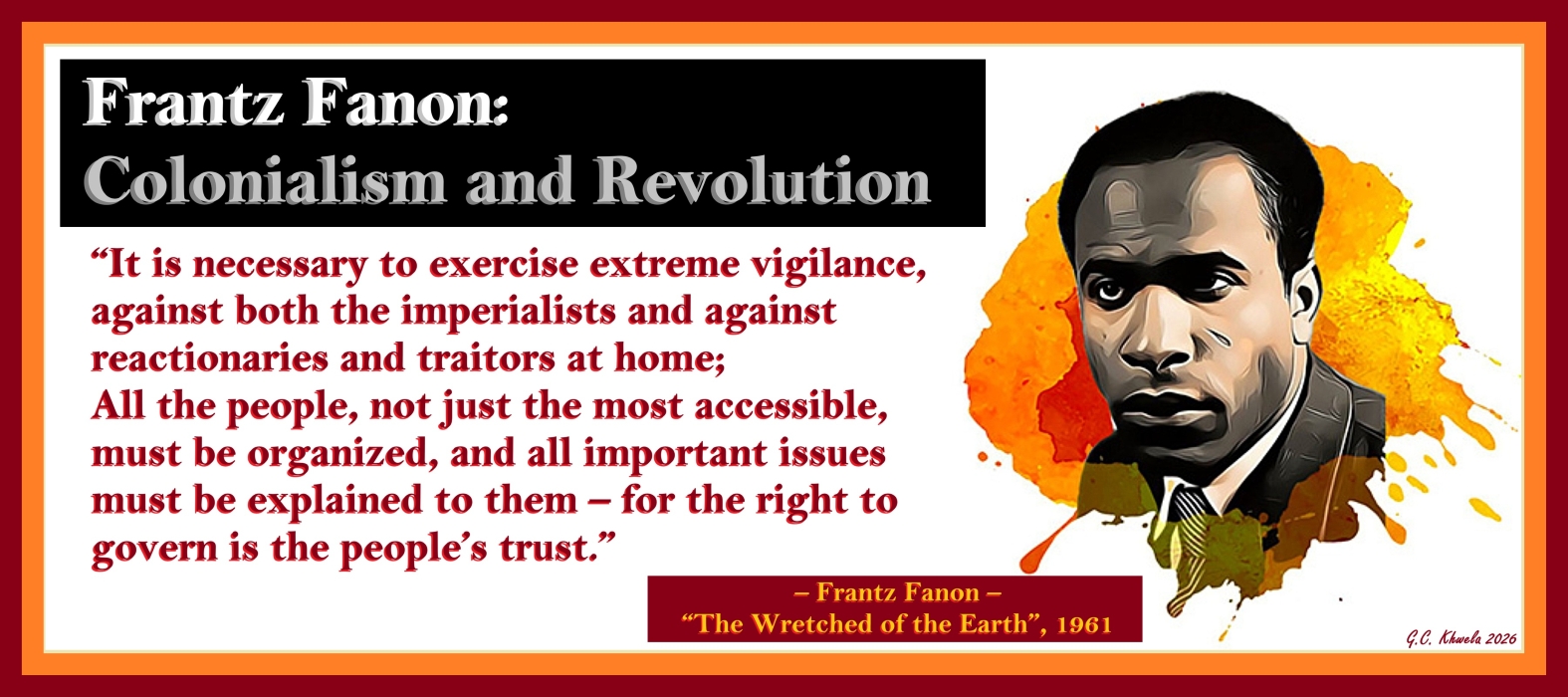
“It is necessary to exercise extreme vigilance, against both the imperialists and against reactionaries and traitors at home; All the people, not just the most accessible, must be organized, and all important issues must be explained to them – for the right to govern is the people’s trust; Lastly, and most importantly, no true or lasting progress is possible except by advancing steadily towards socialism, and completely abolishing the exploitation of man by man.”
If Africa’s patriots resolutely follow that advice, there is little that can impede our continent’s movement towards a bright, independent future.
Source:
A. Langa, “Frantz Fanon: Colonialism and Revolution”, The African Communist, No. 25, Second Quarter 1966, pp. 80 – 85.
Castro Khwela
Good day fellow Compatriots!
Discover more from CASTRO KHWELA
Subscribe to get the latest posts sent to your email.