Signing the D.F. Malan Accord: 12 February 1991
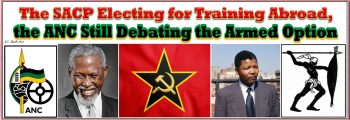
On 12 February 1991, the apartheid South African Government and the African National Congress (ANC) signed the then secret D.F. Malan Accord, which effectively removed most obstacles in the way of a multi-party conference. It became a crucial agreement that further defined the suspension of the ANC’s armed struggle, and it formalised the cessation of armed attacks, the infiltration of personnel, and the creation of underground military structures, while addressing the licensing of weapons and the rights of ANC members to engage in peaceful political activity. The accord was named after the D.F. Malan Airport (now Cape Town International Airport), where the meeting took place.
The D.F. Malan Accord followed the 1990 Groote Schuur Minute and Pretoria Minute, aiming to accelerate the transition to a peaceful, negotiated settlement. The ANC agreed to cease armed attacks, stop infiltration of personnel and weapons, stop creating underground structures, cease threats of violence, and to end military training inside South Africa. Whereas the apartheid government agreed to review security legislation to facilitate free political activity and to manage the legal standing of Umkhonto we Sizwe (MK) members. The accord was crucial for reducing violence and building trust, allowing for the continuation of negotiations despite ongoing challenges. It specifically addressed the practicalities of transitioning from armed struggle to political negotiation.
There was no agreement, however, on the surrender of ANC weapons, the identification of arms caches, the demobilisation of cadres, or the establishment of self-defence units (SDUs). It was further agreed that membership of Umkhonto we Sizwe would not be unlawful, individual weapons would be licensed, and the right to peaceful demonstrations would be maintained.
In its January 8, 1991, statement, the ANC had proposed an all-party conference on constitutional negotiation that would include the Inkatha Freedom Party (IFP) and the Conservative Party (KP). The conference was intended to handle three tasks: to set out broad constitutional principles; to determine the composition of the body that would draft the constitution; and to establish an interim government to oversee the process of transition. While the apartheid government, the Democratic Party (DP) and the IFP welcomed the idea, the Pan Africanist Congress (PAC), the Azanian People’s Organisation (AZAPO), and the Conservative Party (KP) remained opposed.
On the other hand, during the first anniversary of his 2 February 1990 speech, apartheid President F.W. de Klerk was keen to be seen to be taking the initiative, especially after the ANC’s call for an all-party congress. In his opening speech to Parliament, he announced the total scrapping of major discriminatory laws, including the Population Registration Act, the Group Areas Act, and the Land Act. According to De Klerk, apartheid was given its official death warrant, as he expected these laws to be repealed by June 1991. The requirements for the lifting of the ban on trade by the European Community had now been met, and he accordingly wasted no time in challenging these countries to “translate basic feelings into real deeds”.
The accord was considered a vital “breakthrough” because it removed major obstacles regarding the definition of the “suspension of armed struggle”. By clarifying these terms, it cleared the path for broader multi-party negotiations, eventually leading to the Convention for a Democratic South Africa (CODESA). With regard to indemnities, two former judges (Justices Solomon and Leon) and an Appeal Court judge (Justice Steyn) were appointed to chair committees to determine whether awaiting-trial prisoners and exiles should be granted individual indemnity.
On 12 March 1991, there was a further breakthrough, when it was agreed that ANC members who had undergone military training automatically qualified for indemnity. In March 1991, thirty-three political prisoners were released after being granted unconditional indemnity, these releases bringing the number of political prisoners released to 310. At the same time, the National Coordinating Committee for Repatriation (NCCR) of former exiles was facilitating the return of a number of exiles. Another positive development was the lifting of the ban on outdoor political meetings. This ban had been in force for the last fifteen years and was a source of much contention and frustration. Its removal greatly assisted the move towards free political activity.
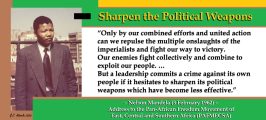
Many in the ANC were suspicious of the agreement, believing that the negotiation was a trap from which the Movement would not be able to recover. However, the ANC leadership remained confident about the negotiations. The agreement also led to relations between the PAC and the ANC being further soured: the PAC denounced the agreement and asked the ANC to review its decision to participate in the all-party conference. The PAC’s Benny Alexander asserted, “in the absence of the ballot, the bullet cannot be abandoned”.
Meanwhile, De Klerk met with leaders of the Bantustans, including the leaders of the two chambers of the tri-cameral parliament, Rev. Allan Hendrickse and Dr J. N. Reddy, as well as the belligerent Gatsha Mangosuthu Buthelezi, late in February 1991. They supported the need for the multi-party conference. Speaking to leaders of the Venda government a month later, De Klerk argued that the agreement to hold the multi-party conference opened the door for the reincorporation of the TBVC states (Transkei, Bophuthatswana, Venda, and Ciskei) into South Africa and would allow their participation in such a conference.
Sources:
Wikipedia.
South African History Online (SAHO).
Office of the State President, “The D. F. Malan Accord”, Office of the State President, Republic of South Africa, Cape Town, 12 February 1991.
Mark Shaw, “Negotiating Defence for a New South Africa”, in Jakkie Cilliers and Markus Reichardt (Eds.), “About Turn: The Transformation of the South African Military and Intelligence”, Institute for Defence Policy, November 1995, pp. 9 – 24.
Gillian Turner, “Working with the Enemy: The Military Integration Process in Transitional South Africa and Factors that Shaped a New Defence Force”, Faculty of the Humanities: University of Cape Town, 7 April 2015.
Castro Khwela
Good day fellow Compatriots!
Discover more from CASTRO KHWELA
Subscribe to get the latest posts sent to your email.