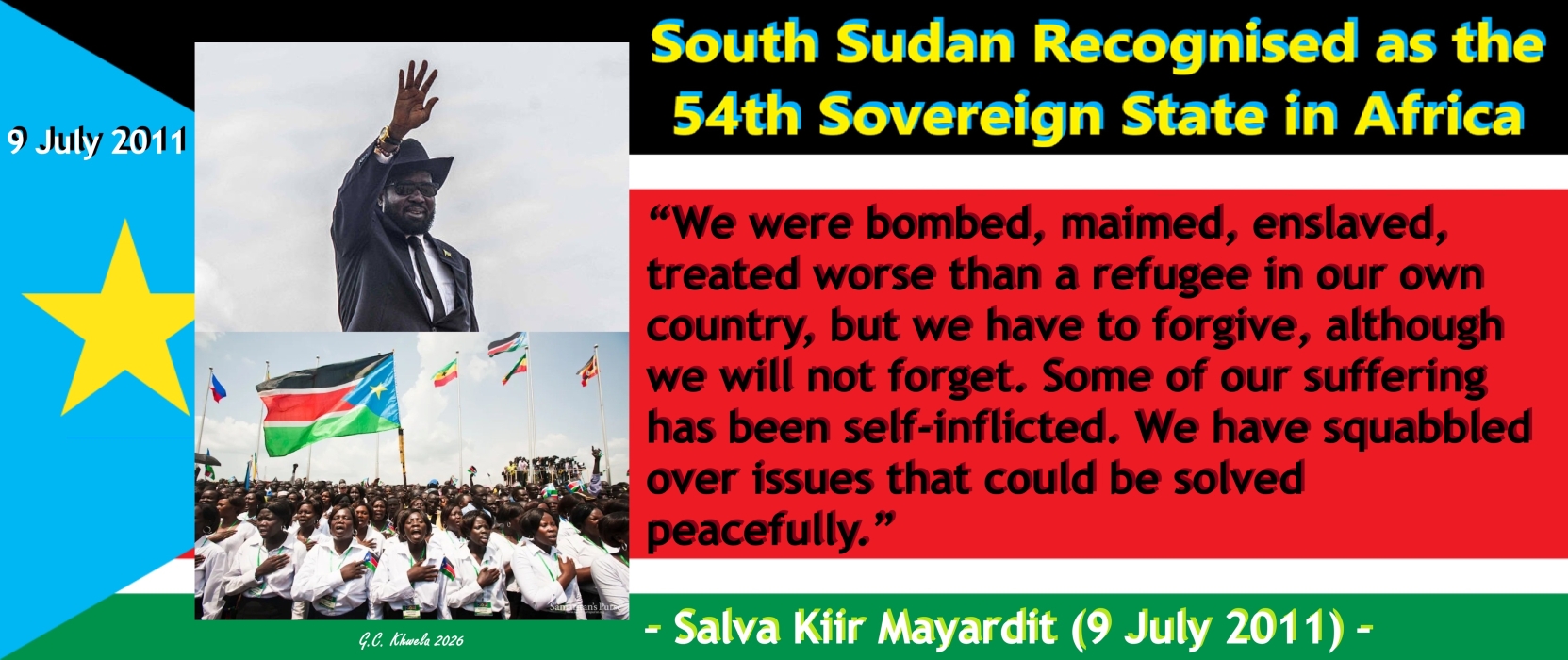
South Sudan Recognised as the 54th Sovereign State in Africa
Fifteen years ago, on 9 July 2011, the new state of South Sudan gained its independence from the Sudan. After five decades of unrest and civil war, South Sudan was granted independence on 9 July 2011 with the town of Juba as a capital. The declaration of independence marked “the end” of intermittent clashes with the north. Salva Kiir became the first President of the newly born African state, thus becoming the 54th internationally recognised sovereign states in Africa.
In 1946, British and Egyptian colonial administrators forcibly unified the distinct northern and southern regions of Sudan. The Arab-dominated north received disproportionate political and economic power, while the black, predominantly Christian and animist south was neglected. Sudan officially gained its independence on 1 January 1956 from the joint administration of Great Britain and Egypt. From 1899 to 1955, Sudan was not a standard British colony but was governed as a “condominium” – a joint protectorate officially shared between Egypt and the United Kingdom. In reality, British officials held the primary administrative power.
Following the 1952 Egyptian Revolution, the new Egyptian government signed an agreement with Britain in February 1953 to grant Sudan self-determination within three years. Nationalist leader Ismāʿīl al-Azharī, serving as Prime Minister, officially bypassed a planned public plebiscite and declared Sudan an independent republic on 1 January 1956. This made Sudan the first sub-Saharan African nation to gain independence from European colonial rule in the 20th century. Fearing northern domination and systemic racism, southern mutineers launched the First Sudanese Civil War (1955–1972).
A brief period of regional autonomy was shattered in 1983 when the Khartoum government revoked the south’s self-governance and imposed Islamic Sharia law nationwide. This sparked the Second Sudanese Civil War (1983–2005), led by the Sudan People’s Liberation Army (SPLA). The conflict cost roughly 2.5 million lives, mostly due to starvation, drought and state-sponsored violence. Exhaustion led to the 2005 Comprehensive Peace Agreement (CPA). The landmark deal granted the south six years of autonomy, culminating in a historic self-determination referendum in January 2011, wherein more than 98% of South Sudanese citizens voted to secede, leading to official statehood on 9 July 2011.
From a political and human rights standpoint, independence successfully delivered self-determination and shielded citizens from northern religious and ethnic persecution. However, on a practical, socio-economic level, independence has fundamentally failed to deliver prosperity or safety to its citizens. The shared goal of independence masked deep ethnic divisions. In December 2013 – just two years after statehood – a political rift between President Salva Kiir (an ethnic Dinka) and Vice President Riek Machar (an ethnic Nuer) plunged the new country into its own catastrophic civil war.
Years of internal conflict, hyper-inflation, and institutional corruption shattered the country’s fragile economy. By 2026, the humanitarian situation has deteriorated further, leaving 10 million people in desperate need of aid – compounded by severe climate shocks, historic floods and a massive influx of refugees fleeing the war in neighbouring Sudan. Despite inheriting vast oil reserves, the government failed to diversify its revenue. Corruption and violent disputes over oil pipelines prevented these resource riches from funding basic public infrastructure, roads, hospitals or schools. South Sudan built a sovereign framework from absolute zero, establishing national universities, state ministries and a constitutional mandate for female representation.
Nevertheless, the country has seen minor improvements in school enrolment rates and greater access to formal education for girls compared to the immediate post-independence era. Ultimately, while the South Sudanese people gained the existential freedom they fought for, they exchanged foreign oppression for domestic instability. Many intellectuals and locals now openly view the promise of 2011 as a “failed promise”.
From a Pan-Africanist perspective, South Sudan’s independence was not a positive contribution to the realisation of post-colonial development, stability and unity. Viewed through this specific framework, its secession is widely considered a catastrophic setback for the continent. The immediate descent into civil war in 2013 systematically destroyed what little infrastructure existed at independence, setting national development back by decades. Independence split Sudan’s economy; South Sudan inherited 75% of the oil fields, but Khartoum retained the export pipelines. This created a toxic economic interdependency that triggered immediate fiscal blockades and currency collapses in both nations.
Instead of achieving self-reliant African development, South Sudan became a hyper-dependent humanitarian state, relying almost entirely on Western NGOs and United Nations funding to feed its population. South Sudan’s internal ethnic war spilled over its borders, triggering massive refugee crises that strained the resources of Uganda, Kenya, Ethiopia and the Democratic Republic of Congo. The failure to cleanly demarcate borders post-secession led to immediate, violent border clashes over resource-rich pockets like Abyei and Heglig, keeping the entire East African region on high military alert.
By proving that colonial borders could be redrawn, South Sudan’s secession emboldened other armed separatist movements across Africa, such as in Cameroon, Nigeria and Ethiopia, threatening wider regional fragmentation. Independence was a structural retreat from the core Pan-African ideal of a multicultural, secular nation. It abandoned the vision of Sudanese People’s Liberation Movement (SPLM) founder, John Garang, who fought for a unified, democratic Sudan where diverse ethnic groups coexisted equally. The rapid collapse of the new state into ethnic factionalism reinforced outdated colonial tropes that African nations cannot self-govern without descending into ethnic warfare, damaging the global political leverage of the African Union.
Pan-Africanists and political realists argue that South Sudan’s secession fractured the core ideals of continental solidarity and set a dangerous institutional precedent. A foundational pillar of the African revolution – enshrined by the Organisation of African Unity (OAU) in 1964 – was the strict preservation of colonial borders (“uti possidetis”). This rule was vital to prevent a chaotic domino effect of ethnic secessions across Africa. South Sudan’s departure breached this principle, fuelling separatist anxieties in regions like Tigray (Ethiopia), Ambazonia (Cameroon), and Biafra (Nigeria).
The ultimate goal of the African revolution was to build prosperous, self-reliant societies. South Sudan quickly degenerated into a brutal internal civil war, economic collapse, and deep-seated corruption. To critics, its status as a fragile state weakened the global standing of African sovereignty and re-invited heavy Western humanitarian dependency. The historic leader of the southern liberation movement, Dr. John Garang, did not originally fight for a separate country. His vision was a “New Sudan” – a unified, secular democratic state where all ethnic and religious groups enjoyed equal citizenship. Secession was a retreat from this revolutionary ideal of multicultural unity.
However, for proponents of radical African liberation, South Sudan’s secession was a monumental triumph for human rights and local sovereignty. The mainstream African revolution primarily fought European empires. South Sudan’s independence proved that black African populations could successfully overthrow “internal colonialism” – the Arab-dominated, discriminatory regime in Khartoum that had weaponised state power against them for decades. The 2011 referendum, where 98.8% of voters chose independence, stood as a massive victory for democratic self-determination on a continent where national borders are rarely decided by the people living within them.
The British artificially stitched the distinct northern and southern regions together in 1946 without local consent. Secession corrected this deep-seated colonial blunder, demonstrating that the arbitrary map drawn at the 1884 Berlin Conference was not permanently immutable. Ultimately, South Sudan’s independence was a profound success for the first phase of the African revolution (liberation from oppression), but a tragic failure for the second phase (the construction of a stable, prosperous society). It proved that winning a country through armed struggle is entirely different from a successfully governing one.
The broad national liberation movement in Africa – specifically the first-generation parties in Southern Africa like South Africa’s African National Congress (ANC), the Zimbabwe African National Union-Patriotic Front (ZANU-PF), Namibia’s South West Africa People’s Organisation (SWAPO), and Mozambique’s National Liberation Front (FRELIMO) – viewed the independence of South Sudan with deep ideological ambivalence. While they felt a profound sense of pan-African solidarity with the South Sudanese people’s fight against oppression, they initially harboured severe institutional anxiety regarding the act of secession itself.
The liberation movements of Southern Africa were trapped between two conflicting pillars of African political doctrine. Parties like the ANC and SWAPO strongly identified with the People’s Liberation Movement (SPLM). They saw the black, Christian and animist populations of the south as fellow victims of a racially and religiously oppressive regime in Khartoum, drawing direct parallels to their own fights against minority apartheid and colonial rule. Historically, these movements strictly adhered to the 1964 Organisation of African Unity (OAU) Cairo Declaration, which mandated that colonial borders must remain sacred (uti possidetis).
To Southern African liberation governments, allowing South Sudan to split away risked creating a dangerous precedent that could legitimise separatist movements inside their own fragile, multi-ethnic nations, such as the Caprivi strip in Namibia or Matabeleland in Zimbabwe. As the diplomatic powerhouse of Southern Africa, South Africa’s African National Congress (ANC) played the most prominent role. The ANC shared a close historical relationship with SPLM leader Dr. John Garang. Because Garang initially advocated for a unified, secular and democratic “New Sudan” rather than a separate state, the ANC strongly backed his vision. They preferred a solution where Sudan stayed whole but underwent radical internal democratisation.
Following Garang’s sudden death in 2005, and when it became clear that the South Sudanese people overwhelmingly demanded full independence, the ANC government pivoted. They actively helped facilitate the 2005 Comprehensive Peace Agreement (CPA). Once independence was inevitable, the ANC viewed South Sudan as a younger sibling in liberation. They deployed extensive diplomatic resources to Juba to train South Sudanese civil servants, provide governance mentorship and attempted to transfer the ANC’s framework of institutionalising a liberation movement into a ruling political party.
The rest of the former Frontline States reacted with careful, pragmatic diplomatic alignment. Movements like ZANU-PF (Zimbabwe) and SWAPO (Namibia) explicitly stated that South Sudan was an “exceptional case”. They justified their support for its independence by arguing that because the government in Khartoum had signed and agreed to the 2005 CPA – which explicitly allowed for a referendum – the secession did not violate African Union principles. It was viewed as a mutually agreed-upon divorce rather than a unilateral, illegal rebellion.
Elements within these older Marxist-leaning liberation movements harboured quiet suspicion regarding the heavy diplomatic and financial backing that South Sudan received from the United States and Western powers. They worried that the creation of South Sudan was being used by Western states to weaken a strategic, Arab-aligned country (Sudan) and gain direct control over East African oil reserves. Nevertheless, Southern Africa’s liberation movements ultimately chose realpolitik over rigid dogma. They suppressed their historical fears of continental fragmentation to welcome the SPLM into the family of independent African states, framing the birth of South Sudan as the final, necessary chapter of the continent’s twentieth-century liberation struggle.
After he was inaugurated, the emotional Salva Kiir Mayardit said, “We were bombed, maimed, enslaved, treated worse than a refugee in our own country, but we have to forgive, although we will not forget. Some of our suffering has been self-inflicted. We have squabbled over issues that could be solved peacefully.”
Sources:
Wikipedia.
South African History Online (SAHO).
Wex Definition Team, “Uti Possidetis Juris”, Legal Information Institute (LII), Cornell Law School, 22 December 1986.
Petrus de Kock, “The Celebrations and Tribulations of Southern Sudan’s Independence”, South African Institute of International Affairs (SAIIA), 6 July 2011.
The Royal House of Norway, “South Sudan Gains Its Independence”, The Royal House of Norway, 9 July 2011.
Brookings Institution, “One Year After South Sudan’s Independence: Opportunities and Obstacles for Africa’s Newest Country”, Brookings Institution, 22 June 2012.
Cheryl Hendricks and Amanda Lucey, “South Africa and South Sudan: Lessons for Post-Conflict Development and Peacebuilding Partnerships”, ISS Policy Brief 49, December 2013.
Joshua Lubandi, “Let South Sudan Learn from South Africa”, Open Society Foundations, 14 May 2014.
Amir Idris, “Introduction: Race, Ethnicity, and Violence in South Sudan”, African Histories and Modernities, Palgrave Macmillan, 2024.
Britannica Editors, “During the Decolonization of Africa, When and How Did Sudan Gain Independence”, Encyclopaedia Britannica, 18 November 2025.
OCHA Services, “Global Humanitarian Overview 2026: South Sudan”, Humanitarian Action, 8 December 2025.
Center for Preventive Action, “Civil War in Sudan”, Global Conflict Tracker”, 8 May 2026.
Britannica Editors, “The British Conquest: In Sudan in History”, Encyclopaedia Britannica, 8 July 2026.
AJLabs, “In Maps and Charts: South Sudan’s 15 Years of Independence”, Al Jazeera, 9 Jul 2026.
Castro Khwela
Good morning fellow Compatriots!🙏🏾✊🏾👊🏾
Discover more from CASTRO KHWELA
Subscribe to get the latest posts sent to your email.