Taking the War to the White Areas Campaign
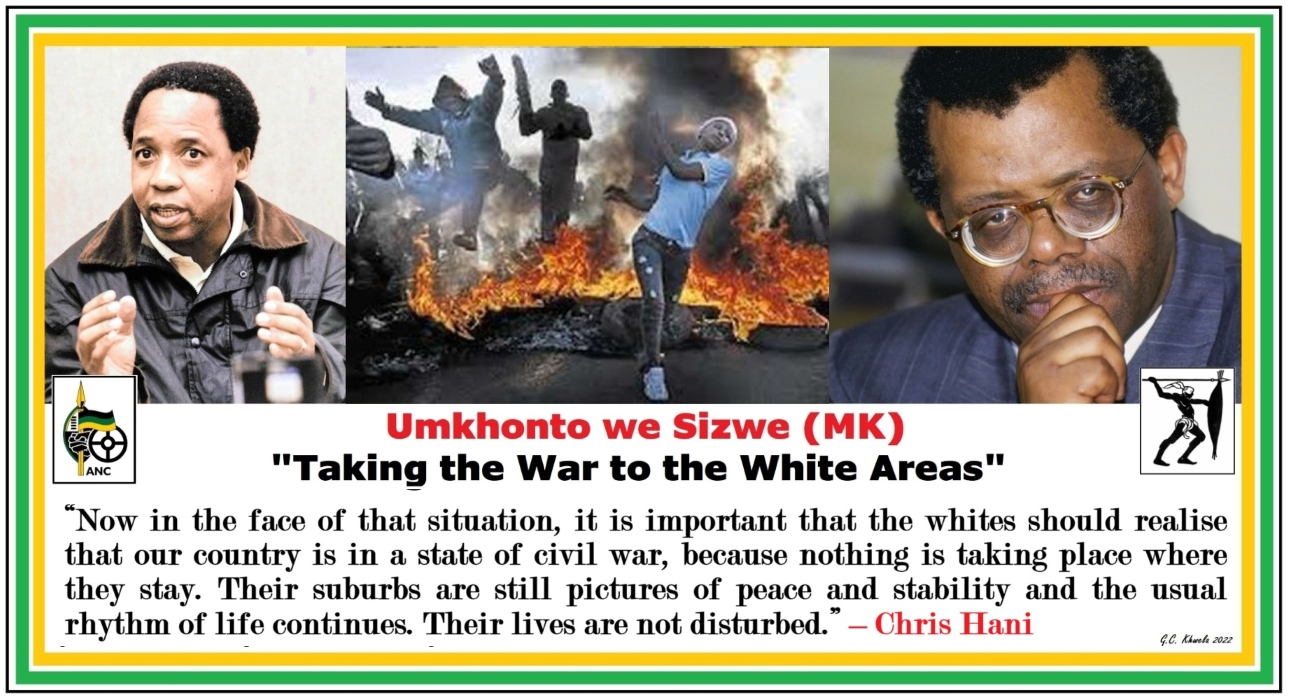
On 3 June 1988, Umkhonto we Sizwe (MK) Chief of Staff Chris Hani and Army Commissar Steve Tshwete were interviewed by John Battersby of The Times of London newspaper in Lusaka following the reshuffle of the military hierarchy in October 1987. Steve Tshwete had replaced Chris Hani as Army Commissar, the latter having been elevated to the Chief of Staff position, which was occupied by Joe Slovo, the new General-Secretary of the South African Communist Party (SACP).
Chris Hani indicated that MK’s key objective in 1988 was to cause the collapse of the municipal elections scheduled for October, as the African National Congress (ANC) viewed them “as one gigantic step by the regime to restore what our people destroyed three years ago when in the place of this puppet system our people were experimenting with new people’s administration. Street committees, people’s organs of power, people’s courts.”
But then, Hani added, “the regime came in, deployed troops, deployed the police and went out of its way to systematically try to destroy what the people had achieved”. Then the government wanted to “bring back the traitors and install them and strengthen the position of the regime in the townships”. The ANC was therefore, according to Hani, “committed to aborting the municipal elections in October. And it is going to use both political and military methods to stop that”.
When Battersby asked them whether the latest Johannesburg and Pretoria blasts represented what was meant by “armed propaganda”, Hani’s comments were notable for the hardening they reflected of the Movement’s interpretation of the mantra of “taking the struggle to the white areas” when compared to the first formulations of it that appeared in 1985. He then mentioned that the bombs “were to tell whites that we are able to creep and crawl next to you. That be careful, and this is not just a threat, we are growing and we shall be able to do something big within your areas.”
Battersby then asked about white civilian casualties. In his response, Hani said, “The death of white civilians is regretted too. I don’t think we have any interest in the death of white civilians. But white South Africans, for a long time, have been complacent.” For Hani, “There must ‘soul-searching’ among them”, and they were supposed to ask, “How long are they going to sacrifice loss of limb to maintain a system that deprives the overwhelming majority of the right to vote, of the right to a proper house, to proper medical attention, right to proper education?” He added that “Before we turned to revolutionary violence we have turned so many cheeks”.
Steve Tshwete then interjected, “We continued to turn our cheek even after we adopted armed struggle, but in the meantime the so-called white civilians in our country have been expressing complicity in this crime of genocide against our people. When they crossed the borders into Lesotho in 1982, massacred women and children and even innocent Lesotho citizens, an opinion poll was held after the raid and over 90 percent of the white population said, ‘well done boys’”.
Following Tshwete’s comments, Hani added that “Their life is good. They go to their cinemas, they go to their braaivleis, they go to their hotels. Apartheid guarantees a happy life for them, a sweet life. Part of our campaign is to prevent that sweet life”.
At the end of the interview, Hani ended with a conciliatory note, saying: “We are saying to the whites: fellow countrymen. Let us join together and save our country from this madman [P.W. Botha] so that it remains a prosperous country. There is a place for all of us. It is a big country. We accept that you are fellow South Africans who must rule this country together. We are not asking for the monopoly of ruling South Africa as blacks. It is not a racial struggle. We are not saying ‘power to the ANC’ but ‘power to the people of South Africa’. We are not advocating a one-party state. We are advocates of parliamentary democracy. But not fascist and racist parties.”
Chris Hani displayed both indifference and disappointment at the false depiction of himself by the apartheid regime, as a bloodthirsty black communist, committed to the murder of white women and children. Prior to this interview with The Times of London newspaper, Chris Hani had made a speech broadcast on the ANC’s Radio Freedom on 1 March 1986, as MK Commissar, wherein he maintained that: “We are saying comrades (…) that our country is in a state of civil war. It is true that so far the brunt of suffering has been borne by our people. Our people are attending funerals, our people are mourning for their dead, but comrades, Umkhonto we Sizwe, instructed by the leadership of the ANC, is gearing itself to step up activity in white areas so that the entire country should be ungovernable.”
“I want to elaborate on this question of extending the struggle to the white areas”, Chris Hani added. “We don’t want to be misunderstood. Unlike Botha. Le Grange, Malan and Chris Heunis, who go out of their way to butcher children, defenceless and unarmed children, old people, black civilians, Umkhonto we Sizwe is a revolutionary army and is not going to embark on mayhem against white civilians, against children, but we are going to step up our attacks against enemy personnel. We are referring to the members of the police force, to the members of the SADF, to those in the administration terrorising and harassing our people, to those farmers and other civilians who are part of the defence force of this country, the military, paramilitary and reserves. The theatre of these actions is going to be in the white residential areas, and it is inevitable that white civilians will die” (ANC Second TRC Submission).
The analysis that emerged was that this campaign of extending the struggle to the white areas was in line with ANC President Oliver Tambo’s orders in the 8 January 1988 Statement, in which he argued that “The reasons which compelled us to take up arms have not changed. Rather, by its actions, the Pretoria regime leaves us no choice but further to escalate our military offensive for the victory of the democratic cause. The armed struggle constitutes the spearhead of our general offensive, a crucial element in our response to the violence of the racist regime. We must raise the level of this struggle in a decisive manner, draw the masses of our people into actual combat and realise our objective of transforming our armed actions into a people’s war. The call we made in the past – every patriot a combatant, every combatant a patriot – continues to be of central relevance in all our work.”
“Accordingly,” Tambo continued, “we charge the heroic people’s army, Umkhonto we Sizwe, with the responsibility of ensuring that we realise this perspective. From all our commanders and combatants and from the people themselves, acting as the mass combat army of the revolution, we expect a level of boldness, daring, courage and effectiveness in our actions against the enemy that will create a qualitatively new stage in our struggle” (Sechaba, March 1988).
This was reiterated by the SACP in its Editorial titled “Forward to Battle on Every Front”, in which it declared, “Despite the emergency, despite the arrests and detentions, the torture and the killings and executions, 1988 showed that the initiative remains in the hands of the ANC and its allies in the liberation and mass democratic movement. Only they have the vision and potential power to shift irreversibly the balance of class and national forces in South Africa so that apartheid can be destroyed and a new life built on the foundations set out in the Freedom Charter. It is an awesome but inspiring responsibility” (The African Communist, No. 116, First Quarter 1989).
Sources:
Wikipedia.
South African History Online (SAHO).
Editorial Notes, “Forward to Battle on Every Front”, The African Communist, No. 116, First Quarter 1989.
African National Congress, “Further Submissions and Responses by the African National Congress to Questions Raised by the Commission for Truth and Reconciliation”, 12 May 1997.
John Battersby, “Notes of Meeting with Chris Hani, Chief-of-Staff and Deputy Commander of Umkhonto we Sizwe, and Steve Tshwete, Political Commissar, 3rd June, 1988, Lusaka Zambia”, The Times of London, 3 June 1988.
Rebone Tau, “Chris Hani’s Dream Deferred”, Rosa Luxemburg Foundation, 10 April 2023.
Jan-Ad Stemmet and Leo Barnard “Oliver Tambo and the Ghost of Struggle Past”, Southern Journal for Contemporary History, Vol. 26 No. 2, 2001.
John D. Battersby, “South African Rebel Commander: A Portrait in Erudition and Ruthlessness”, The New York Times, 12 June 1988.
Thula Simpson, “Umkhonto we Sizwe: The ANC’s Armed Struggle”, Penguin, 2016.
Janet Smith and Beauregard Tromp, “Hani: A Life Too Short (A Biography), Jonathan Ball, 2009.
Castro Khwela
Good evening fellow Compatriots!
Discover more from CASTRO KHWELA
Subscribe to get the latest posts sent to your email.