Reaction to the MK Special Ops SASOL I and II Attacks
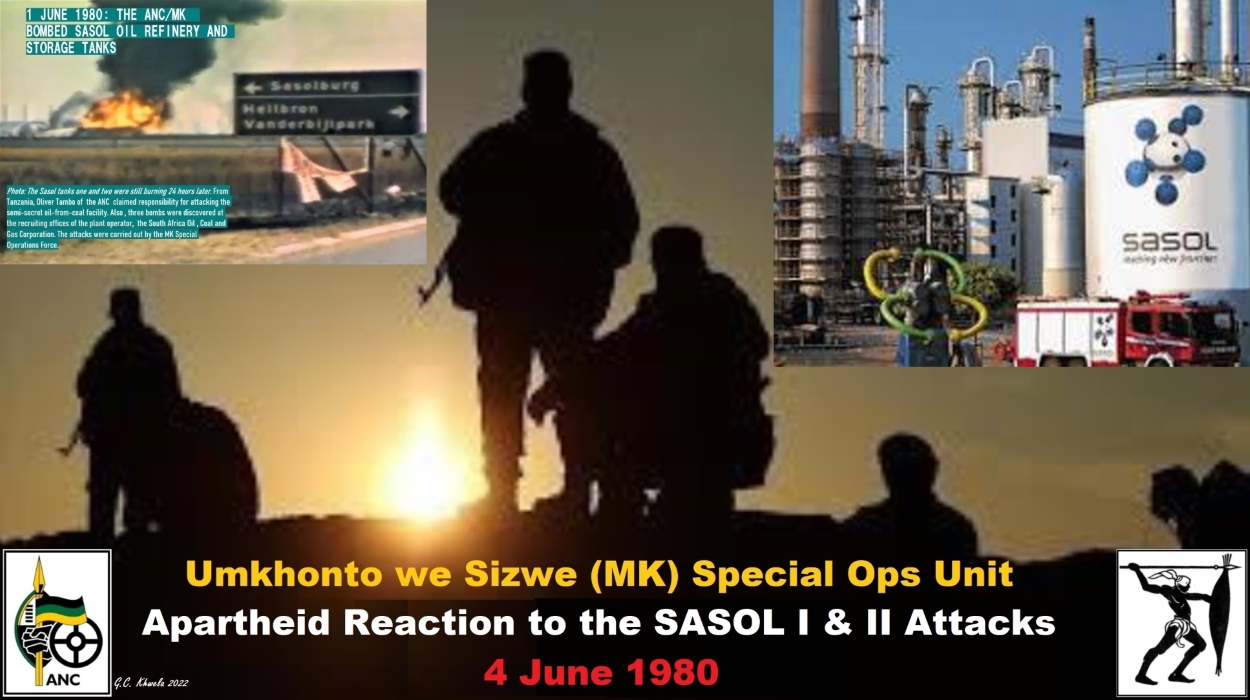
On 4 June 1980, African National Congress (ANC) leader Oliver Tambo’s predictions that the SASOL attack would herald an intensification of the regional conflict were realised. Tambo’s predictions were based on the damage that had been inflicted by the well-coordinated attack that cadres of Umkhonto we Sizwe’s (MK) crack Special Operations Unit had launched on the Sasol One and Two facilities, South Africa’s giant Coal, Oil and Gas Corporation, as well as Natref. For the rest of the week, fires blazed out of control, causing damage estimated at R70 million (or £45 million).
Speaking to a Reuters correspondent in Dar es Salaam on 3 June 1980, Tambo mentioned that he expected apartheid South Africa’s response to the SASOL attacks to be raids on neighbouring states, even though “there is no African country bordering on South Africa which can be said to have helped the ANC do what it is doing. … Unfortunately, no matter how little involved the countries neighbouring South Africa may be, South Africa will harass them”.
Indeed, on the same day that Tambo made his statement, Colonel J.J. Viktor of the Security Branch was telling Dirk Coetzee, an apartheid security policeman, based at Middleburg Police Station, to report to Major Nick van Rensburg in Ermelo. Van Rensburg told Coetzee, Warrant Officer Paul van Dyk, and Sergeants Krappies Hattingh and Chris Rorich that they had to blow up two targets in Swaziland, which included a new ANC transit house and a small wooden house that was occupied by Marwick Nkosi. According to Van Rensburg, Nkosi was involved in building false car panels with which the ANC smuggled arms and explosives into South Africa.
On 4 June 1980, at approximately 02:30 in the morning, Coetzee, Hatting, Rorich and Van Dyk returned to their car after planting a bomb at Marwick Nkosi’s house in Manzini. They drove for a short distance and stopped near a house opposite a block of flats, where Coetzee and Rorich carried explosives, consisting of a ball of dough that was wrapped around cordite, which was fixed to a detonator and timing device in a plastic carrier bag. Coetzee also brought a sandbag, which was placed on top of the carrier bag containing the explosive device. Both of them then took the cordite up a small embankment and across a neighbour’s lawn, close to the street, where they clipped the battery and made their way back to the car. They then drove the vehicle in the northern direction and stopped under a tree near Manzini jail, where they unpacked some beers and began drinking.
A few minutes later, between 03:00 and 03:15, a bright mushroom cloud shot out into the air, followed a second later by an enormous explosion. Mrs Valerie Hlubi was woken by the ceiling falling on top of her while she was sleeping in her bed. She fumbled in the dark to wake up a child that was sleeping in the house. When she got out of the house, she found a number of people walking about, confused. Blankets, sheets and clothing from the neighbouring house were scattered all over, and some were hanging from blown-up and twisted pieces of corrugated iron.
At the house next door, four people, Seiso, Ali, Percy and Wanda, were asleep at the time of the explosion. Wanda’s body was split in two, the lower torso remaining in the debris scattered at the property, the other half thrown into a neighbour’s house, while the others were seriously injured. The simultaneous explosion at Nkosi’s house reduced it to bits and pieces, killing a grandchild instantly while others were rushed to hospital. Nkosi’s daughter, who was one of the injured, was badly lacerated and the bones on her left arm and right leg were left completely without flesh. Nkosi himself was unharmed.
MK member Patrick Makau and a seven-year-old child, Patrick Nkosi, son of Mawick Nkosi, were killed in the bomb attacks. The two houses targeted were thought to be ANC transit facilities and it was believed that the Sasol squad had stayed in one of them. The bombs exploded within a minute of each other, causing extensive damage. In addition to the two killed, three other persons were hurt. One of these was a Swazi, Ms Eunice Dlamini, one of whose hands was mutilated and her hearing badly impaired. After several months of hospitalisation, she committed suicide by locking herself in her home, dousing herself with petrol and setting herself on fire.
Meanwhile, on the same day, Victor Khayiyane, Jack, Solly Mayona, Mochudi, David Moise, Barney Molokoane, Dick Mtimkulu, Lati Ntshekang, M.B. Salomane, Sipho Thobela and Faku Senzangakhona assembled at the headquarters of the Umkhonto we Sizwe (MK) Special Operations Unit in Matola, Mozambique, to report back to their leaders on how the squad’s virgin voyage into South Africa went. Aboobaker “Rashid” Ismail, Montso “Obadi” Mokgabudi and Joe Slovo – the three Commanders of the Unit, which was also known as the Solomon Mahlangu Unit – were present. After hearing all the reports, Slovo expressed his satisfaction with the results of the exercise viewed as a whole.
According to Aboobaker “Rashid” Ismail, “The SASOL operations marked a milestone in MK operations, as the enemy was unable to hide the success of the co-ordinated operations. The flames from the burning refineries could be seen from a long distance and burned for 3 days. The success of the operations can be ascribed to the leadership provided by Tambo and Slovo, the detailed and thorough planning of the Command and the ingenuity, commitment and indomitable will of the cadres based on the trust they had in the leadership and command of Special Operations.”
“The success of the operation”, Rashid declared, “was overwhelming in its armed propaganda value, achieving the objective of winning the support of the people, of showing that the enemy was not invincible. The ANC was able to call on the people for greater involvement in the struggle and spur them on to people’s power. One could sense a sea-change in the attitudes of ordinary people in the townships.”
Sources:
Wikipedia.
South African History Online (SAHO)
South African History Archives (SAHA).
Truth and Reconciliation Commission, “TRC Special Report, Volume 2, Chapter 2, The State outside South Africa between 1960 and 1990” Truth and Reconciliation Commission, 29 October 1998.
Aboobaker Ismail (Rashid), “The ANC’s Special Operations Unit”, The Thinker, Vol. 52, 2103.
Thula Simpson, “Umkhonto we Sizwe: The ANC’s Armed Struggle”, Penguin, 2016.
Peter Stiff, “The Silent War: South African Recce Operations, 1969 – 1994”, Galago, 1999.
Stephen R. Davis, “The ANC’s War against Apartheid: Umkhonto We Sizwe and the Liberation of South Africa”, Indiana University Press, 2018.
Castro Khwela
Good evening fellow Compatriots!
Discover more from CASTRO KHWELA
Subscribe to get the latest posts sent to your email.