Ruth Nhere
In South Africa
In South Africa, the discovery of diamonds and gold in the 1880s was to establish the region as a vital base of imperialist interests. “The transformation began in 1886 … By the end of the second gold boom of 1895 – 6, £57m had been invested in the Rand alone … South Africa for the first time became big business to the British and European merchant and investor …” – Robinson & Gallagher, Africa & the Victorians, 1978
British finance capital was thus confronted with a twofold task to secure imperialism’s treasure house in Africa. This meant putting an end to the heroic resistance of the African people as well as tackling the Boer Republics. The Act of the Union of 1910 signalled the completion of these objectives.
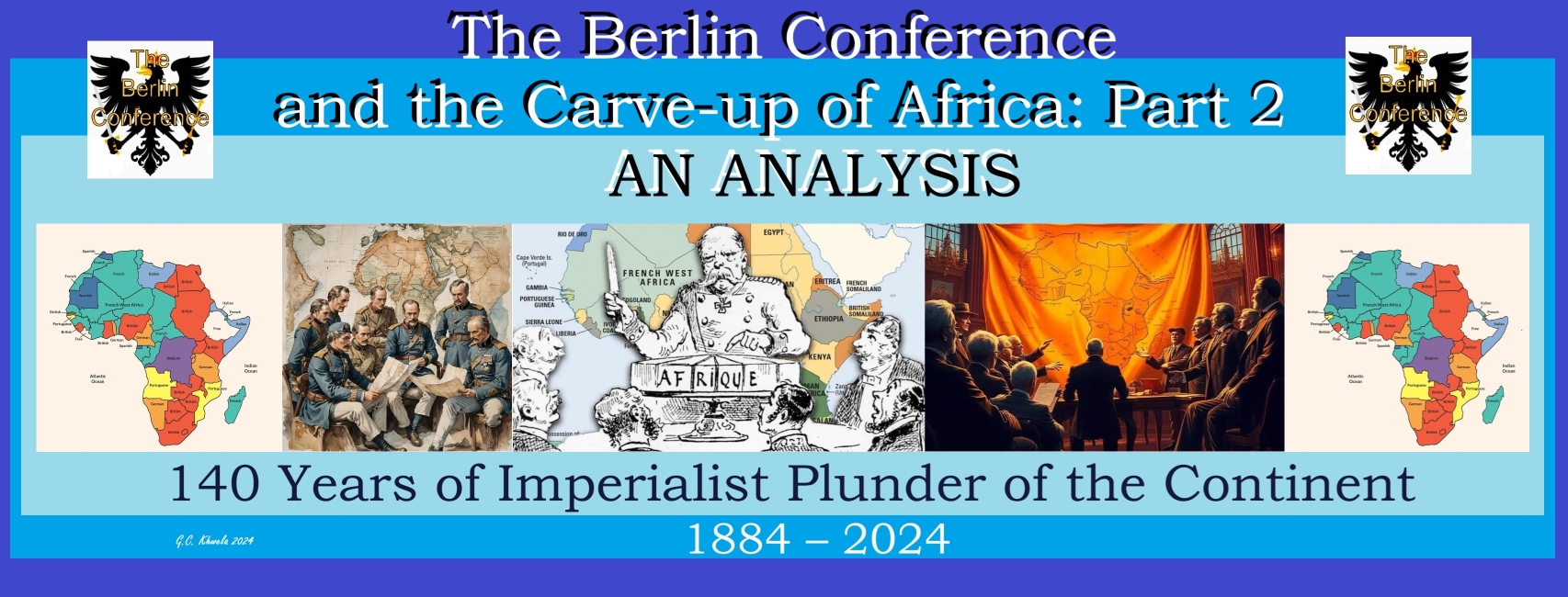
The wealth of the south was a spur to intensified inter-imperialist rivalry throughout the Continent. Aiming to consolidate their empires the ‘Great Powers’ indulged in the sending of expeditionary forces and involved themselves in all conceivable means of diplomatic warfare. At this stage their disputes took the form of wars of conquest against the independent African peoples.
The specific features of the socio-economic systems of the metropolitan powers gave different forms to their colonial administrations. Monopoly capitalism was to exert influence on African societies in far-reaching ways. The process, consolidated by the establishment of colonies, involved the subordination of entire economies to the interests and requirements of foreign capital. The arbitrary division of Africa into colonies was carried out with total disregard for the national and cultural traditions of the indigenous inhabitants. Despite the determined resistance of the African people against the colonial oppressors, the social fabric of African life was twisted and distorted to service the needs of international finance capital.
The imperialist offensive could only be countered by organisation on the part of the oppressed nations. Two processes were to have a decisive impact in fulfilling this need. First, the outbreak of the imperialist war in 11914 and secondly the October Revolution of 1917. Lenin characterised the war as a continuation of the politics of the ‘Great Powers’ in their bid to plunder and exploit the oppressed peoples.
“This is a war, firstly, to increase the enslavement of the colonies by means of a ‘more equitable’ distribution and subsequent more concerted exploitation of them …” Although the battles were fought in Europe, he underlined that “the imperialist war has drawn the dependent peoples into world history”. It did indeed prove an important political school for the African peoples.
It was in the wake of the war, with the victory of the Great October Socialist Revolution and the breaching of international imperialism, that Africa’s peoples were to derive the most significant inspiration for the uplifting of their national struggles. The October Revolution concretely revealed the solution of problems which were similar to those suffered by the colonised nations. It shattered the myth of the invincibility of the capitalists and landowners. It proved that dependence on the imperialist states could be broken. Through its decrees on peace and the rights of the peoples of Russia, the young Soviet state turned the Marxist-Leninist principle of the equality of nations and the right of nations to self-determination into law and applied them in practice.
The First World War had aggravated the contradictions between oppressor and oppressed and the post-war redivision of Africa only served to deepen these. Under the 1919 Treaty of Versailles, the mandate system was devised, and another form of colonial rule emerged whose substance lay in the distribution of mandates for “spoliation and plunder” (V.I. Lenin). Germany’s colonies were divided among the victorious powers. In the process, Britain gave her mandate on South West Africa to the Union of South Africa. The Namibian people were thus placed under the control of the white racist minority who already dominated the adjacent territory and its peoples.
While the end of the war led to the increased penetration of the monopolies into almost every aspect of economic life, it also saw the birth of Africa’s first working class vanguard parties. In the early 1920s, Communist Parties were formed in South Africa and Egypt, and later in Algeria, Tunisia, Morocco and Madagascar. This process was accompanied by the growth and spread of national liberation movements. Mass revolutionary actions took place in those countries with a higher degree of socio-economic development, particularly in northern and southern Africa. (To be continued … The Communist International)
Castro Khwela
Good evening fellow Compatriots!
Discover more from CASTRO KHWELA
Subscribe to get the latest posts sent to your email.