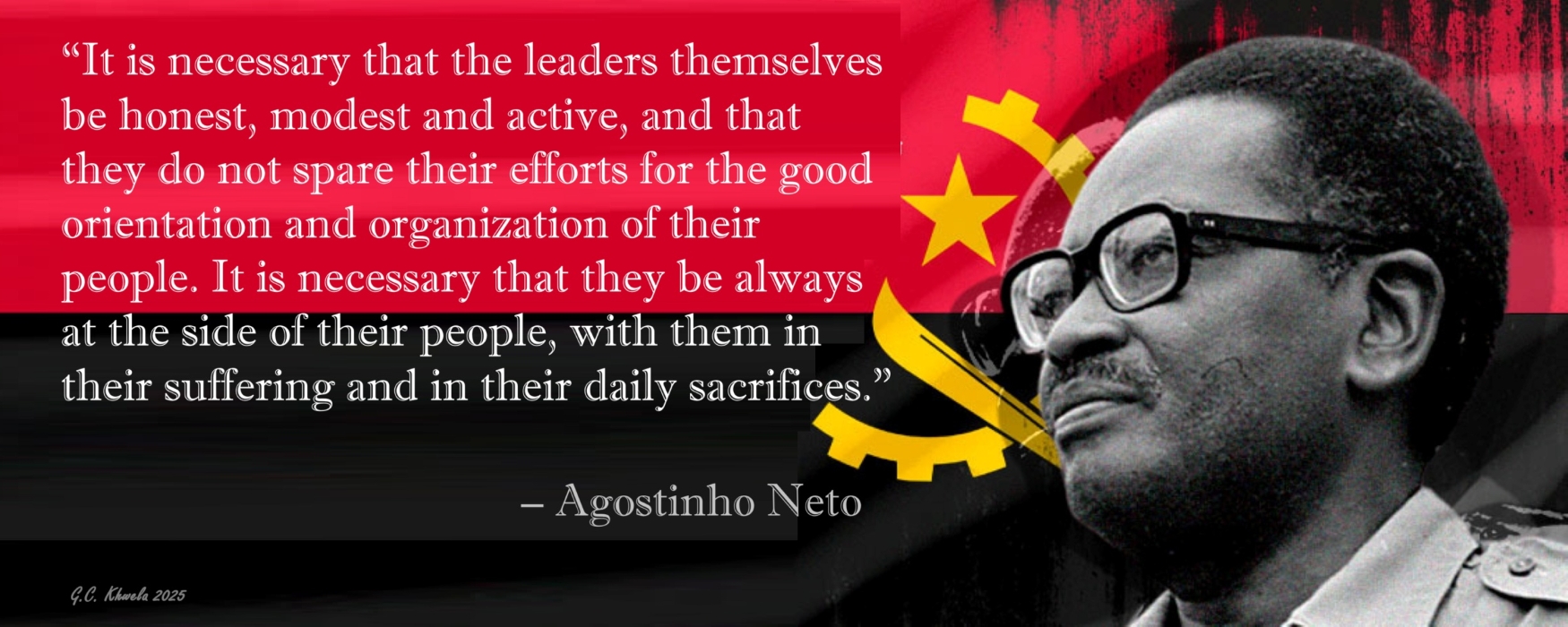
Antonio Agostinho Neto was one of the best and the more authoritative representatives of the “new wave” of African revolutionary democracy that came to power mainly in the mid-seventies. … This “new wave” of African revolutionary democrats went considerably further than their predecessors, the pioneers of national democracy of the sixties … in the scientific analysis of African society, of the objectives and stages of revolution and the arrangement of class forces, and in realising practical reforms. The conclusions which Neto drew from his own revolutionary experience and that of other revolutionaries represent one of the high points of political thought of the African national liberation movement of the seventies, and they deserve generalisation and analysis.
… Regarding armed struggle as the only means of opposing Portuguese colonialism, Neto and his colleagues in the People’s Movement for the Liberation of Angola (MPLA), and also in Mozambique Liberation Front (FRELIMO) and the African Party for the Independence of Guinea and Cape Verde (PAIGC), which headed the liberation movements in Mozambique and Guinea-Bissau, did not place absolute value on military action.
Neto understood the political nature of the war of liberation and the need for its political preparation and political leadership. He insisted on the organic combination of military and ideological, political, social and propagandist work. He stressed that the liberation movement should not enclose itself in insurgent activity but that, on the contrary, it should envelope all areas of national life and, indeed, this was the guarantee of the movement’s success.
The experience of Angola, Mozambique and Guinea-Bissau, as earlier that of Vietnam, has demonstrated the correctness of this approach as opposed to the erroneous, purely military approach which led to the defeat of a series of liberation movements in Latin America.
Dialectics are characteristic of Neto’s activity. He rejected cliched slogans, ideas and forms; in his consistent work for the complete political and social liberation of the Angolan working people he set specific tasks and always took into consideration the existing possibilities. He proceeded from the scientific idea of the stages of the revolutionary process.
Even at the beginning of the sixties Neto realised that national independence could not be ensured simply by overthrowing Portuguese colonial rule, and that it was necessary, as was noted in the documents of the MPLA, to show vigilance with regard to attempts by imperialist powers to replace the archaic Portuguese colonialism with more flexible forms of neocolonialism. Neto also advanced social tasks, demonstrating his desire to reform Angolan society, defend the interests of the workers and peasants and establish social justice under conditions of independence.
… Realising that the anti-imperialist, nationalist stage was a logical step in the development of the mass struggle of the peoples of colonial countries, they (Neto and his comrades) did not hurry to omit this stage or declare it passed or overcome, but they also firmly rejected absolute nationalism, narrow, egoistic and essentially bourgeois nationalism.
The MPLA and its leader, Neto, and their colleagues in Guinea-Bissau and Mozambique fighting against Portuguese colonialism … chose the correct, though long and difficult path of developing revolutionary, democratic, anti-imperialist nationalism, deepening its social content, gradually and continually weakening and forcing out exploitative elements … During the long years of struggle, this path made it possible for the MPLA to rally very broad sections of the population in order to fight colonialism.
– Extracted from R. A. Ulyanovsky, et. al. (1983) “Fighters for National Liberation: Political Profiles”, Progress, Moscow.
Inferences
The violent racist South African aggression suffered by the Angolan people on the eve of independence led to various theories that the only way the MPLA could safeguard the country’s existence would be for it to accept the dictates to collaborate with apartheid South Africa and international imperialism. At the time, the balance of power appeared to be favourable to imperialism, which in its calculations did not reckon with the determination of a leader who believed in his people and who did not fear the worst threats.
Completely assuming his role as the Commander of a country facing devastating aggression, Neto was able to lead the People’s Armed Forces for the Liberation of Angola (FAPLA) on the road to victory, using with particular sagacity the weaknesses of the racist enemy, and the reinforcement at the opportune moment of the internationalist Cuban Revolutionary Armed Forces. After the racist South African Defence Force (SADF) was driven out, with the country ravaged by war, speed was required to rapidly lay the foundations for a new economic development aimed at meeting the interests of the impoverished masses.
Unfortunately the country descended into a destructive civil war with the insurgent National Union for the Total Independence of Angola (UNITA), supported by the United States and apartheid South Africa; the militant National Liberation Front of Angola (FNLA), backed by Zaire; and the and a separatist movement, the Front for the Liberation of the Enclave of Cabinda (FLEC), seeking the independence of the Cabinda exclave, also backed by Zaire.
Until his death on 10 September 1979, Neto confronted an arduous task of running a country devastated by war without sufficient technical cadres to manage and administer all the state institutions and policies. The economy was in complete shambles with most of the nation’s wealth concentrated in a disproportionately small part of the population, as most Angolans had a low standard of living, life expectancy was among the lowest in the world, while infant mortality was among the highest.
Neto did not have the opportunity to see his vision of revolutionary democracy being implemented towards establishing a completely national democratic society in Angola.
Castro Khwela
Good morning fellow Compatriots!
Discover more from CASTRO KHWELA
Subscribe to get the latest posts sent to your email.