Wankie Campaign – Main Group Retreats to Botswana after Discontentment
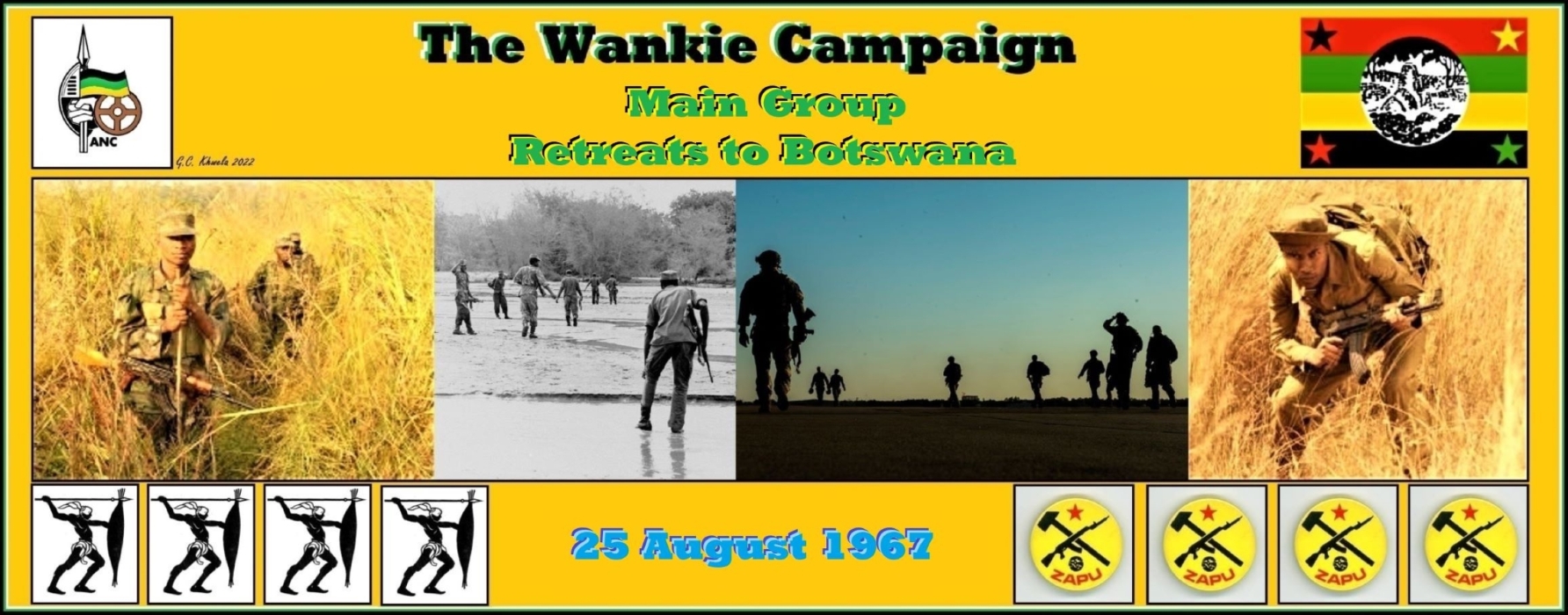
On 25 August 1967, having been marching for two days after leaving the donga, the Main Group, under the command of Mongameli Tshali (aka “Lennox Lagu” or “Mnqarwana” or “Mjojo”), began to experience grumblings within the rank-and-file. There were concerns about the disappearance without trace of the Team of Eight, including their Zimbabwe African People Revolutionary (ZIPRA) Commander and Umkhonto we Sizwe (MK) Commissar. The Group Commander, John Dube (aka “Sotsha Ngwenya”), and Commissar Chris Hani, who were part of the team of eight guerrillas, which went to get water to drink for the entire group were nowhere to be found.
In the afternoon, on 24 August 1967, while the Main Group were waiting for the Group Commander, John Dube, and the team of eight guerrillas, including the Group Commissar, Chris Hani, to return from getting water for the entire group, Shooter Makasi shouted that he had found water. He maintained to the Group that he found water while digging in the donga. Following the discovery of the water source, the rest of the group started drinking the water and filling their water bottles, while waiting for Dube and the others to return.
Meanwhile, the Dube-led group of eight also managed to find a water source on the bed of the Manzamnyama River. However, on their way back, they got lost. As they fired into the air about three times to confirm their location with the Main Group, as a prearranged signal, they got no response. The arrangement was that the Main Group would fire in the air in response, to enable the two groups to find each other. Consequently, Dube and the group of eight spent the night walking in the bush, trying to find their comrades, as they had lost track of where they came from.
In the Main Group, panic was beginning to settle in, as the Acting Commander of the Group, Mongameli Tshali (aka Lennox Lagu or “Mjojo”), ordered Peter Sithole to fire three-times in the air, hoping for a response from the Dube-led Team. Following Sithole’s futile efforts, the Main Group decided to move to another position for security reasons, while they left the weapons and ammunition that was taken from the enemy as well as the haversacks belonging to the Dube-led Team in the grass alongside the donga.
When they were about to leave, Leonard Nkosi, who belonged to the Group’s headquarters, requested Peter Mfene to surrender a watch seized from a Rhodesian soldier to the headquarters, since the one they used previously had left with Chris Hani. For the benefit of the Group, Mfene surrendered the watch to Nkosi.
Close to an hour of marching, Theophilus Mkhaliphi (aka “Victor Dhlamini”) began asking for Daluxolo Luthuli (aka “Can Can”) to relieve him of the Group’s Light Machine Gun (LMG) he had been carrying all along. As the Group paused to look for Luthuli, they found that he was missing, and Tshali sent a team back to the donga to look for him. When they returned, they mentioned that they could not find him, and it was resolved that the Group should find a suitable spot to rest. As they were being deployed into their various positions, according to the different sections, it was realised that Thula Bophela and Leonard Nkosi were also missing.
Later on, it was established that Daluxolo Luthuli had abandoned the Group and was, after some months, arrested in Messina. He was handed over to the apartheid Security Branch and was later sentenced to Robben Island for ten years. Disillusioned with the ANC, after his release from prison, Luthuli joined Chief Mangosuthu Gatsha Buthelezi’s Inkatha KwaZulu Bantustan party. He had left with Thula Bophela to Salisbury, where Bophela had relatives. Along with Leonard Nkosi, they had become separated from the Main Group on 24 August 1967 and went underground in Rhodesia for about eight months.
The intention of the three was to head east and return to South Africa by signing on with Wenela, the Witwatersrand Native Labour Association (WNLA), an agency that recruited workers for the mines. But as the trio moved further east, and when asked by local inhabitants what they were doing in the area, they claimed to be conducting research for a university project. They then unwittingly accepted a lift from a security policeman, who managed to apprehend Bophela, as he was wearing the wristwatch that had belonged to Lieutenant Smith, one of the white casualties of the Wankie campaign.
Bophela was later sentenced to death for Smith’s murder, which was later commuted to life imprisonment, and was released in 1980 following Zimbabwe’s independence. Leonard Nkosi and Daluxolo Luthuli avoided arrest until Luthuli was captured in Messina. Luthuli was one of the youngest recruits to join the Luthuli Detachment of MK. While others his age had opted and were encouraged to continue on with their education in exile with the aid of the ANC, Luthuli insisted upon military training. Despite the fact that Luthuli was just a young boy in the eyes of the rest of MK, he proved himself by becoming the best shot within Umkhonto ranks. He constantly practiced his musketry during his free time and “his shooting skills became legendary in MK”.
Only one of the three guerrillas, Leonard Nkosi (aka “Derek”), actually reached South Africa undetected. Returning to his home in Durban, Natal, he ostensibly handed himself over to the South African security forces after arriving home to learn that his father had been sentenced to imprisonment on Robben Island, and that his mother was living in abject poverty. Some say he was betrayed, tortured and forced to turn against the ANC, as an “askari”, acting as a prosecution witness in several trials and eventually joined the Security Branch.
For instance, Daluxolo Luthuli claimed that it was Nkosi who assisted in his December 1967 arrest in a sting operation in Messina. Nkosi subsequently testified against him, and Luthuli was sentenced to serve ten years in Robben Island. Nkosi also testified for the apartheid state against other members of the Luthuli Detachment, including Mr James April, who was tried in the Pietermaritzburg Supreme Court.
A member of the Security Branch intelligence unit, Mr Jan Daniel Potgieter, in his application for amnesty, stated that Nkosi had been compelled to turn state witness against his former comrades. On 9 September 1977, shortly after testifying against Harry Gwala and nine others in the 1976–77 treason trial in Pietermaritzburg, (The “Pietermaritzburg Ten” Trial), Nkosi was assassinated. Security Branch amnesty applicants told the Commission that Nkosi was shot dead and his wife injured with a single shot from a Tokarev pistol. ANC member Reverend Stanley Msibi (aka “Blackman”, now deceased) was implicated in Nkosi’s death. The ANC claimed responsibility for the assassination in its second submission to the Commission.
Meanwhile, on the morning of 25 August 1967, after separating from the main group the previous day, the party of eight also separated. What actually happened was that they arrived at Choloza village and took cover at a spot near the Manzamnyama and Thekwane River confluence, as they noticed helicopters hovering above. They then spent the whole day under cover until after sunset, when Dube took Chris Hani, Jackson Mandla and Alfred “Willie” Mfamana to locate a nearby village and find some food, leaving behind James April, Khanja Mlonzi, Graham Morodi and Edward Moyo.
Around midnight, seeing that the four, led by Commander Dube, were not returning, those who were left behind (April, Mlonzi, Morodi and Moyo), began to argue over whether to wait or leave. Ultimately they agreed to depart from their position. According to James April, Hani’s disappearance left the four men distraught over the absence of their noble leader, as they started to suspect that the four were “gone for good”.
James April chastened the others for doubting Hani, but eventually, they gave up hope and moved on. They began following the stars, until they arrived at the Rhodesia-Botswana border the next morning. During the early hours of the morningthey crossed the border, and they got arrested by the Botswana police when they went to a house near the border to request for some milk. Later on, a truck full of Botswana police officers arrived and took them away.
The same morning, on 26 August 1967, within the Main Group led by Acting Commander Tshali, a lot of rumour mongering was taking place: that their commanders were cowards, as they were running away from the Boers, leaving their troops to starve and die of hunger. Subsequently, the remaining commanders arranged an emergency meeting, where they decided that the Main Group should reverse course and head West towards Botswana.
After the successful battles on 22 to 23 August 1967, the guerrilla unit was running low on ammunition. Resupply from Lusaka was out of the question, and fearing that the Rhodesians would return with an even larger force, they decided to cross the border into northern Botswana after burying their dead. The intention was to retreat to strategic parts of Botswana, to refresh, heal those who were ill or wounded, acquire food supplies and then proceed with the original objective. Tshali mentioned they had never intended making their way to Botswana, but it just happened that they found themselves closer to the border.
What was common among the various challenges of the final days of the Wankie campaign was that cadres were being lost in a harsh and undifferentiated wilderness. A few days after the last battle, on 23 August 1967, a number of men fell behind, and the Main Group split into two groups, with eight being sent to look for food and water, while the remainder waited in a dry donga for their return. The group sent out for food and water tried to mark their path by breaking twigs and counting stones. But when they became lost, they fired shots in the air to communicate with the Main Group only to receive no response. The difficulties caused by the landscape had a serious effect on morale.
Following the last battle of 23 August 1967, the Rhodesian African Rifles (RAR) did not continue with the fight, they instead used the lull to collect their dead. After emerging victorious from the two battles, Hani believed that the guerrilla formations would be taken seriously, as this was the first time the RAR, which was used to facing weak and poorly organised resistance, had suffered defeat. The Commanding Officer of the elite Selous Scouts, Major-General Ron Reid-Daly, described the encounters with the guerrillas as “assuming the proportions of a military disaster”. The Rhodesian troops had become demoralised, needed assistance and called in reinforcements from their willing apartheid neighbour to the south.
Unfortunately, the guerrilla forces struggling with supplies and the lack of water weighing on their physical condition, the men were unable to complete the march south. As such, being led by Dube, the remaining members of the Main Group made their way towards the Botswana border. The decision to move to Botswana was informed by the combination of a depleted supply line, the build-up of enemy reinforcement and the knowledge that the terrain ahead was even more barren and waterless. They then decided it would be futile to continue fighting and deliberately took a decision to retreat.
This was no surrender, nor a capitulation to the feeble paramilitary units of the Botswana government, but because Botswana was a member of the Organisation of African Unity (OAU), and was committed to the liberation of South Africa, it was a correct decision that the guerrillas were not going to fight them. When the Botswana authorities met with the scattered guerrilla teams, they were conciliatory and friendly. Regrettably, the guerrillas discovered that the Botswana authorities were commanded by white officers from Britain and South Africa, where they were manacled, handcuffed and abused.
Recalling the deliberate move to Botswana Justice “Gizenga” Mpanza (aka “Comrade Kulak”), maintained that, “It was now very bad … we had to move out of the area quickly, because helicopters were searching for us. We were on the road for three days and nights, moving towards Botswana’s border. When we found a small settlement, the men went to buy food for us, and they slaughtered a sheep. They already knew that we had beaten the boers, and warned us that there would be little room for us to manoeuvre, because we were heading for the Botswana border. They showed us the way – they acted as our guides.”
“They could not stop praising us”, Gizenga Mpanza stated delightedly. Disappointingly, however, “We were now in Botswana, only to find out the authorities were waiting for us. We scattered, split and spread in different directions. I found myself running alone in a forest. Others were arrested. I stayed put for two days in the forest before deciding to proceed with my journey, knowing that I was in Botswana and I had my gun with me. I came across a plantation and decided to go inside. But while I was inside, I saw people pointing guns at me. Then I was taken away … I was then taken to a camp where the others were kept. They were also arrested … But after a few days we were all taken to Francistown.”
Cletus Mzimela maintained that in the ensuing confusion of losing the two leading members, the Commander and the Commissar of the Main Group, fighters dispersed in different directions. He and a few others marched for several days without food and water, observing helicopters and spotter planes flying a long distance away from their positions. The ZIPRA fighters with them decided to stay near an unidentified village and the six Umkhonto we Sizwe members marched on. They had no compass and were not at all sure what direction they were moving in.”
Sources:
SAHA, “ZAPU: Through Zenzo Nkobi’s Lens: Regional Alliances”, South African History Archive (SAHA), 2025.
Dumiso Dabengwa, “The 1967 Wankie and 1968 Sipolilo Campaigns: The Impeccable ZAPU and ANC Alliance in Retrospect”, The Thinker, Vol. 80, 2019.
African National Congress, “Statement to the Truth and Reconciliation Commission”, August 1996.
African National Congress, “Further Submissions and Responses by the African National Congress to Questions Raised by the Commission for Truth and Reconciliation”, 12 May 1997.
Luli Callinicos, “Oliver Tambo and the Dilemma of the Camp Mutinies in Angola in the Eighties,” South African Historical Journal, Vol. 64, No. 3, 2012.
Hugh Macmillan, “The African National Congress of South Africa in Zambia: The Culture of Exile and the Changing Relationship with Home, 1964–1990”, Journal of Southern African Studies, Vol. 35, No. 2, 2009.
Nicole (Nicky) Martina Van Driel, “The ANC’s First Armed Military Operation: The Luthuli Detachment and the Wankie Campaign, July-September 1967”, Master of Arts: University of the Western Cape, June 2003.
Thula Simpson, “Umkhonto we Sizwe: The ANC’s Armed Struggle”, Penguin, 2016.
Stephen Ellis, “External Mission: The ANC in Exile, 1960–1990”, Oxford University, 2013.
Janet Smith and Beauregard Tromp, “Hani: A Life Too Short”, Jonathan Ball, 2009.
Stephen Davis, “The ANC’s War Against Apartheid: Umkhonto we Sizwe and the Liberation of South Africa”, Indiana University, 2018.
Hugh Macmillan, “The Lusaka Years: The ANC in Exile, 1963 to 1994”, Jacana, 2013.
Castro Khwela
Good evening fellow Compatriots!
Discover more from CASTRO KHWELA
Subscribe to get the latest posts sent to your email.