
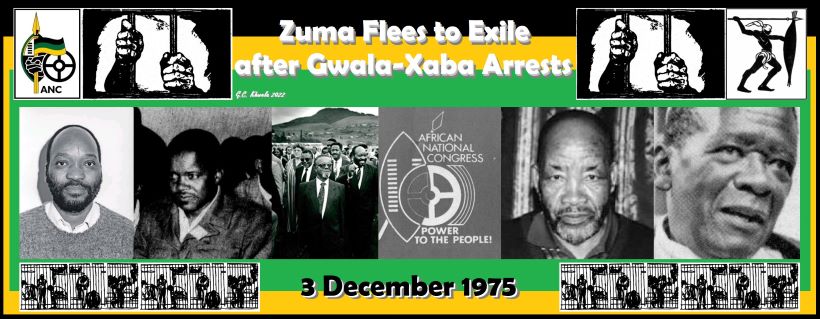
On 3 December 1975, Jacob Gedleyihlekisa Zuma left the country to Swaziland in order to escape the wave of arrests following the interception of a group of African National Congress (ANC) recruits on the border in November, the same year.
Zuma left Robben Island on 29 December 1973, after being arrested as part of a group that was on their way to exile in June 1963, resulting in him being sentenced to ten years. After leaving the Island, he was kept in Pietermaritzburg’s police cells for another two weeks and was finally released to his hometown of iNkandla.
A Durban attorney found work for him in a pet shop in the city, while Zuma resumed his political activities behind the scenes. He played a key role in re-establishing underground ANC structures and aided in organising a massive strike of 160 000 workers in the city.
Zuma worked closely with the South African Communist Party’s (SACP’s) Harry Gwala to send young MK recruits out of the country for military training through Mozambique, from where they later returned with weapons and instructions from leaders in exile.
Zuma had married Gertrude (MaKhumalo) in 1973 but was soon gone from her again by 1975 after Gwala’s arrest. Within the underground structures in Natal, Zuma operated alongside Harry Gwala, William Khanyile, Russel Maphanga, Bhekisisa Nxasane and Anton Xaba, mainly South African Congress of Trade Unions (SACTU) and SACP operatives, as well as underground cadres of Umkhonto we Sizwe (MK).
The month before Zuma left the country, in the early hours of Sunday morning, at around 02:30, on 30 November 1975, Anton Xaba (aka “Mfenendala”) was woken up by six apartheid Security Branch members, five of whom were White and one was Black. On their way to the police station, Warrant Officer Lamprecht informed Xaba that the police had intercepted a group of whom they shot two and captured four. One of the arrestees admitted that Xaba was responsible for arranging for him to exit the country to receive military training.
With the channel to Swaziland being established, following the liberation of Mozambique from Portuguese colonialism, the recruitment of a new generation of MK cadres to be sent abroad for military training commenced in earnest. The arrest of Xaba, was followed by other arrests, including inter alia Harry Gwala, John Nene, Azaria Ndebele, Matthews Meyiwa, Zakhele Mdlalose and Truman Magubane.
In October 1975, Harry Gwala was visited by Peter and Sylvia Gamedze, who were carrying a bag containing pamphlets and stacked bundles of R10 notes. Gwala asked Peter Gamedze about possible routes into Swaziland without a passport. Gamedze then advised Gwala about several ways, including Mahamba, in an area near Nhlangano in Swaziland, where people went over the Swaziland-South Africa border fence all the time.
When Peter Gamedze returned to Swaziland on 6 November 1975, he handed over a letter and a bag that Gwala had asked him to convey to Stanley Mabizela, the ANC Representative in the Kingdom. According to the arrangements then, Gamedze was to receive the “parcels” (recruits) sent by Gwala to Swaziland, and these were to be forwarded to Albert Dhlomo for processing to Mozambique.
Arrangements were again made by Harry Gwala and Anton Xaba to have the boys transported to Swaziland on 13 November 1975. The boys were made to sleep at Machibise, Edendale, near Pietermaritzburg, on 12 November 1975. Just before dawn on the following day, Xaba told the new recruits, Mandla Sikhosana, Madi Ntombela, Ntu Khumalo, Edgar Zondi and Philemon Mokoena, that it was time for them to leave.
Leaving Xaba behind, they travelled in a car driven by Alson Nzama (aka “Mdubane”) to the border and they got to a place with a gate leading across the border into Swaziland, but could not find the couriers who were supposed to receive them. The group had to return to Pietermaritzburg and another fruitful trip was arranged the following morning, as they managed to skip the border into Swaziland.
Meanwhile, Zuma’s began his new life in Swaziland, where he met Thabo Mbeki, who introduced him to the ANC structures in exile. Actually, Zuma had gone to Swaziland to complain to the leadership about the carelessness of his Swaziland-based counterparts, whom he thought needed to be cautioned about tightening underground procedures.
However, when it was discovered that over fifty underground activists had been arrested in the Natal underground machinery, Zuma was persuaded by Albert Dhlomo to stay in Swaziland until he had met with Thabo Mbeki. What was meant to be a weekend mission in Swaziland became the beginning of his 24 years of life in exile.
Castro Khwela
Good day fellow Compatriots!
Discover more from CASTRO KHWELA
Subscribe to get the latest posts sent to your email.
Thank you for the inspiring history of our difficult struggle. Such history requires sharing with all the younger generation to assert new values and patriotism for one’s country. It also helps healing old wounds when one understands the selflessness of past and current leaders who had undying love for their people.
I like to learn.about my former President