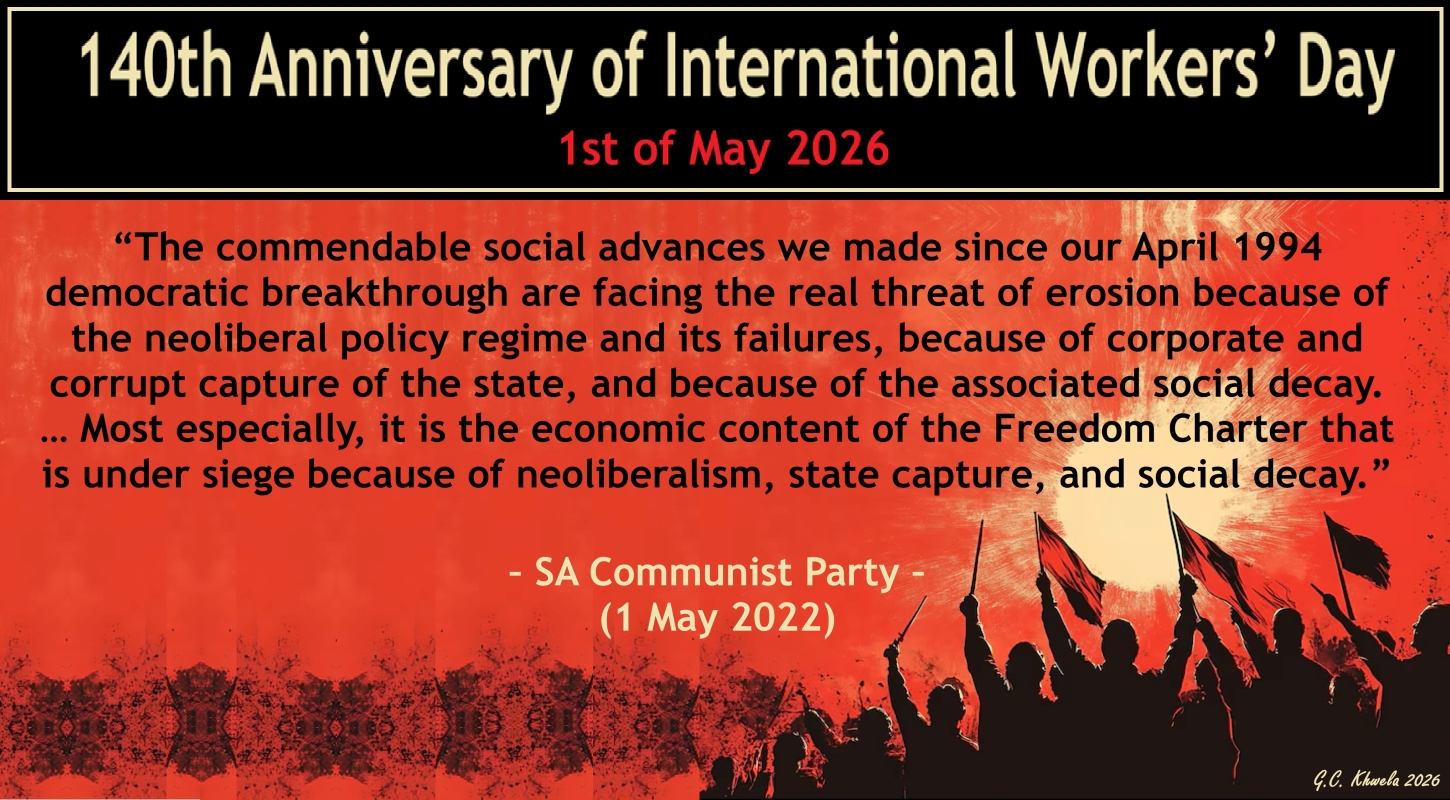
140th Anniversary of International Workers’ Day
The 1st of May 2026 marks the 140th anniversary of International Workers’ Day, commemorating the historic labour struggles in Chicago that began in 1886 to secure the eight-hour workday. This milestone is being observed globally through rallies, parades, and reflections on the legacy of the labour movement and the ongoing fight for workers’ rights. The date honours the events of 1 May 1886, when workers in the United States began a massive strike for an eight-hour work day. It has since become a global symbol of the struggle against exploitation and a celebration of the working class’s achievements.
Labor unions and international organisations are using this anniversary to reaffirm the importance of fair labour practices and collective bargaining. Trade unions like the Congress of South African Trade Unions (COSATU) have organised rallies across all nine provinces to celebrate the occasion, highlighting both historical victories and current challenges. In various regions, including parts of Asia, parades and cultural events have been held to honour the martyrs and pioneers of the labour movement.
This 140th anniversary serves as a reminder of the sacrifices made by previous generations to establish the standards and rights that many workers enjoy today. 1 May 2026 is a landmark milestone that bridges over a century of labour history with modern workplace challenges. It marks 140 years since the 1886 Haymarket Affair in Chicago, the event that catalysed the global movement for the eight-hour workday, where workers demanded “eight hours for work, eight hours for rest, and eight hours for what we will”. Since being formally established as an international holiday in 1889, it has served as a global symbol of the struggle against exploitation and the achievements of the working class.
In 2026, the anniversary is being used as a platform to address evolving 21st Century labour issues. Major themes this year focus on protecting workers’ rights in the age of Artificial Intelligence (AI) and digitalisation, ensuring that automation does not lead to increased labour intensity or precarious employment. Moreover, international labour bodies are highlighting psychosocial risks at work – such as burnout, anxiety, and long hours – as critical modern occupational health hazards.
Key Commemorative Themes for 2026 include “Innovation and Creativity, Enhancing Labor Productivity”, which is a central theme in several regions (notably Vietnam) that links traditional labour values with modern economic goals. Secondly, the working class globally is saying “Our lives and our needs or their profits!” This is a more militant slogan adopted by organisations like the World Federation of Trade Unions (WFTU) to protest inflation, job insecurity, and the restriction of democratic freedoms.
The world communist and class-oriented trade union movement views the 140th anniversary not merely as a celebration, but as a “milestone of struggle” and a call for a global “counteroffensive” against capitalist systems. Communist and socialist organisations and movements use this anniversary to condemn what they describe as the “hypocrisy and inhuman nature of imperialism”.
They argue that 140 years after the Chicago strikes, workers still face austerity and inflation, with escalating prices that erode real income while corporations report record profits; as well as militarisation, where governments are prioritising massive military spending and “war economies” over social needs and welfare. A modern priority for the global working-class movement is the impact of Artificial Intelligence (AI) and digitalisation. They view these technologies as being used to intensify labour and monitor workers more strictly; expand precarious, flexible employment through digital platforms; and to deregulate labour relations to the detriment of workers’ security.
Under the 2026 slogan “Our lives and our needs or their profits!”, the movement has issued several non-negotiable demands, which include the reduction of working time, a global push for a 35-hour work week (7 hours per day) without any reduction in pay; public and free access to universal healthcare, education, and social security; and the right to organise, which involves a fierce opposition to the “criminalisation of strikes” and the persecution of trade unionists.
The 140th anniversary emphasises that the “success of the struggle is linked to the struggles of workers in other countries”. This includes solidarity with specific struggles, such as vocal support for the people of Palestine, Lebanon, Cuba and Venezuela against imperialist interventions; calls for the dismantling of NATO, which is blamed for fuelling global conflicts, specifically in Ukraine; and protection for migrants, particularly equal rights for migrant workers and refugees who are often targeted as cheap, exploitable labour. For the world communist movement, the First of May is “not a day of celebration but of revolutionary struggle”, to take back control of the working class’s destiny.
The South African Communist Party (SACP) views the 140th anniversary of International Workers’ Day as a critical turning point for the South African working class, marked by a historic shift in its political strategy and a militant stance against economic hardship. In South Africa, the 140th anniversary coincides with the 30th anniversary of the Constitution, highlighting the historical role of trade unions in both the labour struggle and the fight against apartheid.
The most significant aspect of the SACP’s perspective in 2026 is its decision to contest the upcoming 2026 local government elections independently. This marks a departure from its historical practice of contesting only as part of the ANC-led Tripartite Alliance. The SACP has expressed frustration at feeling like a “convenient electoral asset” for the ANC, arguing that working-class interests have been sidelined by neoliberal policies and the “jobs bloodbath” currently affecting the economy. In the days leading up to May Day 2026, the SACP explicitly told its members to ignore ANC ultimatums regarding dual membership, thus asserting its independence.
In its official 2026 communications, the SACP highlighted several urgent priorities, which included Resistance to “Neo-liberal Austerity”. The party is calling for a unified front against budget cuts in public services, particularly education and health, which it terms as a “pervasive neoliberal agenda” dominating the state. Furthermore, the central demand remains the radical reconfiguration of the economy to benefit the working class, including resolving the “land question” and ending “slave wages” that persist 32 years into democracy.
The SACP has integrated the struggle for women’s emancipation into its May Day perspective, pledging solidarity against the “grave crisis of gender-based violence” in South Africa. The Party continues to participate through mass mobilisation in nationwide rallies alongside its alliance partner COSATU, with major events held at venues like the Old Peter Mokaba Stadium in Polokwane.
In maintaining its revolutionary legacy, the party is focussing on using the 140th anniversary to honour prominent heroes of the working class, linking today’s struggles to the historic fight against apartheid and capitalist exploitation. The SACP’s message for May Day 2026 is summarised by its call for a “fighting, militant Alliance” that prioritises people’s power over “monopoly capital”.
For the youth movements, the 140th anniversary of International Workers’ Day in 2026 is less of a history lesson and more of a strategic roadmap. It serves as a reminder that the rights they currently navigate – and the ones they still lack – are products of collective disruption. The youth should learn the power of the “unthinkable” that the 8-hour workday was once considered a radical, impossible dream in 1886. The lesson is that current “impossible” demands – such as the Universal Basic Income, the abolition of student debt, or a 32-hour work week – are achievable through sustained mass organisation.
The 140th anniversary highlights that modern “gig economy” jobs, such as Uber, delivery apps and freelance platforms, are often just 19th-century labour conditions with a digital veneer. The youth must learn to guard against “gig” exploitation and to organise outside of traditional factory settings. Youth should expect to be the primary targets of “labour flexibility”. The 140th anniversary should serve as a call to resist the normalisation of unpaid internships and precarious contracts that delay adulthood and financial independence.
The Women’s movement should learn from the historical “Triple Oppression” theory of race, class, and gender, particularly that the 140th anniversary should reinforce the perspective that women’s liberation is impossible without economic autonomy. A key takeaway is the ongoing struggle to recognise unpaid care work, such as housework and childcare as labour. The anniversary is a platform to demand that workers’ rights include protections for those who perform the labour that sustains the workforce. Women should expect a push for “Equal Pay for Work of Equal Value”. Despite 140 years of progress, the gender pay-gap remains a global reality. 1 May 2026 should focus on “Social Reproduction” – demanding that the state and employers provide childcare and maternal health as a right, not a luxury.
Both youth and women’s movements must learn that isolation is a weakness. The SACP and COSATU’s 2026 stance emphasises that the youth, women, and the traditional working class must form a “United Front”. If the youth movement ignores labour rights, it remains a “protest” rather than a “power” movement. In the current world demand for Climate Justice, in which the “Just Transition” is a central theme, this should be accompanied by Labor Justice. In 2026, both youth and women’s movements should learn that the fight for a green planet must include a guarantee of “green jobs” that are unionised and well-paid, ensuring the youth are not inheriting a dying planet with no means to live on it.
What should be expected in 2026 is a much more militant atmosphere. The year 2026 should be expected to be more confrontational than previous years. With the SACP contesting elections independently in South Africa and global inflation rising largely because of imperialist war of aggression in the Middle East, the 140th anniversary will likely see a shift from “celebratory parades” to direct action and strikes. For South African youth and women specifically, they should expect to be at the centre of such action, since the current challenges are impacting on them directly, and they should not allow to inherit a world that is devoid of liberty and peace.
Sources:
Wikipedia.
South African History Online (SAHO)
Polity.org.za
Castro Khwela
Good morning fellow Compatriots!🙏🏾✊🏾👊🏾
Discover more from CASTRO KHWELA
Subscribe to get the latest posts sent to your email.