The SACP Electing for Training Abroad, the ANC Debating the Armed Option
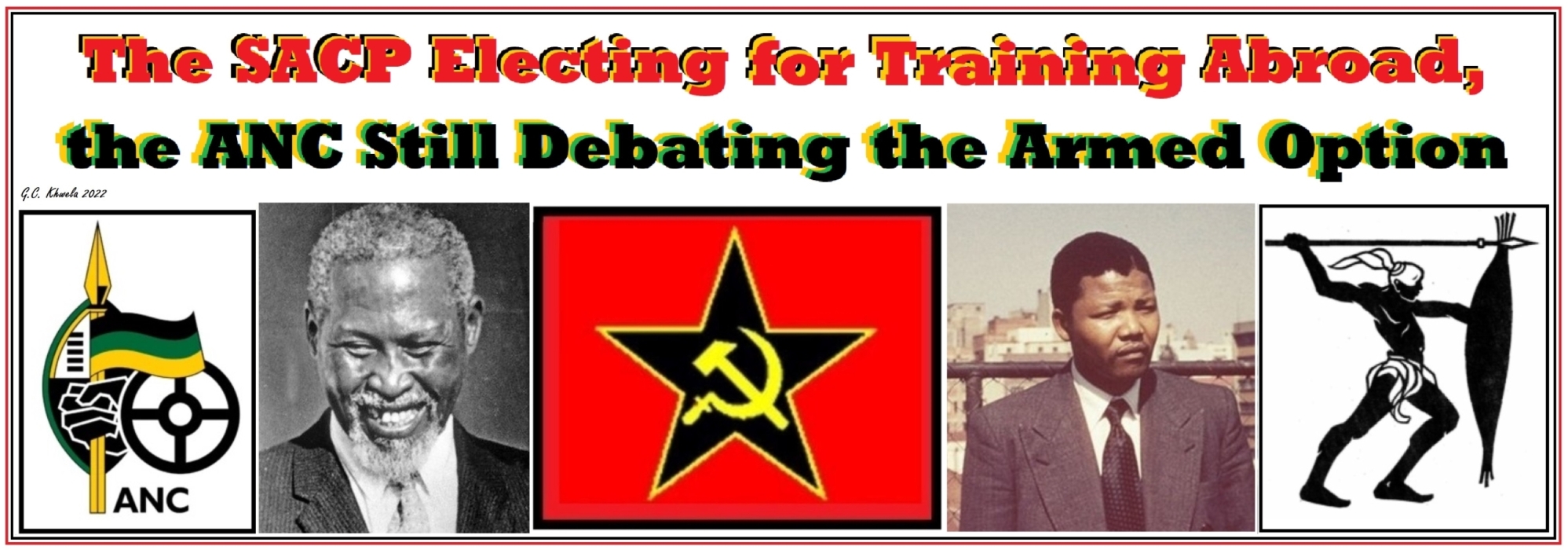
On 1 July 1961, Tennyson Makiwane was conversing with Wilton Mkwayi and Moses Mabhida about the South African Communist Party’s (SACP) December 1960 decision to take steps to initiate the training and equipping of selected personnel in new methods of struggle and thus prepare the nucleus of an adequate apparatus to lead struggles of a more forcible and violent nature.
Accordingly, Mabhida and Mkwayi were to be sent to Prague, Czechoslovakia, for military training during the latter part of the year. One of them would have to undergo preparation in Tanganyika, and the Party had decided that Mkwayi was going to go first to receive training. Furthermore, Makiwane informed them that somebody from London was going to join them for the training.
On the same day, the SACP’s representative in Europe, Vella Pillay, who was based in London, approached Nandha Naidoo about the request for somebody to be sent to study radio technology and communication, thus be able to train others. According to Pillay, the course was intended to take three months, perhaps longer if needs be. Mac Maharaj was also going to undertake military training in East Germany while at the same time studying printing. When Naidoo agreed to be involved, Pillay told him that he was supposed to travel to Prague, where he was to meet Moses Mabhida and Milton Mkwayi, who would be in the Atlantic Hotel.
Meanwhile, on the same night, the ANC’s (African National Congress’s) National Executive Committee (NEC) held a meeting in Groutville, near Stanger in Natal. During the meeting, ANC President Albert Luthuli criticised Nelson Mandela’s statement to the Rand Daily Mail newspaper on 29 May 1961 that the ANC was closing a chapter on a phase of the struggle. According to Luthuli, the statement raised an important matter that should have been discussed by the organisation before a public announcement could be made.
Mandela acknowledged the validity of the criticism but reiterated the basic point that a turn was necessary, since the state had left them with no alternative to violence. For Mandela, it was wrong and immoral to subject the people to armed attacks by the state without offering them some kind of alternative. Some people had taken up arms on their own initiative, hence violence would occur whether the ANC adopted armed struggle or not. Mandela argued that would it not be better for the ANC to guide the violence itself, according to principles whereby it would save lives by attacking symbols of oppression, rather than people? If the ANC failed to lead at this stage, it would be a latecomer to a process that it would be unable to control.
Luthuli initially opposed Mandela’s argument, since for him non-violence was not simply a tactic, but a way of life. However, the champions of the armed struggle worked on him the whole night, and he ultimately realised that they were correct, and agreed that a military campaign was inevitable. When someone made a comment that perhaps the Chief was not prepared for such a course, Luthuli retorted, “If anyone thinks I’m a pacifist, let him try to take my chickens, and he will know how wrong he is!”
Finally, the advocates of the turn to violence pressed their point and eventually the National Executive Committee endorsed the Working Committee’s preliminary decision. The Chief and others suggested that this new resolution should be treated as if the ANC had not discussed it, in order not to jeopardise the legality of its unbanned allies. For the Chief, the military movement was supposed to be a separate and independent organ, linked to the ANC and under the overall control of the ANC, but fundamentally autonomous.
According to Chief Luthuli, there would be two separate streams of the struggle, and this was readily accepted. He also warned against the new phase becoming an excuse for neglecting the essential task of organisation and the traditional methods of struggle, which it was accepted that it would be self-defeating because the armed struggle, at least in the beginning, would not be the centrepiece of the Movement.
Sources:
Nelson Mandela, “Long Walk to Freedom”, Abacus, 1994.
Thula Simpson, “Umkhonto we Sizwe: The ANC’s Armed Struggle”, Penguin, 2016.
Paul S. Landau, “Spear: Mandela and the Revolutionaries”, Jacana, 2022.
Stephen Ellis, “External Mission: The ANC in Exile”, Jonathan Ball, 2012.
Castro Khwela
Good evening fellow Compatriots!
Discover more from CASTRO KHWELA
Subscribe to get the latest posts sent to your email.