The Arrest and Trial of Robert McBride
On 19 July 1986, Matthew le Cordier, who accompanied Robert McBride and Greta Apelgren during the car bomb explosion at the “Magoo’s” and “Why Not” bars in Durban on 14 June 1986, was arrested at his home in Durban. The arrest followed two days after McBride and Apelgren were arrested in Alra Park section of Nigel, south-east of Johannesburg.
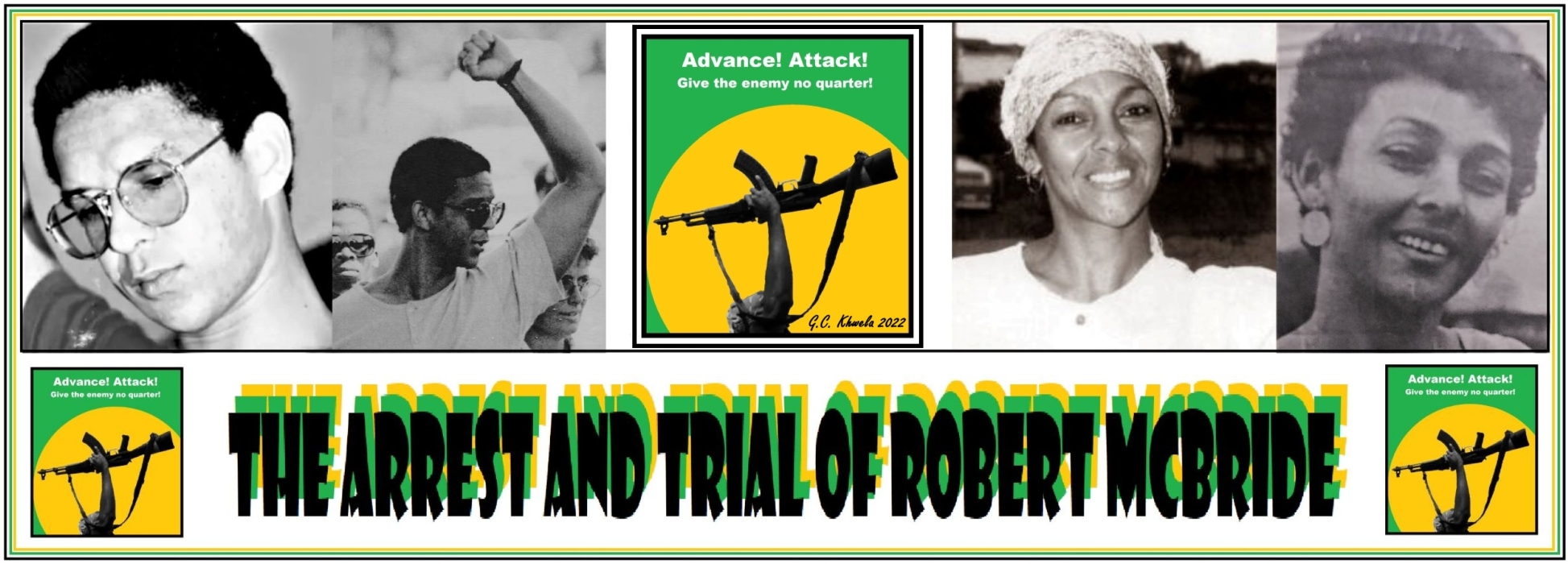
At 06:00, in the morning of 17 July 1987, Robert McBride and Greta Apelgren were sleeping in the sitting room of his brother Leslie’s house, in Nigel, when they were woken up by a knock on the door. When he opened the door, he was confronted by a policeman facing him, and he immediately shut it. While Apelgren was peering through the curtains, she realised that uniformed policemen were all over the yard, in the road and on the rooftops. The policemen began shouting, “Open up, police!” and as McBride opened the door, he found a police captain standing there with a rifle directly pointed at him. Both McBride and Greta Apelgren were arrested.
Robert McBride was detained in July 1986 and first appeared in court in November alongside his comrade Greta Apelgren, who was a social worker. The two faced 24 charges, including murder, attempted murder and ‘terrorism’. The most serious charges concerned two actions carried out in May and June 1986: firstly, the rescue from hospital of a wounded fellow combatant, and secondly, a bombing at Marine Parade, Durban, which killed three women.
The trial of McBride and Apelgren commenced in February 1987 in the Pietermaritzburg Supreme Court. The state’s case relied on the evidence of former accomplices of McBride’s who were being held in police custody, with the most controversial being Mr C who had participated in the rescue of Gordon Webster and had actually chosen the target for the Marine Parade car bomb, before planting it jointly with McBride. For Mr C the threat was clear and explicit – he gave evidence to avoid being hanged.
Although unnamed in the court, Mr C’s identity was widely known in the community. Robert’s mother, Doris McBride, told reporters that she had taught him at school and he was later identified in a news report as Matthew le Cordier. Accomplices were normally granted immunity from prosecution if their evidence was satisfactory but, very unusually, Justice Shearer withheld this from Le Cordier. Concern over Le Cordier’s role mounted when it was revealed that he had argued with McBride over the choice of target for the car bomb. Eventually Le Cordier’s view prevailed.
McBride’s chosen target was a ‘hyperama’ on West Street: the shop was shut by then and although it was possible that the blast might have injured or even killed a passer-by, the chances were much less than at Marine Parade, where the car was parked opposite a crowded restaurant complex. The court accepted that responsibility for the very choice of target lay not with McBride but with his accomplice who was now bargaining for his life.
Throughout the trial McBride was protective of Greta Apelgren, whose role he consistently minimised in his evidence. She did not speak in her own defence. He denied that she was a member of an Umkhonto we Sizwe (MK) unit and said she was kept in ignorance of the car bomb. Thus – even though she had used her own car to reserve a parking space for the car bomb – she was cleared of all charges in relation to this and received a sentence of five years, of which all but 21 months was suspended for other actions.
McBride admitted to helping Webster to escape, sheltering him in Durban and later taking him to Botswana. He also admitted loading a car with 50 kilograms of explosives and detonating it on the beachfront outside the bar. Regarding this operation, McBride maintained that the Marine Parade bomb had been meant as a protest at the state of emergency, which had been declared two days earlier, and he had wanted a massive explosion, too big for the authorities to conceal. Later on, he had felt “bad” and “scared” because he knew he had gone against African National Congress (ANC) policy regarding civilian targets.
On 13 April 1987, Justice Shearer, “with great sadness” McBride was sentenced to death three times over, and to a further 82 years on the other charges. Therefore, he was acquitted of the death of the hospital guard but found guilty of the death of the three at Magoo’s bar. The other charges he was found guilty of included assault and intent to do grievous bodily harm, which arose out of the injuries to the two policemen at Edendale Hospital. McBride was granted leave by the court to appeal against the finding that there were no extenuating circumstances. As he left the court, McBride shouted, “The struggle continues!”
In March 1988, however, McBride’s appeal was rejected. On the day Robert McBride was condemned, his mother, Doris McBride, announced an all-out legal battle to save his life. Doris McBride’s resolve did not waver when the following month her husband, Derrick McBride, was sentenced to 12 years’ imprisonment for his part in the Webster Edendale Hospital escape. Greta Apelgren’s brother told the court that McBride was deeply distressed at the “Trojan Horse” killings and the massacre in Langa. He also perceived the state of emergency as a declaration of war against the oppressed people of South Africa. Apelgren said McBride saw himself as “a soldier for his people”.
When ANC President Oliver Tambo was asked by the press in January 1986 to comment on the Amanzimtoti explosion, he replied that there was nothing in ANC policy or strategy that called for attacks on civilians, but that “the South African situation is one of violence. There is a war going on there … hundreds have been killed. Massacres have been perpetrated against civilians: Mamelodi, a massacre. Uitenhage, a massacre. Botswana, a massacre. Queenstown, a massacre … The whole of South Africa is beginning to bleed.” Adding to this, the ANC maintained that “there is a war going on in South Africa. We demand prisoner of war status for Robert McBride and for all captured soldiers fighting for freedom in South Africa.”
Sources:
South African History Archives (SAHA).
Southern Africa – The Imprisoned Society, “Save Robert McBride: No Apartheid Executions”, Southern Africa: The Imprisoned Society, July 1988.
Claris, “Robert McBride: A Soldier Fighting for His People”, Sechaba, July 1987.
SAPA, “McBride Apologises to Family of Those Slain in Armed Struggle”, South African Press Association, Durban, 5 October 1999.
Staff Reporter, “McBride’s double life”, Mail & Guardian, 13 March 1988.
Marianne Thamm, “Robert McBride: Caught in the Jaws of State Capture, Adrift in the Present While Captive of the Past”, Daily Maverick, 11 March 2019.
Thula Simpson, “Umkhonto we Sizwe: The ANC’s Armed Struggle”, Penguin, 2016.
Castro Khwela
Good day fellow Compatriots!
Discover more from CASTRO KHWELA
Subscribe to get the latest posts sent to your email.