PW Botha Declares a State of Emergency – 20 July 1985
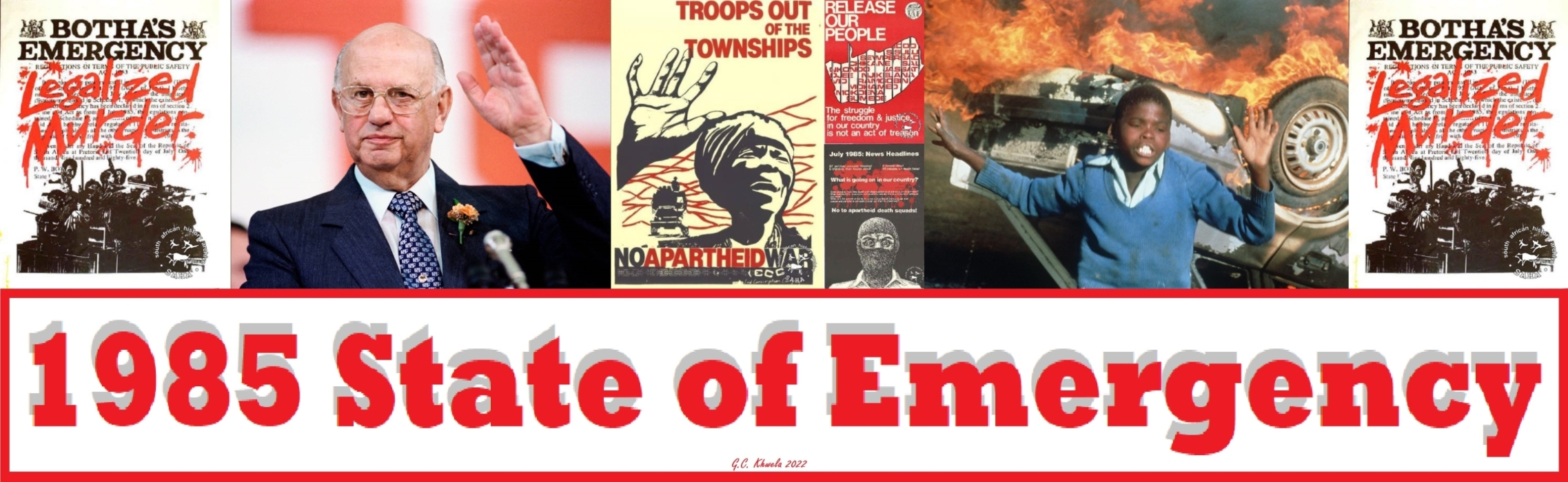
Exactly forty years ago, on 20 July 1985, at a press conference in Pretoria, apartheid President P.W. Botha claimed that “violence and lawlessness” in the townships had “increased and become more severe and more cruel”. According to Botha, such actions had taken the form of “incitement, intimidation, arson, inhuman forms of assault and even murder” and could “no longer be tolerated”. As a result, he then resolved to impose a state of emergency that was to be applied in thirty-six districts nationwide, primarily in the East Rand and the Eastern Cape.
Indeed, during that period the township rebellion had brought government structures in black townships around the country to the point of collapse. On 19 July 1985, writing in the “Christian Science Monitor”, Patrick Laurence reported that the Centre for Applied Social Sciences in Durban estimated that by the end of June 1985, at least 240 local government councillors in South Africa’s black areas had resigned. Consequently, fewer than six black councils were operative in the entire country. According to Laurence, the resignations were the consequence of a sustained campaign of violence from militants against councillors.
Following the increased efforts by the apartheid government to retain control of South Africa’s political, economic and social spheres, resistance against the state came in different forms. Within the country, resistance came from various civic groups, trade unions, church and political organisations. One of the most prominent organisations was the United Democratic Front (UDF), established on 23 January 1983 and comprised of over 400 organisations, with non-racialism being the main ethos. At its peak, the UDF had over 3 million active members throughout the country.
In April 1985, the UDF established closer and more effective links with trade unions, church and civic organisations against the continued social, political and economic exclusion practiced by the apartheid government. One of the biggest moments of resistance practiced by the UDF was the opposition to the Tri-cameral Parliament in 1984. Under then Prime Minister PW Botha, the Tri-cameral Parliament was a shallow attempt at reforming the racially-exclusive structures of apartheid by including so-called Coloured and Indian representatives into Parliament. The lack of Black representatives in this ‘reformed’ structure was met with great resistance, along with the limited and superficial representational powers given to “Coloured” and Indian representatives.
The apartheid regime, with Botha at the helm, promised real reform for marginalised Black South Africans. The reform however was limited to Blacks in urban areas; with the promise of ‘future’ reform for Blacks confined to the Bantustans. This reform was largely criticised by anti-apartheid resistance movements, for being disingenuous and not wholly inclusive. On 25 May 1985, the apartheid government enforced the Prohibition of Political Interference Act, which repealed the banning of racially-mixed political organisations. This move effectively diluted the organisational capacity of anti-apartheid groups as many of them advocated for non-racialism.
The enforcement of the partial State of Emergency on 20 July 1985 severely curtailed the already-limited individual and collective human rights of Black South Africans. In response to this, resistance from the UDF increased. The National Party responded to the continued insurrection by taking a harder stance against resistance from the African National Congress (ANC), UDF, civic groups and individuals fighting against the state.
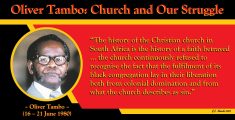
The ANC, led by Oliver Tambo reaffirmed its commitment to “making the country ungovernable, and apartheid unworkable”, much to the detriment of white South African economic and political interests. Sabotage and armed propaganda became effective weapons of resistance against the apartheid government, which included the attacking of power plants, the bombing of shopping centres, businesses and national essential services. In the townships, alternative Organs of People’s Power were established, thus undermining the apartheid-created governance structures.
During the course of the State of Emergency, the apartheid South African Defence Force (SADF), the police and other security forces were simply invading and occupying African residential areas, claiming to be looking for “subversive” literature. Weekends were no longer a period of relaxation for the workers – away from work, escaping police searches for passes, work permits, taxes and so on. Instead, weekends became days for burying people killed by the racist police and the defence force.
What the emergency meant for the people was that they had to expect more “disappearances” and less information about them, because the press was forbidden to report anything. Moreover, people had to expect more brutality because the police and the authorities were legally indemnified – they were above the law and could not be taken to court.
The apartheid government had long declared war on the people and their ideas, and with the imposition of a State of Emergency they were declaring war on the international community. The international community, which had a right to know what was happening in South Africa, was denied that right. South African journalists were not allowed to report on anything except what the Ministry of Defence deemed fit for publication. The international community was thus being denied the right to know.
During the State of Emergency, a new problem arose. The London “Times” of 9 August 1985 reported that “Last night, gangs of up to 1 000 strong, mainly of young Blacks, were roaming the townships, burning and looting homes, shops and government offices, and attacking everyone in their path. Indians were the prime target …” The article went further, “The Indian township of Inanda was worst hit as young Black gangs embarked on a rampage of arson and looting. President Botha said yesterday there were no immediate plans to extend to Durban the state of emergency, which covers 36 districts.”
Gatsha Buthelezi, the President of Inkatha and Chief Minister of the KwaZulu Bantustan, also added, “It grieves me that members of a certain political organisation, plus the external mission of the African National Congress, are promoting this Black-on-Black confrontation. It is hogwash to present this kind of political thuggery as the Black political struggle”.
There were too many problems here – two sides of the same coin. The African youth who were “roaming the townships, burning and looting homes, shops and government buildings and attacking everyone in their path” left Botha cold – he said there were no immediate plans to extend the state of emergency to Durban. What was happening here was that there was no consistency. When the Whites and the “system” – the status quo – were threatened, the state of emergency was necessary. When Blacks killed Blacks, all was normal.
The ANC maintained that it had expected such talk from the racists, and paradoxically enough from Gatsha Buthelezi. But what it did not expect was for Buthelezi to go further and accuse the ANC of being behind the reported “Black on Black confrontation”. According to the ANC, Gatsha Buthelezi conveniently forgot that he – more than anybody else – was beating the drums of chauvinism for quite a long time. Buthelezi’s “big tribe” chauvinism fertilised the soil on which he sowed the seeds of hatred and confusion, inflaming passions, spreading the obnoxious bacteria of tribalism and chauvinism.
Gatsha Buthelezi was terrorising – in a literal sense – anybody who differed with him, although he claimed to be a “leader”. Who was he leading? Gatsha Buthelezi was for a long time reminding everybody – especially the Indians – about the 1949 incidents, when Africans and Indians killed each other, incited by the racists. He had gone on record as being one of “our” greatest tribalists, saying that one of the problems in Natal (a Zulu area) was the presence of “Xhosa lawyers” who had run away from the miserable conditions in the Transkei and Ciskei. Two of these “Xhosa lawyers” were murdered, namely Griffiths Mxenge and his wife, Victoria Nonyamezelo Mxenge.
The struggle of the people – especially in Natal – was shaking the fence on which Gatsha Buthelezi had been sitting for a long time. He ultimately fell on the side of the people’s enemies, on the side of the Pretoria racists, where he belonged. The people were prepared to deal with him, especially when he tried to stand up on the wrong side. The combination of the objective and subjective factors made the situation of Africans, especially in Natal, more critical and desperate. The incidents that were taking place in Durban were connected with frustration and desperation – with the hope and despair that affected the Africans in that part of the country.
The ANC argued that it was the organisation that was destined, and called upon, to intervene in that situation. This was not only because it was the oldest, most democratic and most respected and most adhered-to organisation in the country. The ANC had a democratic approach to everything – as the Kabwe Conference in the same year proved and displayed that. What was more, the ANC’s non-racial philosophy, and the fact that it was the only organisation in the country (and not outside it, as Gatsha Buthelezi always claimed) which had the capacity of challenging and facing the enemy. The ANC was already at the time confronting the enemy in the field of battle – militarily. All the talk of Gatsha Buthelezi about his “non-violence stance” was hot air, because he was very violent when it came to confronting unarmed UDF members, students of Ngoye University and ministers of religion, such as Reverend Xundu.
The South African Communist Party (SACP) also added its voice by declaring that the “Botha regime’s resort to emergency powers (was) an open confession that its attempt to ‘pacify’ the people through a combination of the carrot and the stick was an abysmal failure. Indeed, the government is patently no longer able to govern in the old way. In the townships, its writ does not run at all, its institutions have been destroyed, its emissaries and stooges driven out. The police and military, with the aid of bullets, batons, tear gas, dogs, agents provocateur and undercover assassins, can manage to blast their way into and out of the townships, but all attempts to establish any form of civil authority responsible or responsive to Pretoria have come to nothing. Schools and universities are shut down. An economic boycott has been launched which has threatened the very basis of the white economy in the urban areas.”
Sources:
Wikipedia.
South African History Online (SAHO).
Editorial, “The State of Emergency”, Sechaba, September 1985.
Editorial Notes, “The ANC’s Reply to the State of Emergency”, The African Communist, No. 103, Fourth Quarter, 1985.
Thula Simpson, “Umkhonto we Sizwe: The ANC’s Armed Struggle”, Penguin, 2016.
Castro Khwela
Good day fellow Compatriots!
Discover more from CASTRO KHWELA
Subscribe to get the latest posts sent to your email.