Chief Albert Luthuli and Reverend Martin Luther King: “Appeal for Action Against Apartheid”
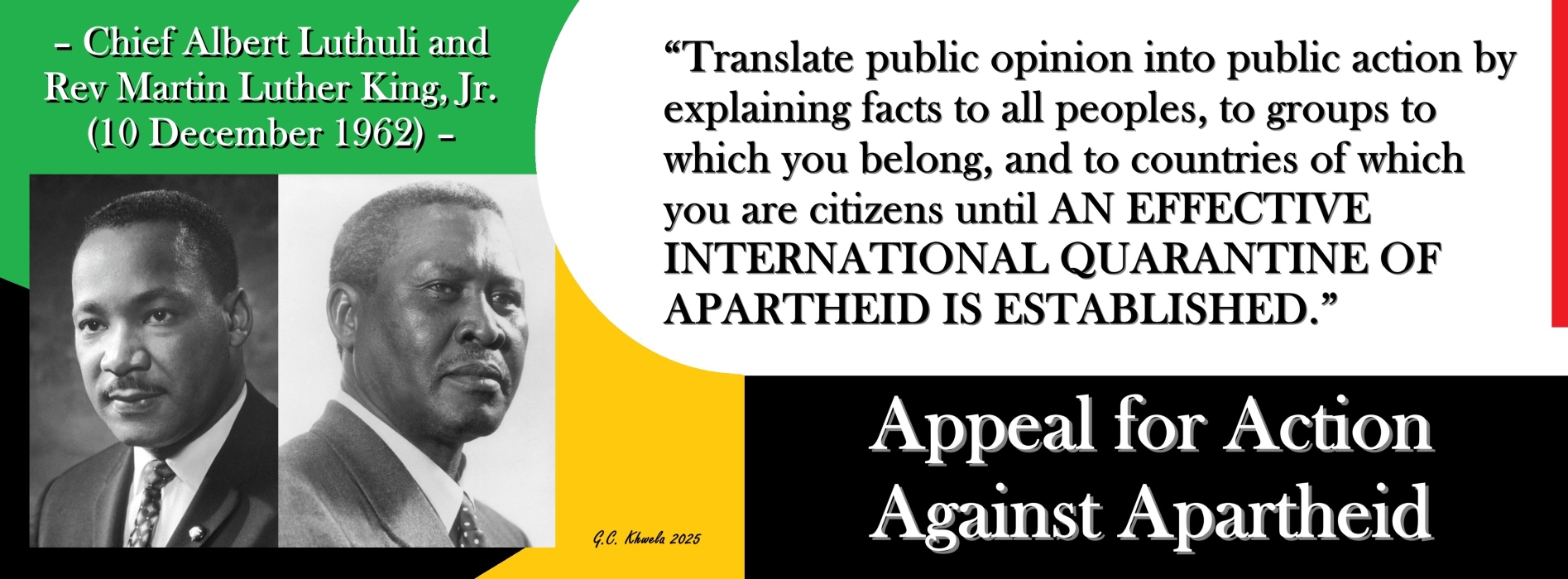
On 10 December 1962, Chief Lutuli and the Rev. Dr. Martin Luther King, Jr. initiated a joint statement, which was signed by many prominent Americans and promoted the public campaign for sanctions against South Africa. The statement was titled, “Appeal for action against Apartheid”, as the only solution which represented sanity – a transition to a society based upon equality for all without regard to colour.
This began in 1957, when an unprecedented Declaration of Conscience was issued by more than 100 leaders from every continent. That Declaration was an appeal to South Africa to bring its policies into line with the Universal Declaration of Human Rights adopted by the General Assembly of the United Nations. The Declaration was a good start in mobilising world sentiment to back those in South Africa who acted for equality. The non-whites took heart in learning that they were not alone. And many white supremacists learned for the first time how isolated they were.
Subsequent to the Declaration, the apartheid South African government took the following measures: it banned the African National Congress (ANC) and the Pan Africanist Congress (PAC), the principal protest organisations, and jailed their leaders; it coerced the press into strict pro-government censorship and made it almost impossible for new anti-apartheid publications to exist; and it established an arms industry, more than tripled the military budget, distributed small arms to the white population, enlarged the army, created an extensive white civilian militia.
Moreover, the apartheid regime activated total physical race separation by establishing the first Bantustan in the Transkei – with the aid of emergency police regulations; it legally defined protest against apartheid as an act of “sabotage” – an offence ultimately punishable by death; it perpetuated its control through terrorism and violence: it killed 12 South West Africans at Windhoek and wounded 40 as they fled police on Human Rights Day, 10 December 1959; and on 21 March 1960, 72 Africans were killed and 186 were wounded at Sharpeville by the racist police. Before and during the two-year “emergency” in the Transkei, 15 Africans were killed by police, and thousands were arrested and imprisoned without trial.
Consequently, Chief Albert Luthuli maintained at Oslo, Norway, in December 1961, where he had to accept the 1960 Nobel Peace Prize, that despite all the apartheid atrocities, “Nothing which we have suffered at the hands of the government has turned us from our chosen path of disciplined resistance”. It must be noted that in July 1961, Luthuli had mediated private debates among ANC and Congress Alliance leaders about the proposed turn to armed struggle with the formation of Umkhonto we Sizwe (MK). He actively participated in and accepted a compromise solution that authorised the formation of MK as a separate, but related entity of the ANC, which at that time was to remain officially non-violent.
Subsequently, he met privately with MK personnel, declaring support and understanding for those who turned to armed struggle. Luthuli’s insistence that the ANC remain officially non-violent while also accepting MK went beyond the conceptually rigid binaries of violence versus non-violence. Before and after the turn to armed struggle, Luthuli practiced “international non-violence” calling for global economic boycotts, sanctions, arms embargoes and diplomatic isolation of the apartheid regime. He then engaged in global anti-apartheid and human rights activities, in which he was supported by his fellow Nobel laureate, and longtime admirer, Reverend Martin Luther King, Jr.
Martin Luther King declared his support for South Africans “to achieve basic human rights for all as proclaimed in their ‘Freedom Charter’”. He and other US civil rights activists also raised money for the legal defence for Luthuli and the other 154 defendants during the five-year Treason Trial. By July 1962, King and Luthuli developed the “Appeal for Action Against Apartheid,” which called for the world to support economic sanctions, trade boycotts and “an effective international quarantine of apartheid” until South Africa aligned its policies to the United Nations Declaration of Human Rights.
Accordingly, On 10 December 1965, International Human Rights Day, flanked by the singer Miriam Makeba and ANC leader Robert Resha, who were both South African exiles, Martin Luther King read the joint statement, which said, “Any solution founded on justice is unattainable until the Government of South Africa is forced by pressures, both internal and external, to come to terms with the demands of the non-white majority. The apartheid republic is a reality today only because the peoples and governments of the world have been unwilling to place her in quarantine. Translate public opinion into public action. We, therefore, ask all men of goodwill to take action against apartheid in the following manner:
“Hold meetings and demonstrations on December 10, International Human Rights Day; Urge your church, union, lodge, or club to observe this day as one of protest; Urge your Government to support economic sanctions; Write to your mission to the United Nations urging adoption of a resolution calling for international isolation of South Africa; Don’t buy South Africa’s products; Don’t trade or invest in South Africa”. The statement went to urge global citizens to “Translate public opinion into public action by explaining facts to all peoples, to groups to which you belong, and to countries of which you are citizens until AN EFFECTIVE INTERNATIONAL QUARANTINE OF APARTHEID IS ESTABLISHED.”
Sources:
Lutuli, A.J. and Luther King, M. Jnr., “Appeal for Action Against Apartheid”, African National Congress Archives, 1962.
Eugenie Banhegyi, et. al., “Footprints in the Sands of Time”, Department of Education South Africa, 2007.
Jacob Zuma, “Chief Albert Luthuli Memorial Lecture by His Excellency President Jacob Zuma at the Inkosi Albert Luthuli International Convention Centre, Durban”, The Presidency, 24 November 2010.
The Mercury, “A Giant and a Foot Soldier: Chief Albert Luthuli”, The Mercury: Sponsored Supplement, 24 November 2010.
William Minter and Sylvia Hill, “Chapter 9: Anti-Apartheid Solidarity in United States–South Africa Relations: From the Margins to the Mainstream”, The Road to Democracy in South Africa, Vol. 3, International Solidarity, South African Democracy Education Trust (SADET), 2015.
Adekeye Adebajo, “Opinion: Remembering Albert Luthuli”, Business Day, 7 August 2017.
Robert Trent Vinson, “Albert Luthuli, MLK and Global Human Rights”, Africa Is a Country, 2019.
Larry Shore, “Chief Albert Luthuli and the American Anti-Apartheid Movement”, Luthuli Museum 20 Years Public Lecture, 21 August 2024.
Castro Khwela
Good morning fellow Compatriots!
Discover more from CASTRO KHWELA
Subscribe to get the latest posts sent to your email.