Violent and Non-Violent Transition
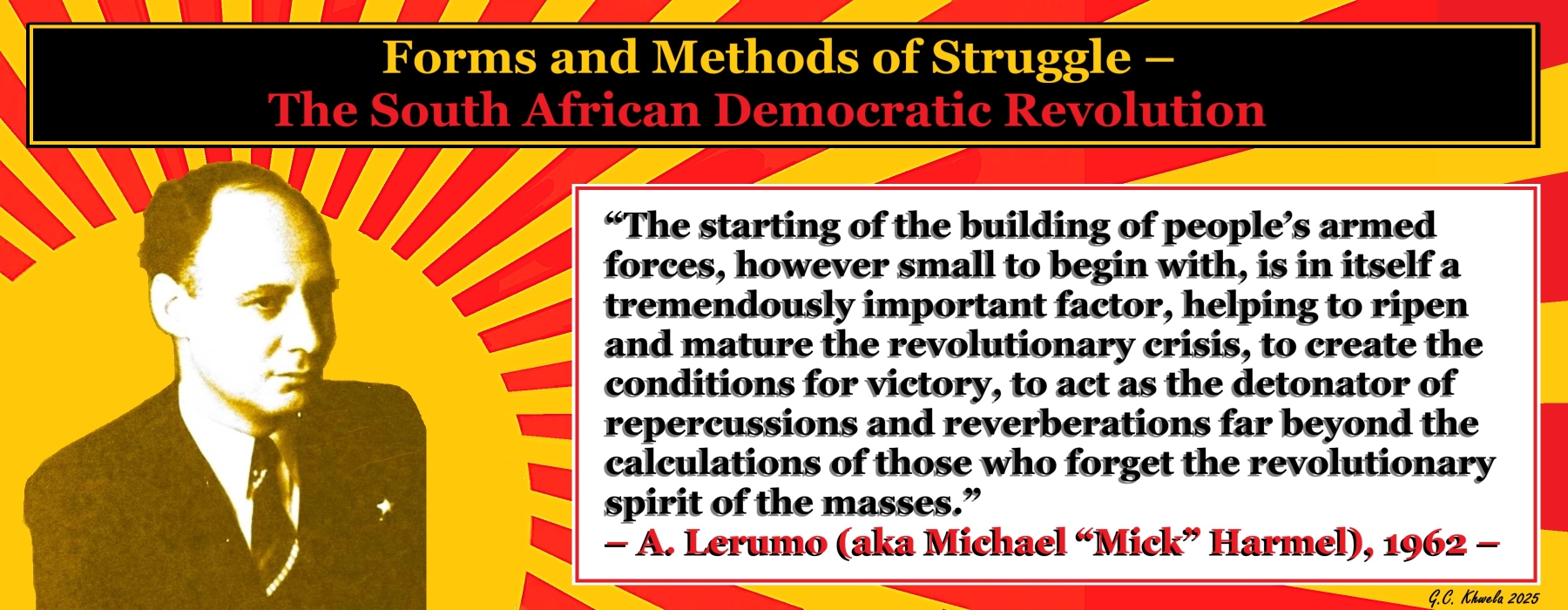
Forms and Methods of Struggle – The South African Democratic Revolution
by A. Lerumo (aka Michael “Mick” Harmel), 1962
“The time comes in the life of any nation when there remain only two choices: submit or fight. That time has now come to South Africa. We shall not submit and we have no choice but to hit back by all means in our power in defence of our people, our future and our freedom”
(from the Manifesto of “Umkhonto We Sizwe”, December 16, 1961).
It is not necessary in the present article to dwell on the burning necessity for sweeping democratic changes in South Africa. The very name apartheid – the vile form of oppression practised by the ruling White minority – stinks in every corner of the world. The formal concessions advocated by such bodies as the United and Progressive Parties will satisfy neither the people of South Africa nor world opinion, since they would leave 87 per cent of the land and all the dominant sectors of the economy in the hands of foreign and local White monopolists. In any case, even such concessions are bitterly resisted by the ruling Nationalist Party which has declared it will maintain a “granite wall” against any democratic reforms and continues to intensify its policy of discrimination and oppression with every year that passes.
The great majority of South Africans are determined upon a clean break with apartheid and racialism. They demand a South African Democratic Revolution, whose main content will be the national liberation of the African people from White colonialism. They demand, in the words of the Freedom Charter, which represents the will and the decision of all the main democratic organisations of the country: that the People shall Govern; that All National Groups shall have Equal Rights; that the People shall Share in the National Wealth; that the Land shall be Shared among those who work it.
There are no serious differences among South Africa’s 13-million strong majority of oppressed non-White people about these goals and aims of the Democratic Revolution. The question that really faces us is that of the forms and methods of struggle by which they are to be achieved.
THE TRADITION OF “NON-VIOLENCE”
For many years, ever since the Campaign of Defiance of Unjust Laws in 1952, the Congress Alliance, which is the national liberation front in South Africa, laid great emphasis on non-violent methods of struggle. Basing themselves on this slogan and also the similarity, in many respects, between the Defiance Campaign and Gandhi’s campaigns in India, some observers have attempted to saddle the Alliance with the Gandhian pacifist philosophy of ‘satyagraha’ (soul-force). But this analogy is incorrect. The Defiance Campaign differed both in its methods and its goals from the Indian pattern of passive resistance. It is true that some of the leaders of the South African Indian Congress, which was a partner in the campaign, were Gandhians, but many others even in the SAIC were not, for example, the outspoken Communist and revolutionary Dr Y. M. Dadoo. The senior partner in the Alliance, the African National Congress, never accepted pacifism as a philosophy. Chief Luthuli, ANC President, said bluntly that in adopting non-violence, “one is not guided by pacifist considerations but by practical considerations.
What were these “practical considerations”? Naturally, every people’s leader prefers peaceful to violent methods, for in the hardships and sacrifices of war, including civil war, it is inevitably the masses of the people who are the principal victims. Then, in South Africa, in particular, no one is ever allowed to lose sight of the fact that the State, representing exclusively the White minority, is armed and organised for civil war. Apart from the regular army and the police, who in this country are furnished with such unusual equipment as armoured cars and Sten guns, the country is covered with civilian units (“skietcommandos” – literally “shooting squads”) openly designed against possible African insurrection. Even women are encouraged to form pistol-clubs for training in the use of firearms, and the proportion of White civilians in possession of licensed private firearms must be among the highest in the world. On the other hand, Africans are strictly forbidden to own firearms or other “dangerous weapons”. Even possession of a knife whose blade is more than three-and-a-half inches long is a criminal offence which can involve the African caught with it in a jail sentence of up to six months.
It is not surprising that in conditions such as these the African and other oppressed peoples should seek every possible path to achieve their aspirations by peaceful means. This preference arises nether from timidity nor from a national tradition of pacifism. Indeed, the African peoples of South Africa have a great military tradition in the struggle for national liberation.
THE AFRICAN MILITARY TRADITION
From the time when White invaders spread eastwards from the Cape of Good Hope, grabbing the Africans’ land and cattle, they met with vigorous armed resistance. Though the invaders had firearms, horses and wagons the Xhosa people, inspired by such legendary leaders and generals as Nqgika, Ndlarnbe, Hintsa and Makana met them in the battlefield with shield and spear, and held them at bay for a century from the year 1778. The brilliant military tradition of the Zulu nation, created by that genius of the battlefield, Shaka, and developed further by famous men like Dingane and Cetshwayo, for long held the White invaders at bay; as late as 1906 the Zulu martial spirit flared up again in the “rebellion” headed by Bambata.
From his mountain fastness at Thaba Bosiu the father of the Basuto nation, Moshoeshoe, combining astute diplomacy with outstanding battle-tactics, defied the joint and separate efforts of British and Boer colonialists to conquer Lesotho. British treachery cost Lesotho the lush farmlands west of the Caledon River, but the heartland of the country was never conquered. It was not force of arms but the duplicity of imperialist emissaries, abetted by undermining activities of missionaries and Basuto traitors, which were responsible for the loss of most of Basutoland’s independence. Indeed, all over the Transvaal and the Orange Free State one may find historic battlegrounds of the past, testifying to the stout resistance of the Tswana, Pedi, Griqua and other peoples to the invaders on their northern treks.
Two great main factors led to the conquest of Southern Africa by the White invaders. First was the disunity that prevailed among the indigenous African defenders. Time and again, Moshoeshoe sent ambassadors to appeal for a common front of resistance. But his appeals were in vain ; the colonists were able to fight the inhabitants tribe by tribe, indeed, tragically often, they were able to make use of “Native Auxiliaries” and Coloured troops from the Cape, in their wars of conquest.
Second, the invaders were enormously assisted by superior weapons and transport, the fruits of a more advanced economy. Time and again they were out-generalled and out-manoeuvred by their African opponents. But, inevitably, over the long run, the ride prevailed over the assegai . Disunity and backwardness of African societies opened the road for White domination in South Africa.
It has been the aim of the White rulers, ever since, to perpetuate both disunity and backwardness as a means of preserving their conquest. It has been the aim of every African patriot to overcome both so as to regain for his people their right to freedom and self-government.
It is not surprising that in seeking this aim the African people should have sought political rather than military means. The point has been put with admirable clarity and simplicity by Chief Luthuli: “In the days when our forebears tried to defend their lands, the wars ended disastrously for us, and perhaps our forebears felt that as the white man was better armed it was no use challenging him by violent means”.
SITUATION HAS CHANGED
This year, 1962, sees the fiftieth anniversary of the African National Congress. For half a century, Congress has striven for the interests of the African majority of South Africa. Innumerable struggles and campaigns have been waged not only by the ANC but also by the Communist Party, the trade unions, the Indian Congress, the Congress of Democrats and the Coloured People’s Congress and other fighters for liberation against the citadel of White domination.
It would be incorrect to assert that these struggles and campaigns have been fruitless. Far from it. In the course of defiance, pass-burning and other campaigns, strikes, demonstrations, boycotts and other forms of non-violent mass action, the political consciousness of the masses has been tremendously raised. Steeled and disciplined fighters for freedom have been developed and trained. The atrocious crimes of apartheid and baasskap have been exposed on a world scale. The South African people have created a powerful united front of national liberation – the Congress Alliance – with its own inspiring and well-defined programme – the Freedom Charter.
But all these protracted and bitter struggles, waged with skill, imagination and unwearying determination, have not wrung a single concession from the Nationalist Government. On the contrary, that Government has announced the policy of the granite wall against the demands of the people. It has driven the principal organisations of the people’s resistance, first the Communist Party and then the African National Congress, underground. Hundreds of peoples’ leaders have been ordered, without charge or trial, and for periods, in many cases, of more than ten years each, to abstain from attending all gatherings, to resign from all progressive organisations, to confine themselves to a particular area of the country.
Others have been exiled far from their homes and their families. Democrats of all races are continually raided and searched by the special political police, spied upon day and night, their letters opened and their telephones tapped. There is no freedom of speech; in most African residential areas meetings are forbidden, publications are constantly being banned.
A turning point was reached following the Sharpeville and Langa massacres of 1960 when a “state of emergency” was declared and 2,000 political prisoners detained for months without charge or trial. The so-called “emergency” has continued in parts of the Transkei until the present time. The Government is relentlessly intensifying its policy of repression to the point where every possible door to peaceful and constitutional protests and methods of change is slammed in the faces of the people.
The Government is openly preparing for civil war. All these things add up to a major shift in the political situation in South Africa, where no further progress is possible along the traditional paths or by adhering rigidly to the non-violence slogan in a situation where every democratic demand or criticism is treated as an act of rebellion and treason.
THE QUESTION OF POWER
The African people have passed the stage of fruitlessly asking for concessions or reforms from a Government which declares hysterically that any concession would mean “suicide for the White race” and whose Minister of Defence openly declares: “We are arming in order to shoot down the Black masses”.
The people have openly raised the question of a transfer of State power from the hands of a colonialist minority into those of the masses. That is the central meaning and significance of the historic African People’s Conference at Maritzburg on March 28th, 1961, for a new National Convention – a constituent assembly fully representative of the whole population, with sovereign powers to promulgate a new, democratic, non-racial Constitution for South Africa.
Essentially, that is a demand for revolution. That is not to say that the representatives of the people gathered at Maritzburg had abandoned all hope of bringing about the revolutionary transfer of power into the hands of the people by peaceful methods. On the contrary, the first stage of struggle for a National Convention took, once again, a non-violent form a three-day general strike.
And, once again, against this peaceful withdrawal of labour, the Nationalist Government mustered all the force and violence at its disposal, so that its declaration of a “Republic” on May 31st took place in the atmosphere of virtual martial law.
UMKHONTO WE SIZWE
It is against this background of a people which has, for half a century, exhausted every possible non-violent means to assert its just demands and human rights, that we must view the emergence on Dingane’s Day, December 16th, 1961, of a new organisation in South Africa, Umkhonto We Sizwe (“Spear of the Nation”). On this day, units of this new, independent organisation which was formed by Africans but includes members of all nationalities, carried out, on a nation-wide scale, a series of planned attacks with explosives against government buildings, particularly those connected with the implementation of apartheid.
The attacks were not very many, and except in Port Elizabeth have not thus far been continued. Some explosions were ineffective. One African, comrade Petrus Molife, was tragically killed by a premature detonation in Johannesburg. Benjamin Ramoutsi, who was seriously injured in the same explosion, was arrested, by the police and is facing charges, A number of arrests were also made in Port Elizabeth, and a number of men, including Govan Mbeki, Harold Strachan and Joseph Jack are at the time of writing imprisoned and facing trials.
However, it would be a serious mistake to judge the effectiveness and potential of this organisation by this first “pilot” operation. A manifesto pasted on the walls of Johannesburg simultaneously with the operation makes it clear that this is but the first move in a long-term plan of campaign.
Referring to the non-violent policy hitherto pursued by the national liberation organisations, the manifesto declared: “… the people prefer peaceful methods of change to achieve their aspirations without the suffering and bitterness of civil war. But the people’s patience is not endless …
“The Government has interpreted the peacefulness of the movement as weakness; the people’s non-violent policy has been taken as a green light for government violence … without any fear of reprisals. The Umkhonto We Sizwe marks a break with the past.
“We are striking out along a new road for the liberation of the people. The government policy of force, repression and violence will no longer be met with non-violent resistance only. Umkhonto We Sizwe will be at the front line of the peoples’ defence. It will be the fighting arm of the people against the government …”
At the same time, Umkhonto makes it clear that it is not being established in opposition to the recognised political movements for national liberation. It will, it declares, “complement the actions of the established national liberation organisations. Umkhonto We Sizwe fully supports the national liberation movement and our members, jointly and individually, place themselves under the overall political guidance of that movement.”
Nor does the new movement, despite its military character, abandon the hope and prospect of non-violent revolution in South Africa.
“We of Umkhonto We Sizwe have always sought as the liberation movement has sought – to achieve liberation without bloodshed and civil clash. We hope – even at this late hour – that our first actions will awaken everyone to a realisation of the disastrous situation to which the Nationalist policy is leading. We hope that we will bring the government and its supporters to their senses before it is too late, so that both the government and its policies can be changed before matters reach the desperate stage of civil war. We believe our actions to be a blow against the Nationalist preparations for civil war and military rule.”
APPROVAL OF THE MASSES
There can be no doubt that the appearance and activities of Umkhonto We Sizwe met with the fullest approval and support of the masses of the people of South Africa. The slogan and the era of “non-violence” is over and past; it served its purpose, but not a single voice among the democrats of South Africa was raised to propose its continuance or its revival in a situation where even the blind can see that today to restrict the movement to peaceful methods alone means nothing less than surrender to the Government. Of course, peaceful methods will continue; strikes, demonstrations, and other mass actions will be even intensified, despite the conditions of illegality and terror which make it ever more difficult and dangerous to organise them. They remain, at the present stage, the main form of activity of the freedom movement.
But they will not be the only form. The Government will have to reckon with a new factor the knowledge that future violence and atrocities against the people will meet with stern reprisals from the side of the people. They will have to learn that they are no longer able to count on easy “victories” when they can sit in armoured cars and shoot down unarmed men, women and children with machine guns. In Umkhonto We Sizwe the people have created the nucleus of an army of national liberation, an organisation which will enable patriots of the freedom struggle to obtain arms and train themselves in their use and the art of military science.
Until now it has been the Nationalist Government alone which thought and spoke of settling the future of this country by violence. The sort of violence they had in mind is the suppression of every peoples’ movement for liberation and democratic change by means of the army and militarised police, with the aid of a mass mobilisation of part-time White civilians, armed and organised for civil war by the State. Although the Whites constitute only 3 million out of 16 million South Africans, this did not seem a difficult task in view of the fact that the African and other non-White people are neither armed nor organised for guerilla warfare.
It is very doubtful whether this enthusiasm of the White colonialists for forcible solutions would continue in a situation where the people were organised and equipped to fight back, to conduct a protracted guerilla war which would exact casualties, not on one side only, and have profound effects on the economy of the country and aggravate immensely its already grave international relations. There, indeed, lies the sole prospect of forcing the colonialists to reconsider their adamant and intransigent attitude towards peaceful transition to a non-racial, democratic society. In a word-before the racialist oppressors can be made to listen to reason their ears must be opened by speaking to them in the only language they can understand
So long as the prospect of such reconsideration remains open, the armed struggle of Umkhonto We Sizwe will remain the supplementary, not the main form of struggle, while the people continue, as before, to attempt by every means in their power to win democratic changes by peaceful methods of mass action. The possibility, however, is not to be excluded that, headed by the fanatical Verwoerd junta of Nazi herrenvolk ideologists, the South African state will continue to turn a deaf ear to the warnings of the people’s leaders and to the ominous rumblings of the explosions which have already begun.
In that case the likelihood is that the armed struggle will become the principal form of struggle in South Africa.
WHITE COLONIALISTS WILL BE DEFEATED
Should they commit the country to such a course, the colonialists are doomed to defeat.
Umkhonto We Sizwe, now in its earliest stages, may seem small and relatively ineffective. No doubt its cadres lack experience and adequate equipment. But it enjoys the support of the masses of the people at home and the sympathy of the overwhelming majority of mankind outside South Africa. These factors are bound to tell increasingly in the long run, while the colonialists, however powerfully and energetically they may continue with their present policy of militarising the White population, are placing their confidence in inherently limited and shrinking resources. However long and bitter the struggle, therefore, the people are bound to win.
Experience, particularly in Cuba and Algeria, has shown that it is an academic and mistaken approach for revolutionaries to observe events in a detached spirit awaiting the situation where “conditions are ripe for insurrection”. While adventurism and “playing with revolution” are always to be avoided, the overwhelming lesson of events in these countries is that the starting of the building of people’s armed forces, however small to begin with, is in itself a tremendously important factor, helping to ripen and mature the revolutionary crisis, to create the conditions for victory, to act as the detonator of repercussions and reverberations far beyond the calculations of those who forget the revolutionary spirit of the masses, who attempt to gauge the outcome of a people’s struggle against tyranny merely by counting the size and fire-power of the units which each, at the beginning, is able to put in the field.
In this article and the previous one (African Communist, No. 8) I have been concerned to analyse some of the factors, both international and is South Africa itself, governing the probable forms of struggle which will lead to the victory of the people’s revolution in South Africa. But these factors themselves are constantly changing and changing in favour of our people and against their oppressors. With every advance of the strength and unity of the socialist camp, the world movement for peace and disarmament, the national liberation movements of Asia and Latin America, and above all of the African Revolution for freedom and complete independence and unity, the doom of the White colonialists of South Africa and the victory of the oppressed people of this country comes nearer and more certain.
A. Lerumo, “Forms and Methods of Struggle – The South African Democratic Revolution”, The African Communist, No. 9, April/May 1962, pp. 43 – 51.
Castro Khwela
Good evening fellow Compatriots!
Discover more from CASTRO KHWELA
Subscribe to get the latest posts sent to your email.