Chris Hani: The Demand of the Time
(Address by Chris Hani, the Deputy Commander and Commissar of Umkhonto we Sizwe, to the MK People’s Army, Luanda, Angola, January 1986)
“1985 has been a year of intensive and sharp struggles between the oppressed masses on one hand and the ruling class of our country on the other. It was a year of great and tremendous sacrifices by our people who went into the streets to battle enemy soldiers, police and their saracens and casspirs.
“The deeds of heroism and courage are indeed unparalleled in the recent history of our country. This struggle threw out thousands of young people who are ready to make all sort of sacrifices in the struggle for freedom and social justice. This climate of unparalleled upsurge has thrown into the fore a lot of serious demands, especially for our people’s army, Umkhonto we Sizwe. Its role has become very crucial within the context of a situation of escalating violence by the enemy. An enemy which has lost all options except more and more reliance on brutal and naked force.
“For the success of our assault on the enemy we need to look very carefully into the way we prepare our army. This army is expected more than ever before to be seen to be a people’s army, to be seen to be responding to the demand of the time. And the demand of the time is the escalation of the armed struggle.
“Our people are demanding to see us confronting the enemy. In fact our People’s Army has got to translate into reality the message of the African National Congress conveyed to our people by the President in the New Year Message. The marrow of that message was: ‘let us be on the offensive, let us attack, and that we should give the enemy no quarter’.
“In order then to realise this central message, Umkhonto we Sizwe has got to brace itself to attack that enemy and furthermore to translate into reality the earlier call of the movement to take the war to the white areas both in the urban areas and the countryside.
“The enemy personnel has got to be attacked more sharply and intensively than before. We are all agreed that the country is in a state of civil war. That grim reality has already been recognised by our people as they bury thousands, as they go to funerals every week.
LIMPOPO TO SALDANHA
“This is the picture throughout the country, literally from Limpopo to Saldanha. We all know that the majority of the whites in our country are cushioned off from this reality. For them life is normal. They do their shopping, go to cinema and to various pleasure places to enjoy themselves with their families. Their kids go to school everyday. But for our people it has been almost two years of conditions of civil war, of burying their dead. Our kids have not known the inside of a classroom for a long time. And these magnificent Black kids have seen, young as they are, what death means.
“The enemy has not discriminated when killing our people. It has killed children, women and the very old. It is a terroristic enemy, and an enemy which is beginning to smell defeat. We should know now that the Botha regime has lost the townships. There is no way in which it can regain the control of these townships because there is a new mood of optimism and rejection of white domination. Now we must make Botha lose all the townships and the countryside.
“This takes me back to the question of rendering the country ungovernable and the system of apartheid unworkable. We know that with regard to rendering the country ungovernable there are still some areas of uncontested terrain, especially in the rural areas.
“Going back to the demands facing the army, you know the regime has unleashed an offensive to flush us out around our country, especially in the neighbouring independent countries. Lesotho is under pressure, so is Botswana and Mozambique. For us the struggle has always been very difficult. We should match those difficulties with increasing courage and determination. We must defy these odds and obstacles and be ready to penetrate our country even in the light of all these difficulties.
DEMANDS
“So we want to place before our army the following requirements and demands:
Firstly, total preparation. By this we mean we should equip ourselves with all the military skills and with all the necessary physical requirements of that demand.
“Secondly, we must be mentally prepared to cope with every turn and twist in the situation because it is an ever dynamic situation. We must take seriously the fact that we have no rear base. In other words, we are our own liberators. Nobody is going to come and create favourable conditions for us. This means that we must literally be ready to walk, if necessary for hundreds of kilometres, as we march towards our country. There is indeed no easy way out of this situation.
“Thirdly, we’ve got to sharpen our hatred for that enemy. I think it has done everything to incur the wrath of our army. Numerous of our cadres have lost, if not their parents, brothers, sisters, cousins. Everybody is affected by what is happening inside the country. We have as a duty to stop the increasing genocide of the enemy.
“Fourthly, inside the country we enjoy conditions we have never enjoyed before. The oppressed people are ready to join us. We have won the confidence of our people. But in the process that confidence repose on our shoulders a need for a special way of conducting ourselves. We are revolutionaries and this we should never forget.
“Revolutionaries are special people. They are patriots and committed people. They are dedicated to a transformation of a country and the building of a new life. In order to justify this confidence our people are placing on our shoulders we have to get rid of the inherent habits we have acquired from the system of oppression.
“We are members of our people’s army, Umkhonto we Sizwe. Our people’s army requires of each and every cadre to have the deepest love and respect for the people because they – thousands of those young people – are placing their destiny in our hands as the commanders, commissars, officers and men of their army. This necessitates that we should behave correctly towards them.
UNFORTUNATE EXAMPLES
“There have been unfortunate examples in the conduct of a few of our cadres. Some have been received with open hands by the people and tended to betray this trust given to them. In certain cases we have even endangered the very people who have provided shelter for us. We have been seduced literally by frivolous requirements of life, the sort of requirements I believe we can do without.
“Some of our cadres have been seen to frequent shebeens and in moments of drunkenness to take out weapons and terrorise the people. Others have brought to their hiding places unknown women, and in some cases there has been over-indulgence in liquor. These are few examples, but they are significant in the sense that they ought to focus on the need for us to become cadres, fighters and revolutionaries of a new type. The situation so demands.
“1986 is the YEAR OF THE PEOPLE’S ARMY, UMKHONTO WE SIZWE. We should recognise the significance of the designation of this year as our year. It simply means that there should be a qualitative difference between this year and other proceeding years. There should be a qualitative change in the way we fight that enemy. It should be a year:
- of many victories against the enemy;
- when we should deepen the insecurity of the regime;
- to deepen the economic and political crisis by the skilful use of our weapons;
- of making Umkhonto we Sizwe a people’s army involving the whole population in the fight;
- when we should be in a position to arm the young lions who have been battling with the racist army for more than a year;
- when the countryside should be unsafe for the enemy. Already there are indications that this is beginning to take place. But what has happened is the tip of the iceberg. We should spread those operations in the rural areas and the farms; and
- when we are going to attack very seriously the transnational corporations which are doing their best to stabilise the apartheid economy. Let us make it a year when the international investors are going to lose confidence in the performance of the regime’s economy.
“Lastly, it’s a year when our people must feel that we are beginning to be on top of the situation as their fighters. In other words the maintenance of the momentum of our struggle and even its stepping up has got to be seen this year. What is required of Umkhonto we Sizwe now is to plunge itself into the country, train and arm our people and be part of the struggles of those millions of our people.
“We must enrich and strengthen the struggles of the workers and the entire democratic movement. We have to weaken and undermine the bantustan administration. What is required is that we should make each and every corner of our country a sphere of military action and intense political battles. But we shall only be able to do that if we eliminate all shortcomings and deficiencies in our training and preparation, and everywhere we move, whether in transit. The high spirit of discipline, commitment and revolutionary zeal which we display in our camps should not be lost en route to and also inside the country.
“These are very big demands, but our people have shown the way. There is no way we can allow ourselves to lag behind the escalating battles that the masses of our country are waging.
“Though we have dwelt at length on the deficiencies and shortcomings of our cadres, it is important also to note that the past year has seen some of the most heroic deeds by our comrades. 1985 was a year of the biggest number of military operations. The hand-grenade became a feature of our resistance and for the first time the landmine was used in our country.
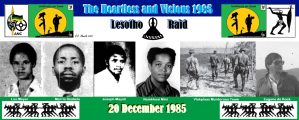
“We therefore pay tribute to our combatants whose exemplary and courageous performances contributed into making the country ungovernable and the system of apartheid unworkable. Their deeds and revolutionary commitment will always inspire us to heights of valour and patriotism. We remember with pride and love comrades like Barney Dladla, Victor Khayiyana, Sidney Sebepi, Morris Seabelo, Leon Meyer, Joseph Mayoli, Jacob Williams, Madoda, Duma, Patela, Victor Masuku and others.”
DISCIPLINE IS THE MOTHER OF VICTORY!
TO MOVE FORWARD WE MUST ATTACK, ACT IN UNITY AND UNITE IN ACTION!
– Chris Hani (January 1986) –
Source:
Chris Hani, “The Demand of the Time”, Dawn – Journal of Umkhonto we Sizwe, Vol. 10, No. 2, February 1986.
Castro Khwela
Good day fellow Compatriots!
Discover more from CASTRO KHWELA
Subscribe to get the latest posts sent to your email.