The Massive Collapse of the Bantustan “Homelands” System
On 9 March 1990, the African National Congress (ANC) veteran and stalwart leader, Walter Sisulu, denied allegations levelled at the ANC by the apartheid South African parliament and the mass media that the Liberation Movement was responsible for the unrest that broke out throughout the country’s Bantustans. Sisulu described the unrest as consisting of a popular revolt against the Bantustans’ repressive dictatorships.
The unrest broke out after a demand by the ANC that all “homelands” should be reintegrated into South Africa, as part of the dismantling of Apartheid pieces of legislation. The apartheid regime’s programme of separate development, of which the Bantustans were the major component, was widely detested inside and outside South Africa.
The Bantustan or “Homelands” system was central to the apartheid National Party (NP) regime’s policy of territorial and political separation based on race and ethnicity. Long before the victory in 1948 elections, legislation had been enacted to lay the groundwork for the development of the Bantustans, which included the 1913 and 1936 Land Acts. In the early 1950s, the Bantu Authorities Act was passed in increasing the powers of traditional authorities in preparation for “ethnic self-governance”. This was followed by the Promotion of Bantu Self-Government Act in 1959, which provided the legislative basis for the future “homelands”.
The premise was that South Africa’s indigenous population was composed of eight, which was later converted to ten, ‘Bantu’ – African – national groups. The architects of apartheid designed that each group was to be given the opportunity to advance to higher forms of self-government until independence for each could eventually be realised. The Bantu Homeland Citizenship Act stipulated that all African (‘Bantu’) South Africans were citizens of one of the homelands, even if they currently resided in the “white” Republic. This piece of legislation was largely rejected resulting in unrests that became more fervent in the mid-1980s into the 1990s, when it was becoming obvious that the apartheid regime was unable to rule in the same old way.
According to Indicator Project South Africa Researcher, David Jarvis, “Although a number of South Africa’s homelands were already in ferment during the last decade, the unbanning of popular political organisations on the 2nd of February this year (1990) led to mass political protest and escalating violence in most of these ten ‘states’. It has become clear that independence – the fruits of which were held up as attractive by architects of the system – is rejected by large numbers of homeland residents. The fact that these homelands need to rely on South African security forces further underlines this point. Instead, reunification within a broader South Africa promising a more democratic political dispensation is fast becoming a tangible goal” (Indicator SA).
Following the outbreak of widespread unrest in the mid-1980s into the 1990s, the Bantustan armies were increasingly used to assist police forces in suppressing internal opposition. Not only were such operations explicitly condoned in the various homelands’ defence acts, but legislation was often enacted to indemnify security force members from civil or criminal prosecution for acts committed in “good faith” while “maintaining law and order” (Padraig O’Malley).
“The tide of revolt that swept across the country’s urban townships in 1985 spilled over into Transvaal’s homelands [in 1986], turning them into a new frontline in the struggle for South Africa. … In the next few months simmering violence erupted in Bophuthatswana, Lebowa and KwaNdebele successively, and did not completely by-pass the three remaining Transvaal-based homelands of KaNgwane, Gazankulu and Venda. But they felt the heat of its outer edges rather than its core” (Patrick Laurence, Indicator SA).
In March 1990, 14 people were killed and around 450 were wounded in Bophuthatswana, after police shot at demonstrators who were in favour of the relocation of the Bantustan and calling for the abdication of President Lucas Mangope. In all, 1 1671 people were detained without trial in 1990, 608 of them in Bophuthatswana. This figure was more than twice that for 1989. The unrest in Bophuthatswana – and the rioting that followed a coup d’état in the Ciskei Bantustan earlier in that week – was initiated by growing unhappiness with the homeland system, which had stripped millions of Africans of their South African citizenship and placed them under the control of often autocratic black leaders supported by the racist regime.
Many poverty-stricken residents, angered by high taxes and government corruption, wanted to relinquish their independence and return their land to South Africa. But Mangope, like Ciskei President Lennox Sebe, who was deposed on Sunday, 4 March 1990, had refused to consider such a move. On 6 March 1990, South African Defence Force (SADF) troops were ordered into Ciskei to restore order after a wave of looting and destruction unleashed by the Brigadier Oupa Gqozo-led military coup on 4 March in the nominally “independent” homeland.
Apartheid Foreign Minister Roelof F. “Pik” Botha, mentioned that South Africa would not interfere with the coup, and stressed that the security forces had been sent at the request of Ciskei’s new military ruler, Brigadier Oupa Joshua Gqozo. Gqozo, who was the intelligence chief of Ciskei’s small army, ousted President Lennox L. Sebe while the Sebes were visiting Hong Kong. The overthrow of President Sebe, whose authoritarian rule made him unpopular with people in the Ciskei, was greeted with public rejoicing that turned into widespread pillaging and arson lasting through the night. The lawlessness spread from Mdantsane, the homeland’s largest township, to the communities of Zwelitsha, Phakamisa and Dimbaza.
On Wednesday, 7 March 1990, apartheid President F.W. de Klerk said that the government was concerned about the unrest, and he vowed to prevent the situation from “slipping into anarchy”. He added that South Africa’s state of emergency, which gave apartheid police sweeping powers, was to remain in place as long as the unrests prevailed in the country. De Klerk vowed to take “strong steps” where necessary to avert “anarchy and chaos”, and conferred on Thursday, 8 March 1990, with the leader of another self-governing Bantustan, Gazankulu, which was also hit by political upheavals. A joint statement said South Africa would provide additional security aid to the territory’s leader, Hudson Ntsanwisi, and de Klerk reiterated that “a situation of calm and of law and order … is essential for the normalisation of the political process”.
Bophuthatswana President Mangope declared a state of emergency in parts of the Bantustan on Wednesday, 7 March 1990, and asked the apartheid South African racist regime for military assistance to quell the violence. Apartheid Foreign Minister Roelof “Pik” Botha said that the South African security forces, which restored Mangope to power after a 1988 attempted coup, agreed to assist him. The trouble in Bophuthatswana began when more than 20,000 people marched on a magistrate’s court in Ga-Rankuwa, about 24 kilometres north-west of Pretoria. Bophuthatswana was divided into seven separate parts and had about 2 million residents in all.
On the same day, 7 March 1990, protesters carried a petition demanding Mangope’s resignation and reincorporation of the nominally independent “homeland” into South Africa. The petition also complained about escalating rents and taxes and high electricity and water bills. Some protesters in Bophuthatswana carried banners reading: “Away with Mangope’s dompas and his independence” (The “Dompas” was an identification pass that was designed for control influx of Africans into “white” South Africa). Demonstrators set fire to the Bantustan government offices and buildings in Ga-Rankuwa and later erected barricades of burning tyres to prevent troops in armoured personnel carriers from entering. Mobs later threw stones at Bophuthatswana soldiers and police officers, who responded with shotgun fire.
Calls for reincorporation into South Africa had increased in South Africa’s 10 Bantustans, four of which the Pretoria racist regime considered “independent” (no other nation recognised their “independence”), since De Klerk lifted the ban on anti-apartheid organisations and freed black revolutionary leader Nelson Mandela in February the same year. Most of those who resided in the Bantustans, especially the “independent” ones, were appalled by the conditions under which they struggled to be regarded as “foreigners” in the land of their birth, wherein they were required to carry passports to move from one point to another within the borders of South Africa.
Support for the “homelands” was not limited to South Africa’s bigoted enfranchised white minority. Some Africans, especially members of the rural elite, also lent their authority to the system through which they immensely benefitted. Most of these, particularly Bantustan officials and entrepreneurs with a stake in the system, had opposed reincorporation into South Africa. Those who participated in the established structures did so for a variety of reasons. Some sought political or economic gain; and others truly believed in the stated goals of traditional rule or ethno-national development. Still others argued that they participated in the system only to work for change from within.
The Centre for the Study of Violence and Reconciliation maintained that “during 1990 it became increasingly evident that the ANC was caught unprepared by De Klerk’s speech of 2 February. … The violence which broke out in the subsequent months did much to thwart the process of rebuilding the ANC. It prevented the organisation from taking full advantage of the changed context in which it operated. Moreover, the focus on the ANC was shifted from rebuilding local-level organisation to defensive manoeuvring, as many ANC constituencies were faced with daily battles for survival” (Human Rights and Labour Law Yearbook 1991).
Apparently, the apartheid regime had designed this process to disable the liberation movement from gaining a foothold in the rural areas, which were largely run by the ethnocentric traditional leadership. Nevertheless, the ANC, refused to come to the negotiating table until the state of emergency was lifted. According to the ANC, “In respect of those within the Bantustan structures, the immediate challenge they face is to create the atmosphere for free political activity in their areas. They must lift the ban on organisations and individuals; lift the state of emergency; repeal repressive legislation; stop all political trials and executions; and refrain from attacking the struggling masses” (Sechaba, April 1990).
The South African Communist Party (SACP) in its 1989 Programme had insisted on adopting a revolutionary focus regarding the Bantustans. According to the SACP Programme, “Within the economy of apartheid colonialism the bantustans serve as suppliers of cheap labour and as dumping grounds for the unemployed, the aged and the sick. Apart from migrant labourers and ‘commuters’, who are forced to travel for many hours from dormitory townships, the vast majority of people in the bantustans are workers’ families, unemployed workers and poor peasants. They are linked in many ways, direct and indirect, to the South African working class in their outlook and in their objective interests” (The African Communist, No. 122, Third Quarter 1990).
The SACP Programme maintained that “Their demands are for land, for the right to settle where they choose, for secure and rewarding work, and for an end to the corruption and repressive actions of the bantustan authorities. In their struggle to achieve these demands, the rural masses are the major social ally of the working class in the struggle for national liberation movement, and the long-term struggle for the socialist transformation of our country.”
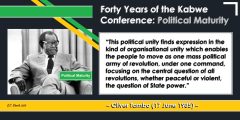
In its January 8, 1988, Statement, the ANC had seen the possibilities of turning the Bantustans into revolutionary bases, wherein President Oliver Tambo had insisted that “the masses of our people within the bantustans must be activised to transform these into strong and reliable mass bases of the revolution. New possibilities exist for the people to act decisively to turn these enemy-created institutions against their creator, the Pretoria regime.” (Sechaba, March 1988).
According to Tambo, “Our people should join hands with those (forces) within the bantustan administrative system that are prepared to break with the apartheid regime and join the people in struggle for a united, democratic and non-racial South Africa. … Let us act together with these healthy forces to transform what the enemy conceived of as its rear-base of counter-revolution into forward trenches of militant struggle for the victory of the national democratic revolution.”
Sources:
Wikipedia.
South African History Online (SAHO).
David Jarvis, “Turmoil in the Homelands”, Indicator SA, Vol. 7 No. 3, Spring 1990.
Thando Zuma, “Revolt in the Bantustans: Apartheid’s Master Plan in Ruins”, The African Communist, No. 122, Third Quarter 1990.
Patric Laurance, “Rural Revolt: Transvaal’s Homelands in Ferment”, Indicator SA, Vol. 4, No. 2, Spring 1986.
Graeme Simpson, Steve Mokwena and Lauren Segal, “Political Violence: 1990”, In Robertson, M. and Rycroft, A. (eds), Human Rights and Labour Law Yearbook 1991, Vol. 2, pp. 193-219. Cape Town: Oxford University Press, 1992.
African National Congress, “The Bantustan Question: A New Approach?”, Sechaba, April 1990.
Oliver Tambo, “Forward to United Action for People’s Power! Message from the NEC of the ANC, January 8th, 1988”, Sechaba, March 1988.
Jack Reed, “South Africa unrest continues in homeland”, United Press International, 6 March 1990.
Jeffrey Butler, Robert I. Rotberg and John Adams, “The Black Homelands of South Africa: The Political and Economic Development of Bophuthatswana and Kwa-Zulu”, University of California Press, 1977.
Padraig O’Malley, “The Homelands”, hosted by the Nelson Mandela Foundation, https://omalley.nelsonmandela.org/index.php/site/q/03lv02424/04lv03370/05lv03413.htm
Scott Kraft, “Unrest in Black Homeland in S. Africa Leaves 11 Dead”, Los Angeles Times, 3 July 1989.
Scott Kraft, “Violence Erupts in Second S African Black Homeland: Bophuthatswana: Police fire on protesters calling for the leader’s ouster. The eruption follows a coup in Ciskei”, Los Angeles Times, 8 March 1990.
Castro Khwela
Good day fellow Compatriots!
Discover more from CASTRO KHWELA
Subscribe to get the latest posts sent to your email.