South Africa After the 1994 Elections: A Luta Continua!
(Excerpts of the South African Communist Party discussion document, titled “The Present Political Situation”, arising from first plenary meeting of its Central Committee held on 18 June 1994, to undertake a political assessment of the post-1994 elections in South Africa).
Following the 27 April 1994 elections, the Editorial titled “A Luta Continua” of The African Communist (No. 137, Second Quarter 1994) asked serious questions on the pressing post-election situation in South Africa, whether in the first place, what it was that had just happened? Was it liberation, a sell-out or the first beginnings of a complex and long process of democratisation?
According to the Editorial, there were some tendencies in the broad movement that presented the April elections and the May inauguration of President Mandela as the culminating moment of the liberation struggle. It argued that the significance of the moment should not be underrated, however at the same time maintained that speaking too easily of “liberation” could only serve to demobilise the main, mass-based forces.
The fact that a long struggle still lay ahead was not a reason to indulge in a demoralised “left” rejection of real advances that had been achieved. For instance, the class opponents of the National Democratic Revolution had failed to defeat the struggle, and had been forced back into working within the recently introduced Reconstruction and Development Programme (the RDP). What was important to note was that they were going to do so “with their own agenda – to dilute, to subvert and generally to frustrate our attempts to empower the majority of South Africans”.
The Editorial then advised that “Let us be neither smug about our achievements, nor demoralised by the fact that complex struggles lie ahead. Indeed, the new institutions at national and provincial level, and even our own programme, the RDP, are real sites of struggle. This is why the key slogan of the present moment must be quite simply: A luta continua!” The details of the article are posted herein below:
INTRODUCTION: MAYIBUYE’S APPROACH
“Our ANC-led liberation movement has just emerged from a major election victory, celebrated world-wide. Yet despite, or rather partly because of our major breakthrough there is, at present, considerable strategic confusion throughout the ANC-led aligned movement, including within our own party. We believe that the SACP, as in the recent past, now has a very important duty to help develop a clearer strategic perspective for our whole movement. That there is a crying need for such a contribution is underlined by, for instance, the most recent ‘Mayibuye’, the official monthly journal of the ANC.
“In the spirit of comradely criticism, we believe that it is a useful starting point to consider, in some detail, the editorial of the May/June 1994 issue of ‘Mayibuye’. The issue, with a cover of Impala jets flying over the Union Buildings and slogan ‘FREE AT LAST’, devotes itself to celebrating and analysing the situation in South Africa after the elections of April. The editorial sets about its analysis as follows:
“I. ‘The moment has arrived. Liberation. Real change. National Democratic Revolution. Call it what you may. It is the moment that flashed through the minds of many a hero as they succumbed to the assassin’s bullet, the hangman’s noose and the torturer’s fatal blow … It was slow in coming. From the forebearers’ welcoming embrace many centuries ago which was returned with a suffocating grip. And the modest beginnings of mass action, armed struggle and underground work. To the wrangles in negotiating chambers and Third Force violence. And, at the apex, the attempted sabotage of the electoral process …
II. ‘Yet we dare not forget in the din of the cry of success and the soothing words of reconciliation: the march has been long and difficult; but we have only reached a milestone. Important in its significance, imposing in its frame and high up the steep – but only a milestone all the same. The real battle, beyond pomp and ceremony and the symbolism of a new flag and anthem, has just begun.
“‘Now, ordinary people will rejoice only at the sight of the foundation of the first of the million houses that have to be built over the next five years … Now is the time to make good the election pledge. In this regard, the words of a writer on the French Revolution are instructive: ‘Patiently endured so long as it seemed beyond redress, a grievance comes to appear intolerable once the possibility of removing it crosses men’s minds. In June, allocations from the budget will be decided upon. A modest beginning can then be made. Commitment of the multi-party cabinet and civil service to reconstruction and development is crucial.’
“III. ‘But, above all, the ANC must rely on the basic source of strength that brought us to where we are: confidence in the people and accountability to them.’
“IV. ‘This and only this will give meaning to the moment’s outpouring of emotion. The deserved victory will be worth its salt because it will be able to defend and advance itself.’
“This is an editorial that reveals considerable uncertainty, and some hedging of bets. There are four distinct ‘gear-changes’ which we have labelled I, II, III and IV.
“GEAR-CHANGE I – In line with the FREE AT LAST! cover of the edition, the present moment is portrayed as the culmination of decades, even of centuries of struggle. It is the moment. It is: ‘Liberation. Real change. National Democratic Revolution. Call it what you may.’ The last sentence starts to give the game away – the truth is, the ‘Mayibuye’ editorialist is not sure how to characterise the conjuncture.
“However, having done its best (with much rhetorical hype and pomp) to present the conjuncture as the crowning moment of centuries of struggle, the editorial then, somewhat unconvincingly, shits to:
“GEAR-CHANGE II – ‘The real battle, beyond pomp and ceremony and the symbolism of a new flag and anthem, has just begun.’ How does this square with the earlier claim that what we have just witnessed is ‘the moment’, ‘real change’? But, leaving this aside, what is the content of the ‘real battle’ that now still lies ahead? It is clearly (and correctly) in the mind of the editorialist a battle for the implementation of the RDP. But notice how this implementation is conceptualised:
– ‘Now, ordinary people will rejoice only at the sight of the foundation of the first of the million houses …’ Ordinary people are reduced to spectators of an RDP process. This is reinforced by:
– The quotation from the ‘writer on the French Revolution’. (Significantly, this unnamed writer is Tocqueville, a conservative 19th century writer. This particular quotation happens to be one that in now frequently quoted by neo-liberals as a warning about the dangers of inciting ‘rising expectations’. It is a quotation beloved by those who want negotiated transitions to be elite affairs). The quote itself (‘Patiently endured so long …’) suggests that the mass forces in our country have been passive until this moment, and that it has only now dawned upon them that things could be different.
– And then, in line with all of the above, the editorial goes on: ‘In June, allocations from the budget will be decided upon. A modest beginning can then be made.’ This suggests an entirely bureaucratic and state-centred (not people-driven) RDP.
However, the writer seems to be aware of these kinds of allegations, and so to protect this flank, there is a shift to:
“GEAR CHANGE III – where the editorial appears to gesture towards a mass-driven process, but only in the most neutralised way: ‘The ANC must have … confidence in the people …’ What does that mean practically? And so:
“GEAR-CHANGE IV – The inability of the editorial to offer some basic pointers to its leadership on what to DO (apart from wait for the June budget) is underlined by the closing sentence: ‘The deserved victory … will be able to defend and advance itself. People have disappeared from the scene, and ‘victory’ is doing all the work by itself. Gear-change IV has put history into automatic.
“We have dealt at some length with the ‘Mayibuye’ editorial because it has the great merit of displaying visibly many of the reasons for the present strategic and organisational confusion in the ranks of our broad liberation movement. If we are to effectively analyse the present situation we need at least to begin to:
1. correctly characterise what has happened as a result of the elections;
2. defend a progressive interpretation of the process over these past four years;
3. correctly characterise the main political challenges confronting the liberation movement’; and
4. provide some practical guidelines to our cadres and members on how to move forward.
So far (and the ‘Mayibuye’ article is typical) we have not been doing well in any of these regards. What follows is an attempt to outline a broad framework (no more) for the first three of these issues (the fourth is left to the separate discussion on Organisation and a Programme of Action):
1. THE POST-ELECTION SITUATION
“1.1 The April election was an extremely important victory for our liberation struggle. The huge majority backing for the ANC, which we have always claimed, was decisively demonstrated. The extreme right-wing had calculated that its campaign of bombings and general destabilisation would result in a poor turn-out. The disciplined mass turnout was a decisive rebuff to these forces. Once more, at a critical turning point, the process was mass-driven. However, despite the historical significance of the elections, it is entirely wrong to portray them as the culmination of the National Democratic Revolution. The election was an extremely important moment in the process of an unfolding and still lengthy NDR. The election victory must neither be over- nor understated.
“1.2 The election has, generally, and once more, altered the relative balance of forces in our country. It has considerably strengthened the ANC-alliance. In the government of national unity the ANC is dominant.
“1.3 But the balance of forces remains complex, the security forces, the civil service, the control and ownership of the economy, the media, the judiciary – in all of these areas, we are inheriting a white minority and capitalist legacy. Protracted transformation struggles lie ahead, and clearly such transformation requires effective use of our new positions in government and co-ordination of these new positions with our traditional power-base – our mass and community-based structures.
“1.4 However, our own extra-parliamentary areas of traditional strength, in the mass and community-based movements, are certainly not as powerful as they were in the second half of the 1980s. The ANC and SACP organisational structures are also extremely weak on the ground.
2. DEFEND AND POPULARISE A CLEAR PERSPECTIVE ON THE LESSONS OF THE PAST FOUR YEARS
“21. As the SACP has repeatedly emphasised, there has been a consistent campaign by our strategic opponents to transform the ANC. Having failed to defeat and liquidate the ANC in previous decades, their agenda is to transform it into a narrow neo-colonial bureaucracy and/or, at best, centre-left electoral machine. Drawing the correct lessons from the past four years is part of the struggle to counter this agenda.
“2.2 Our neo-liberal strategic opponents constantly try to undermine our confidence in our own mass-based strength. Mass campaigns, MK … the SACP and socialist and progressive ideas, all are the targets of systematic attempts to undermine their legitimacy. Neo-liberal voices have even attempted to analyse the election result in centrist terms.
“2.3 In order to draw the correct conclusions about how to continue the struggle in the coming period, it is absolutely essential that we defend and popularise the past four years as essentially a mass-driven process. In doing this we are not exaggerating or bending the truth, on the contrary. In this regard, our Party chairperson’s 20th November 1993 political overview presented to the Central Committee remains absolutely relevant:
“The experience of the past three years proved that negotiations are a terrain of struggle which, at the end of the day, depend upon the balance of forces outside the process. It was the link between the negotiations and our mass struggle that played an absolutely key role.” – Joe Slovo
“This does not mean, of course, as cde Slovo immediately went on to say at the time, that we uncritically romanticise all mass activity in the last period. Nor does it mean that we should overlook periods in the past four years in which we failed, for various reasons, to give adequate leadership to the mass movements. In order to defend the mass-line we need also to accurately locate our activity within the context of:
3. THE THREE BASIC POLITICAL CHALLENGES OF OUR PERIOD
“Some of the strategic confusion (in the ‘Mayibuye’ editorial, for instance) comes from an inability to distinguish and interrelate three distinct, overlapping and to some extent conflicting political challenges.
3.1 A Consensus Against Barbarism
“The first challenge has been to build a massive national (and international) consensus against a descent to barbarism in SA. This is a consensus against the destabilisation of the whole democratisation process, including the elections and the newly elected institutions.
3.2 A Consensus Around the RDP
“The second challenge is to build a massive national consensus, not just around stability and against barbarism, but for real reconstruction and development. Today it is this challenge that is, perhaps, most in the foreground.
3.3 A Mass-Driven ANC-Alliance Led RDP Process
“We should certainly not try to monopolise or jealously guard the RDP for ourselves. But the major lesson to be learnt from these past four years is that transition is either mass-driven, or is empty. Put another way, in seeking to consolidate the above two consensuses, we must at all times struggle to ensure a working class and popular hegemony over them.
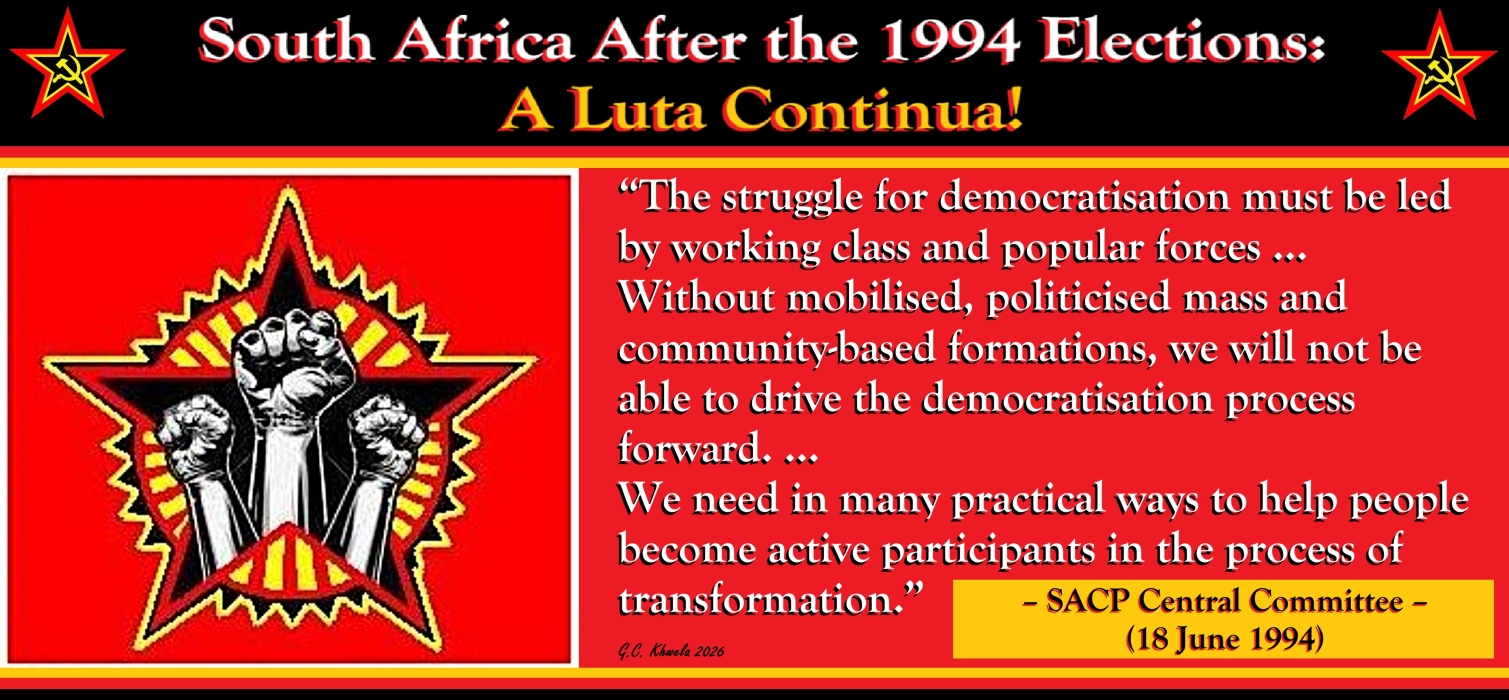
“The struggle for democratisation must be led by working class and popular forces … Without mobilised, politicised mass and community-based formations, we will not be able to drive the democratisation process forward. … We need in many practical ways to help people become active participants in the process of transformation.
CONCLUSION
“The SACP has an important leading role to play in developing our ideological outlook, our organisational capacity and our programme of action, we need to be guided by the above considerations.”
Sources:
Editorial, “A Luta Continua”, The African Communist, No. 137, Second Quarter 1994.
SACP Central Committee, “The Present Political Situation”, The African Communist, No. 137, Second Quarter 1994.
Castro Khwela
Good morning fellow Compatriots!🙏🏾✊🏾👊🏾
Discover more from CASTRO KHWELA
Subscribe to get the latest posts sent to your email.