Recalling the Incredible Edendale Hospital MK Rescue Operation
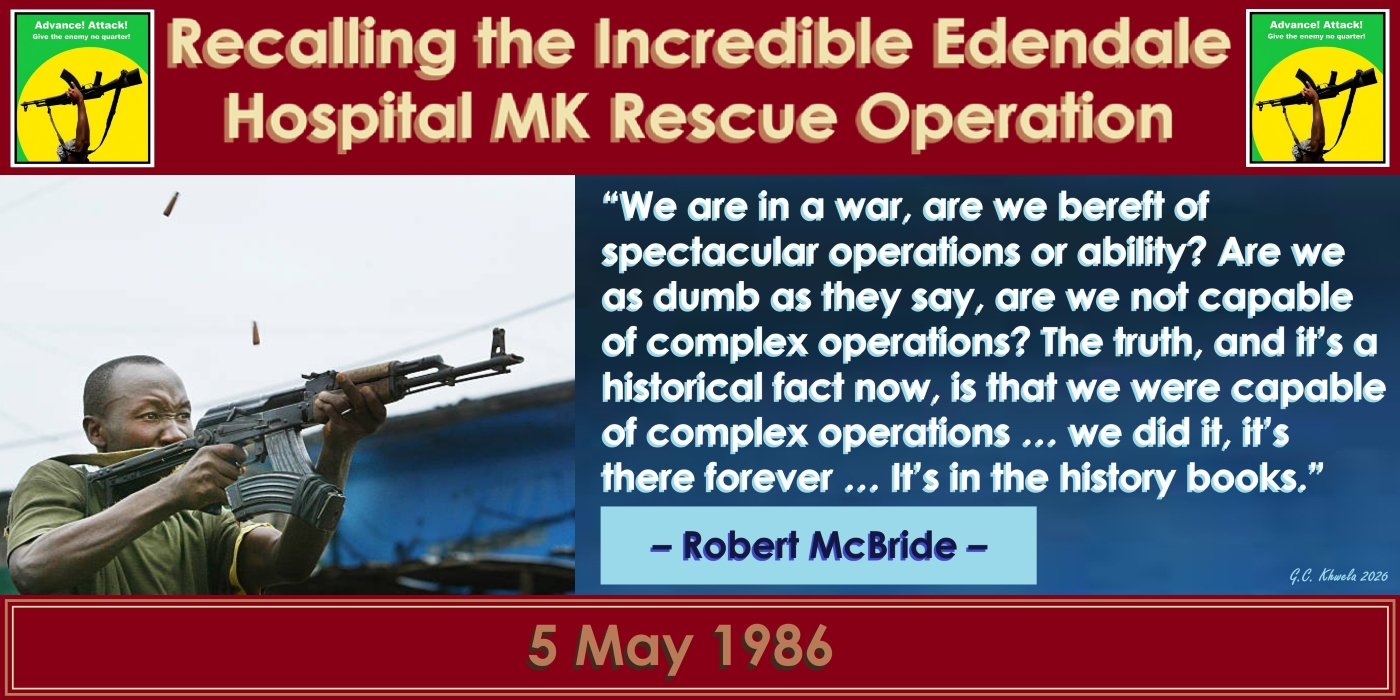
On 5 May 1986, at approximately 16:20, Derrick McBride was involved in a meeting with Matthew Lecordier, Antonio du Preez, Greta Apelgren and Walter Khumalo at the Factorama Workshop, whereby Robert McBride was addressing the group and consistently pointing at a hand-drawn street map that was on a stuck piece of cardboard hanging on the wall, saying “This is the Edendale Hospital”.
Previously, on 2 May 1986, Robert McBride had visited a 22-year-old Antonio du Preez, a twenty-two-year-old political activist in the Wentworth area, in Durban, to seek help from him about a friend who had been shot and was in intensive care in hospital. Robert McBride’s father, Derrick McBride, had also witnessed that his son was concerned about the arrest of a person he knew by the name of “Steve Mkhize”, who according to the report was injured by the police in an incident related to the African National Congress (ANC).
The “Steve Mkhize” that Robert McBride was worried about was actually his friend and comrade, Gordon Webster. Earlier, on 19 July 1984, Gordon Webster had asked his friend, Robert McBride, about going into exile to join the ANC and asked if McBride was going to join him. McBride refused to go and he told him that he would try to keep in touch with him from abroad. Around October-November 1985, Robert McBride met his friend Gordon Webster again, who had returned from his training abroad and had recruited him into Umkhonto we Sizwe (MK) Webster’s Special Operations Unit cell. Their mission was to disrupt the energy grid, mainly consisting of power substations, electricity pylons and oil pipelines.
The Webster’s MK Special Operations Unit managed to undertake several operations in the Durban and Pietermaritzburg areas, especially after Gordon Webster had managed to introduce Robert McBride to his operational commanders in Botswana and having received sufficient military material for the Unit’s missions. Most of these operations were linked with political events or as reaction to the activities of the apartheid security forces inside and outside South Africa.
Some of these operations included: the bombing of the Cato Manor electricity substation on 6 January 1986; the Jacobs electricity substation, on 9 January 1986; on 18 January 1986, the Huntley’s Hill electricity substation in Westville; an electricity pylon in Carrington Heights, Rossburgh, on 20 January 1986; on 1 February 1986, the industrial water pipe in Lion Park, near Pietermaritzburg; a police station in Umlazi, on 10 February 1986; an electricity substation in Umlaas Road, near Cato Ridge, in early February 1986; an electricity substation in Springfield on 12 February; an electricity substation in Assagay, in Hammarsdale, on 12 March 1986; and an electricity substation on Chamberlain Road, Jacobs/Wentworth, on 21 March 1986.
The Unit included two sisters, Greta and Jeanette Apelgren; Bheki Ngubane and Walter Khumalo, who were related to Gordon Webster; Matthew Lecordier and Antonio du Preez, who were McBride’s neighbours in Wentworth; Alan Pearce, who was involved in youth activities that were linked to the United Democratic Front (UDF) in Wentworth; and Naziem Cassiem, whose father was imprisoned on Robben Island, as the head of Qibla (a radical Islamic anti-apartheid organisation). Lecordier and du Preez were involved in attacking houses with hand-grenades belonging to notorious Labour Party leaders in Wentworth, who were also known to be police reservists, Kevin Leaf and Peter Klein, on 8 April and 1 May 1986 respectively.
In the afternoon of 27 April 1986, Gordon Webster and Bheki Ngubane were on their way to hit an electricity substation in Mooi River, near Pietermaritzburg, when Webster told Ngubane to stop the Ford Granada on a gravel Sinathing Road in the Edendale district of Pietermaritzburg. He said he wanted to check on the detonators in the boot. As he was busy checking the boot, he got involved in a scuffle with the apartheid police, Sergeant Richard Nxumalo and Detective Constable Dorasamy, who suddenly approached them. Webster and Ngubane were standing close to an open boot of the car, which Webster closed when the policemen approached them. The policemen demanded Webster and Ngubane to reopen the boot and Webster responded that he did not have the key.
After the policemen forced the boot to open, they saw what was in it, and they called for reinforcements, including requesting that the apartheid SA Army should also be involved, as they had caught “the terrorists”. While the police were calling for reinforcement, Webster and Ngubane made a run for it in separate directions. The police ordered them to stop, and at the same time firing their weapons, thus hitting Webster with three bullets, and Ngubane being shot dead on the gravel verge on the edge of the dirt road. Webster was then taken to the second floor of Edendale Hospital’s Intensive Care Unit (ICU), where he was placed in a bed directly opposite the door.
During the meeting on 5 May 1986 at the Factorama Workshop, in Wentworth, Robert McBride and members of the Webster Unit were finalising the plans to rescue their commander from Edendale Hospital. McBride had received the greenlight to undertake the operation from the Operations Commander of the Special Operations Unit, Aboobaker Ismail (aka “Rashid”), who was at that time in Botswana. They had done a thorough reconnaissance of the hospital and surrounding areas and had also first-rate information on the situation inside the hospital from a nurse, Pam Cele, who had visited Webster several times in the Intensive Care Unit (ICU) ward, as Trevor Webster’s (Gordon’s brother) partner.
During the same evening of 5 May 1986, after cutting a hole in the perimeter fence at Edendale Hospital, while a bakkie was parked nearby with the hazards on, McBride took an AK-47 rifle and pulled out a doctor’s coat from a bag. He then told Lecordier to enlarge the hole while he and his father were inside the hospital. Meanwhile Apelgren and Khumalo were creating an incident that was to divert the police, Derrick and Robert McBride entered the hospital building through the hole in the fence, and at 20:30, they moved towards Ward 2R, where Gordon Webster was admitted.
A policeman, Constable Edward Ngcobo, spotted them and began following them. McBride took out his AK and fired in front of him, hitting the hand that was carrying the gun, and the policeman ran back to where he came from. When reaching the Ward, McBride found Webster’s bed empty. Webster had been moved by a white policeman, Johannes Visagie, who drew a revolver and began shooting at McBride. Unfortunately, he missed and McBride returned the fire hitting him in the arm. The policeman, Visagie, ran to an adjacent sluice room and tried to fire other shots through the closed door.
Robert McBride then asked the male nurse who was in the ward to help him to put Webster on the basket in the trolley, and he gave Webster the AK-47, which allowed him to push the trolley with both hands. In the passage, towards the exit door, Webster began firing a salvo into the ceiling. Outside the hospital building, they managed to get Webster into a proper trolley for patients and took him out of the hole into a bakkie. They then escaped in two cars until they reached Factorama, where Webster was placed on a mattress, and was nursed by Pam Cele, who was assisted by Webster’s brother, Trevor.
As the bakkie and the other vehicles made off, there were people shouting their approval in the surrounding areas, with nurses at the hospital singing and shouting “Viva ANC! Amandla!” They took the bakkie to Wentworth after failing to get in touch with Greta and Khumalo, and Webster was given immediate medical attention by Pam Cele. The following day he was moved to Umlazi, where he was moved from one house to another. On Saturday, 10 May 1986, Robert McBride and Greta Apelgren, crossed into Botswana with Gordon Webster and his partner, Anne Mjikwa, hidden in a secret compartment in the caravan.
This 1986 Edendale Hospital rescue operation became a significant moment in the South African liberation struggle, primarily because it served as a high-profile act of “armed propaganda” that boosted the morale of the anti-apartheid movement while deeply embarrassing the state. The primary objective was not just a military extraction but a political statement. By successfully “springing” a comrade from a heavily guarded intensive care unit, the ANC’s Umkhonto we Sizwe (MK) demonstrated that even the most secure state facilities were vulnerable.
The operation sparked immediate public celebration. Reports from the time indicate that hospital staff, patients, and local residents cheered and sang struggle songs as the rescue team fought their way out. Robert McBride later noted that the mission’s success was only possible because of the deep support and protection provided by the local Edendale community. Politically, the mission reinforced the ANC’s internal culture of loyalty. It sent a powerful message to underground operatives that the movement would take extreme risks to ensure its soldiers were not abandoned to the apartheid security forces.
Coming just weeks before the government declared a nationwide State of Emergency in June 1986, the rescue exposed the limitations of the apartheid police and military control. It highlighted the government’s loss of strategic initiative and its inability to maintain order even within its own institutions.
The mission helped solidify the reputation of the MK Special Operations Unit. This elite unit was designed to bypass standard military bureaucracy to carry out high-visibility attacks that undermined the morale of apartheid supporters while inspiring mass resistance. The legacy of the operation remains a point of historical pride for the Edendale community, which now holds memorial lectures to honour the healthcare workers and staff who assisted the resistance during that era.
Sources:
John Iams, “Guerrillas Rescue Wounded Comrade in Hospital Raid”, United Press International, 5 May 1986.
Archie Mini, “McBride was Cheered on in Webster Rescue”, Independent Online (IOL), 5 October 1999.
Witness Reporter, “The Daring Escape from Edendale”, The Witness, 13 February 2014.
Witness Reporter, “Edendale Hospital’s Unique Resistance History Shared”, The Witness, 3 March 2014.
Thula Simpson, “Umkhonto we Sizwe: The ANC’s Armed Struggle”, Penguin, 2016.
Book Extract, “From Shouts of Fear to ‘Amandla!’: How Gordon Webster was Sprung from Edendale Hospital”, The Independent on Saturday, 5 March 2016.
Gomolemo Mokae, “Arms in Arms, With Arms”, South African History Online (SAHO), 10 December 2025.
Yunus Carrim, “Attacking the Heart of Apartheid: The ANC’s MK Special Operations Unit”, Penguin, 2025
Castro Khwela
Good morning fellow Compatriots!🙏🏾✊🏾👊🏾
Discover more from CASTRO KHWELA
Subscribe to get the latest posts sent to your email.