
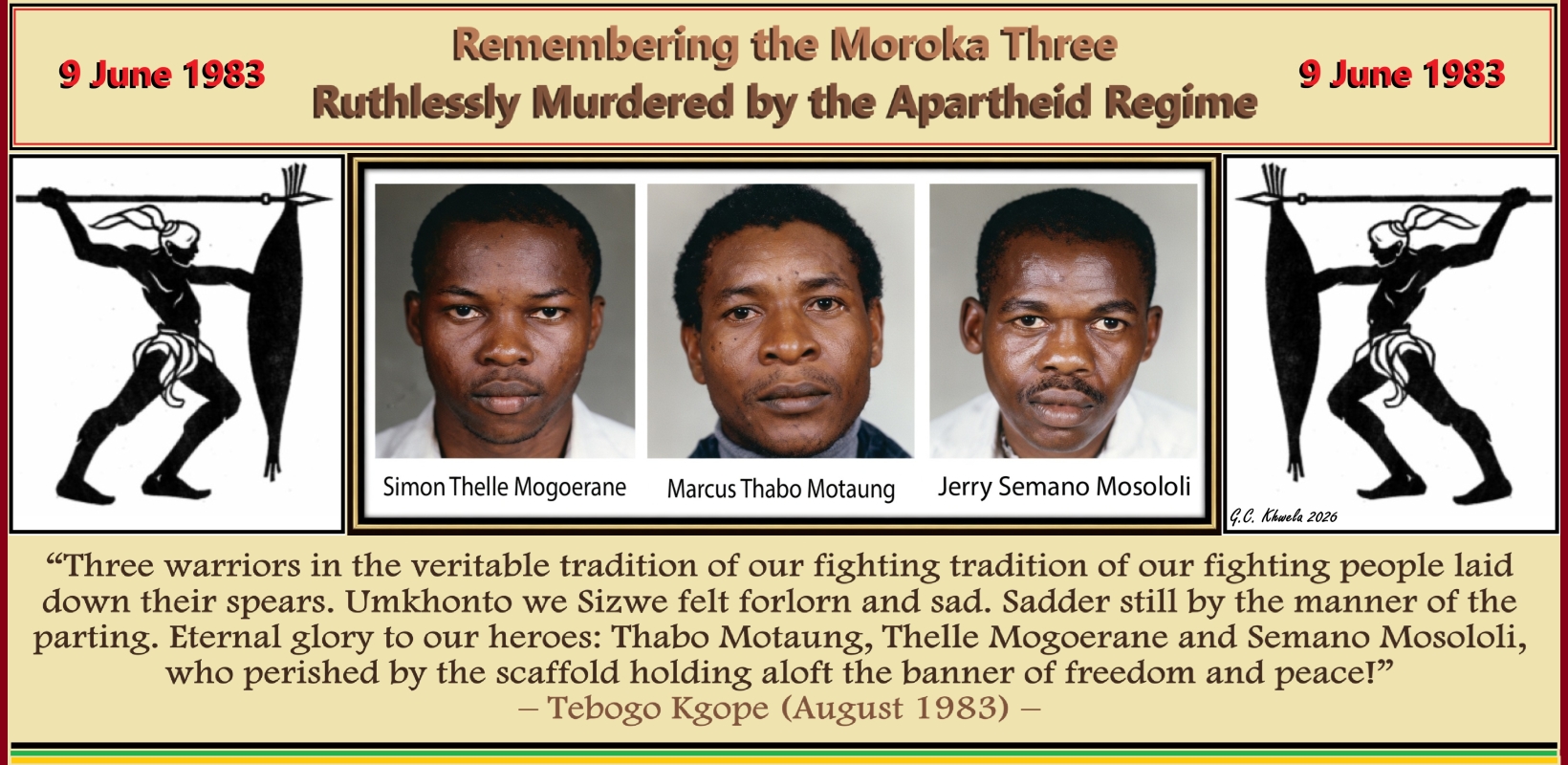
Remembering the Moroka Three: Ruthlessly Murdered by the Apartheid Regime
On 9 June 1983, Umkhonto we Sizwe (MK) operatives, Jerry Semano Mosololi (aka “Dragon Mosepedi”), Thelle Simon Mogoerane (aka “Seiso Moletsane”) and Marcus Thabo Motaung (aka “Abbey”) were executed for their part in a hit on Wonderboompoort police station. The three MK soldiers were brought to court on charges relating to attacks on racist police stations at Orlando, Moroka and Wonderboompoort, during which four apartheid policemen were killed and a number of others injured.
When the trial first opened in the Pretoria Magistrates Court on 23 April 1982, only two men appeared in court. They were Thelle Simon Mogoerane, who was 23 years old then, and Jerry Semano Mosololi, only 25. Both were dragged barefoot into the courtroom wearing leg irons. Both refused to plead to the main charge of treason or the alternative charges of participating in “terrorist activities”, murder and robbery with aggravating circumstances.
When they appeared for a third time, this time in the Pretoria Supreme Court on 1 June 1982, they were accompanied by a third accused, Marcus Thabo Motaung, who was 27 years old. Motaung of the MK Transvaal Urban Machinery G-5 Unit was arrested on 1 May 1982, after being shot by his former Comrade, Lati Ntshekang, also known as “Ghost Mosotho”, who was formerly with the MK Special Operations Unit, and was later captured during the Matola Raid, in Mozambique. Lati Ronald Ntshekang became one of the 17 original “askaris” who were groomed by the Security Branch in Vlakplaas in the early 1980s.
Motaung’s arrest occurred in Stinkwater, near Hammanskraal, where he was in the company of Solly Shoke (aka “Jabulani Lukhele”), at a shop that was to be a rendezvous with Moses Bafana “Madoda” Mbatha (aka “Lake Mpiyakhe”) of the G-7 Unit. Mbatha was also arrested by the apartheid police on 23 April 1982, in house number 5548, Section C, Mamelodi, north-east of Pretoria. When Mbatha was arrested, the police recovered a Makarov pistol and hand grenades from his room. Mbatha then became an “askari” and joined the ranks of the apartheid Security Branch’s murderous unit in Vlakplaas.
During the day when Marcus Motaung was arrested, on 1 May 1982, Mbatha’s legs were in gypsum (plaster) with a microphone concealed on his body. Both Ntshekang and Mbatha were part of an apartheid security police contingent in a Combi commanded by Major Frederik Nel, which was supposed to arrest both Motaung and Shoke once they exited the shop.
The meeting with Motaung had been arranged by Mbatha, as Motaung had previously tried to contact him, and had suspected that he was arrested. Mbatha told him that he got injured, pointing to his legs. While Mbatha and Motaung were still discussing, Ntshekang heard the sound of an oncoming vehicle, and took it as a cue to pull out his service pistol and pointed it to Motaung. Ntshekang then ordered Motaung to walk in the direction of the vehicle, as he was under arrest.
As these engagements were taking place between Motaung, Mbatha and Ntshekang, Solly Shoke who had waited in the passage a few metres away, fled from his position, making a U-turn and running deeper into the Stinkwater township. While Shoke was running away, Motaung moved towards Ntshekang, upon which the latter fired two shots in quick succession, one bullet hitting Motaung in the chest.
When Motaung was arrested and placed into a VW Combi by Captain Nel, Mbatha identified him as “Abbey”. Meanwhile Shoke was jumping fences and fleeing the scene into a village about six and a half kilometres away, where he was hidden by people for the night, and was never apprehended by the apartheid police. Solly Shoke successfully avoided the police dragnet by lying low in the village and later escaping back across the border to Swaziland.
Because the Stinkwater shootout blew the G5 unit’s operational cover near Hammanskraal, Shoke could no longer remain safely inside South Africa. The sympathetic villagers hid him long enough to evade the immediate military cordon, allowing him to navigate through the underground railroad back into Swaziland. Swaziland served as the command forward area for MK’s Transvaal operations at the time.
Going back to the trial of the Moroka Three, they were, among other things, alleged to have undergone military training outside South Africa between 1976 and 1978; to have returned in 1979 to attack the Moroka police station in November 1979, killing two racist police and injuring others; to have attacked the Orlando police station in November 1979, killing one policeman and injuring others; to have attacked the Wonderboompoort police station near Pretoria in 1981, killing two apartheid policemen and injuring others; to have cut the Soweto railway line with explosives at New Canada in May 1981; and were found to be in possession of substantial quantities of arms and ammunition.
According to the African National Congress (ANC), “From all this it might appear that the racist court has its case all sewn up and that the charges against the three are incontrovertible. While the outcome of the trial is a forgone conclusion, it is important that no-one is duped by the phoney ‘justice’ meted out in the apartheid courts. Apartheid ‘justice’ is intended solely for vindictive and deterrent purposes.”
The ANC maintained that “By 1978 the first MK operations by units of the Transvaal Urban Machinery took place. After several years in which there had been no MK actions inside the country, following the impetus of the Soweto uprising, units were sent into the country in 1978 to carry out attacks on police stations – this has come to be known as the G5 Operation. Stations attacked included Moroka, Orlando and Booysens, police stations in the PWV area.”
“At the same time”, the ANC continued, “attacks were launched from the Western Front, aimed at establishing guerrilla bases in the Western Transvaal. During the years from 1976 – 1979 there was a marked escalation in armed actions: railway lines were sabotaged in many parts of the country, police stations in Soweto, Germiston and Daveyton were attacked, and Bantu Administration offices in Port Elizabeth were bombed. A number of notorious security police were executed, and for the first time battles between MK units and the police took place; the battle was slowly but surely being taken to the enemy.”
The judicial murder of the Moroka Three was received with feelings of ambivalence within the ranks of the People’s Army, Umkhonto we Sizwe (MK), as some felt the sadness of having lost those with whom they had shared the trenches in Benguela and Novo Catengue. However, their death also aroused the feelings of anger towards the enemy and the determination to destroy the evil system of apartheid, which was well captured by one of the MK combatants, Aurora Mfanafuthi, in his tributary article (Dawn, June 1983), in which he said:
“On the 9th of June 1983, the Pretoria boers defying all reason and logic executed Comrades Simon Mogoerane, Jerry Mosololi and Marcus Motaung. With these murders the enemy sought to achieve the impossible, to destroy the fighting spirit of our youth and thus prevent them from joining Umkhonto we Sizwe, to dampen the revolutionary spirit of our masses, and therefore corrode the social base of our army, to boost the ever-sagging morale of their fascist army and white population and drive fear into the ransk of our People’s Army. All of these aims will surely perish under the fire of revolutionary struggle fuelled by the blood of Mogoerane, Mosololi, Motaung, Mahlangu, Mini, Khayinga, Mkhaba, Bongco and many others who have died under the apartheid hangman’s noose.”
Aurora’s words were poetically echoed by Tebogo Kgope, who lamented that “On the morning of June 9, the physical count in our ranks registered minus three. Three combatants who had loomed like Goliaths and blazed a trail of valour in their revolutionary wake did not show up at the roll-call. Three warriors in the veritable tradition of our fighting tradition of our fighting people laid down their spears. Umkhonto we Sizwe felt forlorn and sad. Sadder still by the manner of the parting. Eternal glory to our heroes: Thabo Motaung, Thelle Mogoerane and Semano Mosololi, who perished by the scaffold holding aloft the banner of freedom and peace!” (Dawn, August 1983).
“Indeed”, the ANC averred, “the stand taken by our three soldiers proved an inspiration to our people as a whole. Their deaths evoked more than mourning – they filled thousands more of our best sons and daughters with a stronger dedication, and a determination to take the place of those who had fallen. As with the criminal murder of Comrade Solomon Mahlangu, the racists had failed in their attempts to hold back the struggle. They have succeeded only in adding fuel to the growing flames of revolution in our country.”
The message from Jerry Semano Mosololi’s mother was clear, “Go well, my son, I love you. I am proud of you because you are to die for your people. We’ll meet where you are going. You must know the struggle will not end, even after your death!” Sara Mosololi (Dawn, August 1983).
Within the ranks of the People’s Army, Umkhonto we Sizwe, it became critical to emphasise that “At this point in our struggle it is necessary to remind ourselves what we, as members of MK, truly are drawing inspiration from their spirit and reaffirming our vow … Even when they were facing death in the hands of the enemy, these three heroes defied it and denied the enemy information he did not have, thus saving other comrades. We who knew them and worked with them say their families, relatives and friends must remain proud for having produced such heroes for the South African revolution. For us their deeds shall remain a deep source of inspiration until the ideals they cherished have been brought to fruition.”
OUR BATTLE CRY IS AND WILL CONTINUE TO BE VICTORY OR DEATH WE SHALL WIN! – Oliver Tambo
Sources:
African National Congress, “Further Submissions and Responses by the African National Congress to Questions Raised by the Commission for Truth and Reconciliation”, 12 May 1997.
Aurora Mfanafuthi, “Desperate Murderers – The Pretoria Cutthroats”, Dawn, Vol. 7 No. 6, June 1983.
Tebogo Kgope, “Heroes of Our Revolution: May Their Memory Never Fade”, Dawn, Vol. 7 No. 8, August 1983.
Editorial, “Heroes of Our Revolution”, Dawn, Vol. 1 No. 1, 1988.
Editorial, “The Three Soldiers of the People’s Army”, Sechaba, August 1983.
Thula Simpson, “Umkhonto we Sizwe: The ANC’s Armed Struggle”, Penguin, 2016.
Stanley Manong, “If We Must Die: An autobiography of a Former Commander of uMkhonto we Sizwe”, Nkululeko, 2015.
Castro Khwela
Good evening fellow Compatriots!🙏🏾✊🏾👊🏾
Discover more from CASTRO KHWELA
Subscribe to get the latest posts sent to your email.


