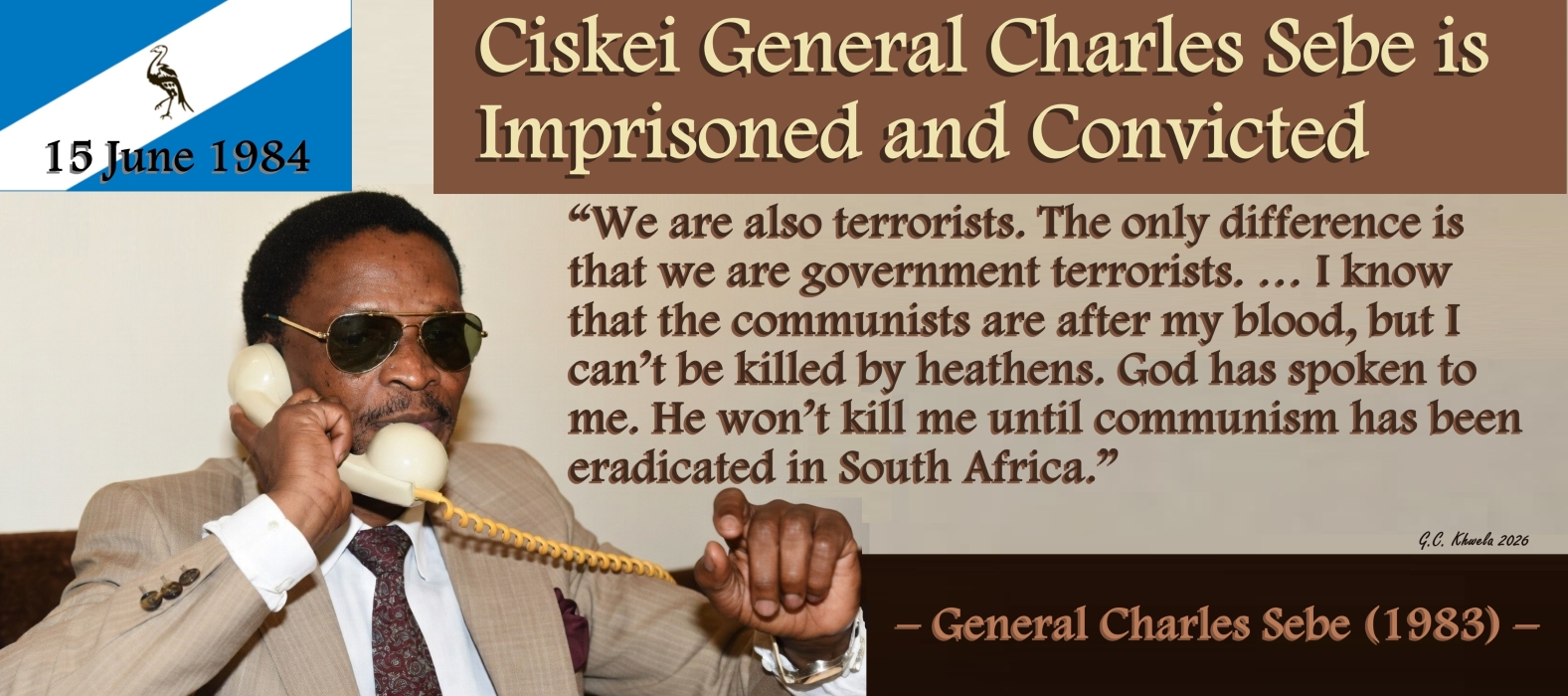
Ciskei General Charles Sebe is Imprisoned and Convicted
On 15 June 1984, former Commander of the Armed Forces of the Ciskei, Major-General Charles Sebe, brother of President Lennox Sebe, was sentenced to twelve years’ imprisonment after being found guilty of incitement to public violence. He was charged of having established and being leader of a brutal elite unit named “Ikrele Lesizwe” (Sword of the Nation), an anti-terrorist squad that championed state-sponsored violence and intimidation, and was later bent on destabilising and overthrowing the Ciskei Bantustan government.
Major-General Charles Sebe (often referred to as Lieutenant-General Xhanti Charles Sebe) was the former commander-general of the combined armed forces and the Director of State Security in the former Ciskei Bantustan. He was one of the most powerful, feared and enigmatic figures of South Africa’s apartheid-era homeland system. His life and career epitomised the volatile, paranoid and often violent politics of the “Bantustans” – territories established by the Pretoria government referred to as ‘Bantu Homelands’ to enforce ethno-geographic and racial segregation.
As the architect of a ruthless police state in the Ciskei, his rise to absolute power, spectacular fall from grace, and violent death in a South African-orchestrated trap serve as a vivid case study of Bantustan “homeland” politics.
Charles Sebe began his career as an ambitious agent within South Africa’s notorious apartheid intelligence networks. He served as a security policeman in the apartheid South African Police (SAP) Security Branch and later joined the South African Bureau of State Security (BOSS). When his brother, Lennox Sebe, led the Ciskei homeland toward unilateral “independence” in 1981, Charles was dispatched to build and manage its local military apparatus. He rapidly consolidated his power. He was named Commander-General of the combined armed forces and Director of State Security.
In this role, he commanded the Ciskei Defence Force (CDF), police force, prison system, intelligence services and traffic police. Within six years, he transformed a tiny police unit of three men into a heavily armed security state of over 3,000 personnel, backed by an enormous South African budget. During the early 1980s, Charles Sebe was widely regarded as the de facto ruler of the Ciskei, operating with absolute impunity. Using the sweeping, draconian powers of the Ciskei National Security Act of 1982, Charles instituted a total police state. He systematically crushed political dissent, banned trade unions, and oversaw the routine detention and torture of students, activists and perceived political enemies.
He established a brutal elite unit named “Ikrele Lesizwe” (Sword of the Nation), an anti-terrorist squad that became synonymous with state-sponsored violence and intimidation. Ikrele Lesizwe served as the ultimate iron fist used by General Charles Sebe to violently suppress the national liberation struggle within the Ciskei homeland and neighbouring regions. Operating essentially as a state-sanctioned paramilitary death squad and anti-terrorist unit, the group was deliberately engineered to insulate the apartheid state by outsourcing the execution of brutal counter-insurgency warfare to an internal black proxy force.
The unit targeted the national liberation movement through several distinct methods, including crushing domestic resistance and mass mobilisation. The primary objective of Ikrele Lesizwe was to ensure that anti-apartheid liberation movements – most notably the African National Congress (ANC) and the United Democratic Front (UDF) – could not establish a strategic foothold in the Eastern Cape. The unit ruthlessly targeted the South African Allied Workers’ Union (SAAWU), which was heavily active in the industrial hubs of Mdantsane and East London. Its operatives routinely abducted, beat, and intimidated union leaders to break strikes and halt pro-liberation labor mobilization.
Ideological resistance led by the Congress of South African Students (COSAS) was met with immediate, armed retaliation. The squad conducted midnight raids on schools and universities, detaining youth organisers under the draconian Ciskei National Security Act. Ikrele Lesizwe operated completely outside the bounds of conventional law, using systemic violence to extract intelligence regarding the underground liberation network. The unit utilised specialised detention facilities where political activists were subjected to severe psychological and physical torture, including electric shocks, mock executions and prolonged beatings. Activists suspected of hosting underground cells for the ANC’s armed wing, Umkhonto we Sizwe (MK), or facilitating the movement of recruits out of South Africa, were targeted for extrajudicial elimination or “disappearance”.
Beyond local policing, Charles Sebe positioned Ikrele Lesizwe as a direct ally to mainstream South African apartheid structures, such as the apartheid Security Branch and SA Defence Force’s (SADF) Military Intelligence. The unit actively gathered intelligence on regional liberation corridors, monitoring the borders between Ciskei, the Transkei and the broader Cape Province. Information extracted by the unit was funnelled directly to Pretoria to disrupt MK guerrilla paths. The unit was deployed to crush popular rural resistance against apartheid’s forced resettlement programmes, ensuring that displaced communities remained compliant and subdued under the homeland system.
A former apartheid South African intelligence agent and covert operative, Major-General Taillefer “Tai” Minnaar, played a foundational and operational role in the creation and advancement of Ikrele Lesizwe in the Ciskei bantustan. Operating as the right-hand man and security adviser to Ciskei’s intelligence strongman, General Charles Sebe, Minnaar weaponised the unit into an aggressive counter-insurgency force designed to suppress national liberation movements like the ANC and independent labour unions.
Minnaar became the primary operational mastermind behind the establishment of Ikrele Lesizwe, institutionalising it as a dedicated, elite “anti-terrorist” task force within the broader Ciskeian Central Intelligence Service (CCIS). He designed the unit as a highly selective, tight-knit 32-man crack squad. It was intentionally staffed with fanatically loyal personnel – including Charles Sebe’s own son, Khambashe Sebe – to insulate the homeland regime from political subversion. To advance the unit’s tactical capabilities, Minnaar built and commanded the Mapasa Special Warfare Centre located at Peddie in the Ciskei.
The Mapasa Special Warfare Centre served as the localised military base where Ikrele Lesizwe operatives were permanently stationed and trained. Drawing from his deep background in South African military intelligence and espionage, Minnaar personally oversaw the advanced training regimes of the troops. He instructed them in specialised urban counter-insurgency, intelligence tracking, rapid deployment and harsh interrogation techniques. Under Minnaar’s guidance, Ikrele Lesizwe advanced from a protective detail into an active instrument of state terror.
It was deployed to hunt down underground ANC guerrilla networks operating in the Eastern Cape and to brutalise internal civic organisations like the South African Allied Workers Union (SAAWU). As noted by the ANC’s official organ, Sechaba, Minnaar’s leadership within the unit ensured that Ikrele Lesizwe functioned effectively as an extension of South Africa’s broader apartheid security apparatus. The unit allowed Pretoria to maintain plausible deniability while aggressively cracking down on liberation forces within the bantustan’s borders.
The formal historical records and Truth and Reconciliation Commission (TRC) transcripts provide documented biographies of key anti-apartheid activists who directly opposed, survived or were martyred by Charles Sebe’s security forces and the Ikrele Lesizwe apparatus. Because the unit focused on crushing trade unions and underground liberation cells, the most prominent figures who stood up to them were leaders of the SAAWU. Thozamile Gqweta was the founding President of SAAWU and arguably the most hunted anti-apartheid organiser in the East London and Ciskei region. He became the primary target of Charles Sebe’s personal fixation on destroying the black labour movement.
Gqweta organised thousands of factory workers living in the Ciskei mega-township of Mdantsane. He openly rejected the Ciskei’s nominal independence, declaring that homeland structures were designed to strip black South Africans of their citizenship rights. Between 1980 and 1983, Gqweta was detained without trial by Sebe’s security police eight separate times without ever being convicted of a crime. The apartheid regime resorted to extrajudicial terror to break his spirit. In November 1981, his mother and uncle were burned to death when their house was wired shut from the outside.
Days after the funeral, Ikrele Lesizwe/Ciskei forces opened fire on a crowd of returning mourners, killing his fiancée, Deliswa Roxiso. Despite undergoing brutal “helicopter” and suspension tortures that led to a psychological breakdown, Gqweta survived the era to help integrate SAAWU into the Congress of South African Trade Unions (COSATU).
With “helicopter” and suspension torture, the detainee’s hands were handcuffed or shackled together in front of them. The victim was forced to squat, pushing their knees through their bound arms. A thick wooden stick or broomstick was passed over the wrists and behind the knees. The ends of the stick were then lifted and balanced between two high tables, a pair of chairs, or suspended from the ceiling. This left the victim hanging completely upside down, unable to move. Interrogators would then aggressively spin them around or swing them back and forth like a pendulum.
Another leader was Sisa Njikelana, who was the National Vice-President and later General Secretary of SAAWU. He worked alongside Gqweta to fuse shop-floor labour issues with the broader national liberation struggle. Njikelana famously argued that workers’ economic oppression could not be separated from their political subjugation by the Bantustan systems. He heavily mobilised workers to join the anti-homeland campaigns. He was detained seven times between 1980 and 1982. In August 1983, shortly before SAAWU was formally banned inside Ciskei, Njikelana was captured by Sebe’s elite forces. Despite enduring severe physical abuse in Ciskei cells, Njikelana refused to yield or stop organising. He went on to become a key figure in the United Democratic Front (UDF) and served as a post-apartheid political figure.
Third was Archibald Patuleni. While not a prominent public intellectual like Gqweta, Archibald Patuleni represented the underground liberation movement network that directly confronted Charles Sebe. Patuleni was an underground operative operating within the Border region – King William’s Town and Ciskei. He was tracked down and personally interrogated by Charles Sebe and his case was highly significant because his testimony at the TRC vividly exposed Sebe’s psychological torture methods. Patuleni testified that Sebe mockingly forced him to sit in an “imaginary government chair” for hours on end without moving. If his legs buckled, he was severely beaten. Patuleni’s survival and harrowing accounts were demonstrated at the TRC hearings and preserved in the TRC Final Report.
The Truth and Reconciliation Commission (TRC) ultimately passed formal findings regarding the activities of Sebe’s regime against these specific individuals: The TRC officially found the Ciskei leadership and security forces, under Charles Sebe, responsible for severe human rights violations, including the harassment, torture and killing of SAAWU members.
The absolute authority wielded by Charles eventually triggered immense paranoia within the ruling elite, especially from his brother, President for Life Lennox Sebe. In April 1983, amid rising rumours that Charles was planning a military coup, Lennox Sebe moved pre-emptively while Charles was out of the country. Lennox stripped Charles of his command and replaced him. Charles’s son, Khambashe Sebe, alongside other top military aides, were detained and Charles Sebe was arrested and charged with incitement to public violence and plotting to overthrow the state. In 1984, he was convicted and sentenced to 12 years in prison at the Middledrift Maximum Security Prison. Lennox Sebe subsequently rejected multiple formal requests from South Africa’s Foreign Affairs Minister, Pik Botha, to grant his brother clemency.
The highly volatile, paramilitary nature of Ikrele Lesizwe eventually accelerated the internal collapse of the Ciskei regime itself. By 1983, the unit’s absolute authority caused massive paranoia inside the presidency. When President Lennox Sebe suspected Charles of plotting a coup, Ikrele Lesizwe became a central target of the subsequent state purge. Top members of the squad – including Charles Sebe’s own son, Khambashe Sebe – were arrested and detained by rival wings of the Ciskei military, effectively ending the unit’s cohesive run as a state entity.
Minnaar’s advancement of Ikrele Lesizwe abruptly halted in July 1983 during a paranoid internal power struggle within the homeland’s ruling family. Believing that Charles Sebe was using his highly weaponised Ikrele Lesizwe network to coordinate a coup, Ciskei President Lennox Sebe pre-emptively arrested both his brother and Minnaar. Minnaar was detained under the National Security Act, effectively dismantling his grip on the elite force he had engineered. Following his detention in leg irons by Ciskei President Lennox Sebe in 1983, the South African government intervened to secure his release.
After his 1983 arrest in Ciskei, Minnaar returned to the shadowy world of South African Military Intelligence and international espionage within the broader South African Defence Force (SADF) security apparatus, eventually rising to the rank of Major-General. He continued to operate in deep-cover intelligence networks up to and through South Africa’s democratic transition in 1994. His post-apartheid life was defined by illicit arms dealings, biological weapons brokering, and high-level political assassination probes before his sudden death.
In the late 1990s and early 2000s, Minnaar transitioned into the private sector as an independent intelligence broker and private investigator. He frequently capitalised on his old apartheid-era networks to sell secrets, operating across borders in Europe and the United States. Shortly before his death, Minnaar worked alongside private investigators to commercially probe the 1986 assassination of Swedish Prime Minister Olof Palme. Minnaar claimed to possess explosive, authentic Military Intelligence documents proving that an apartheid-era hit squad was responsible for Palme’s murder. Extracts of these findings made front-page news across the Swedish and South African press right around the time of his death.
According to investigative reports by the Mail & Guardian newspaper, what likely cost Minnaar his life was his direct involvement in trying to sell South African biological warfare expertise abroad. Minnaar was part of a syndicate attempting to hawk anthrax and chemical weapon secrets derived from South Africa’s notorious apartheid-era chemical weapons program, Project Coast – led by Dr Wouter Basson). On the night of 9 September 2002, Minnaar suddenly fell violently ill and died the following morning. While officially recorded as a heart attack, the timing of his death – occurring right as the FBI pulled the plug on his chemical weapons deal and amid his revelations about the Palme assassination – led intelligence experts to widely believe he was poisoned to be silenced.
Charles Sebe’s imprisonment did not mark the end of his involvement in homeland geopolitics; instead, it made him a valuable pawn for South African military planners. By 1986, the apartheid SADF, under regional commanders like General Joffel van der Westhuizen, drafted a covert destabilisation strategy known as Operation Katzen. The goal was to merge the Ciskei and Transkei homelands into a single Xhosa mega-state ruled by a pro-Pretoria faction, thereby neutralising anti-apartheid resistance in the Eastern Cape.
On 26 September 1985, a heavily armed team of white commandos/mercenaries launched a daring raid on the Middledrift prison, successfully breaking Charles Sebe out of his cell. Simultaneously, Transkei-backed forces abducted Lennox Sebe’s son, Kwane Sebe, to use as a political hostage. Charles Sebe was granted political asylum in the rival Transkei homeland. From there, he formed Iliso Lomzi (The Eye of the Nation), a rebel insurgent group that launched cross-border raids and assassination attempts targeting Lennox Sebe’s government.
In 1990, Lennox Sebe was overthrown in a coup led by Brigadier Oupa Gqozo. Sebe saw this as his opportunity to return to power, but it ultimately led to his execution. In January 1991, an intelligence unit named International Researchers – Ciskei Intelligence Services (IR-CIS), headed by South African operative Anton Nieuwoudt, orchestrated a sting operation. They convinced Charles Sebe and fellow military dissident Colonel Onward Guzana that a coup was underway in Ciskei and that they should cross the border to assume control.
Upon crossing into Ciskei, Sebe and Guzana were ambushed at a roadblock. Guzana was killed instantly, while a wounded Charles Sebe escaped into the bush, triggering a massive manhunt. On 28 January 1991, Sebe was located by Ciskei security forces. Despite attempting to surrender, he was summarily shot and executed on the orders of the Gqozo regime. According to the subsequent investigations of the TRC, Charles Sebe’s life illustrated the absolute failure and internal rot of the Bantustan experiment. He proved how South Africa’s apartheid regime created proxy dictatorships, funded localised police states, and then engineered bloody internal conflicts – using figures like Charles Sebe as disposable tools until they were no longer politically useful.
In its analysis of the Ciskei, as well as broader pieces analysing the Bantustan system during that period, Sechaba (May and December Issues 1983) detailed the reactionary role of Charles Sebe by characterising him as a primary agent of Pretoria’s proxy repression. The journal highlighted his legacy by framing Charles Sebe not as an independent national leader, but as a willing collaborator and security functionary for the apartheid regime. The ANC’s position was that figures like Sebe helped weaponise ethnic division – “Bantustan pottage” – to stall a unified, non-racial national democratic revolution. By building up a highly militarised, autonomous intelligence unit in Ciskei, Sebe actively worked to insulate the South African state from the swelling “People’s War” sweeping the rest of the country.
The publication highlighted how Sebe spearheaded an unyielding “iron fist” campaign targeting anti-apartheid organisations, mass democratic movements, and independent trade unions. Specifically, Sechaba documented his role in framing the leadership of the SAAWU and other labour organisers as “communist-inspired” national security threats; conducting mass detentions of activists, students and workers; and attempting to link legitimate internal civic resistance directly to underground ANC guerrilla networks to justify severe treason trials and torture.
By late 1986, Charles Sebe’s position had shifted dramatically; he had fallen out with his brother, Ciskei President Lennox Sebe, been jailed, and was subsequently busted out of a Middledrift maximum-security prison by armed white mercenaries in September 1986. Sechaba (December 19860 used this internal, violent feuding between the Sebe factions, and the neighbouring Transkei authorities, to demonstrate the inherent rot and instability of the Bantustan “homeland” system. The ANC argued that the puppet infrastructure built by Charles Sebe ultimately consumed itself, proving that these regimes were fragile, artificial constructs unable to withstand the political crisis facing South Africa.
The African National Congress (ANC) and its military wing, Umkhonto we Sizwe (MK), responded to Ikrele Lesizwe and Charles Sebe’s 1986 mercenary breakout through strategic intensification of the armed struggle, aggressive political mobilisation and ideological exposure. Rather than treating the internal warfare within the Ciskei homeland as an isolated mutiny, the ANC integrated these events into its broader “People’s War” strategy to render the apartheid state and its bantustans completely ungovernable.
The ANC viewed the September 1986 prison breakout of Charles Sebe – orchestrated by white mercenaries and backed by the rival Transkei bantustan – as an indictment of the homeland system’s structural fragility. MK leadership capitalised on the chaos by exploiting border weaknesses. The violent border feuds and intelligence friction, between Lennox Sebe’s Ciskei and Kaiser Matanzima’s Transkei, left security checkpoints compromised. MK took advantage of this distraction to accelerate the infiltration of guerrilla units and arms caches into the Eastern Cape.
While Charles Sebe was using his newly formed Transkei-backed rebel group, “Iliso Lomzi”, to mount personal retaliatory attacks against his brother, MK quietly built parallel underground networks inside Ciskei’s mass democratic formations. MK cadres did not attempt to negotiate or align with any faction of the Sebe family; they classified both Charles Sebe’s rebels and the remaining Ikrele Lesizwe / Elite Unit loyalists as illegitimate colonial proxies. MK responded militarily by launching sabotage campaigns against bantustan government buildings, police stations and transport links.
The network of internal enforcers built by Charles Sebe was systematically targeted. Activists and MK guerrillas conducted retaliatory actions against local headmen, tribal authorities, and intelligence collaborators who supplied information to the Ciskei Central Intelligence Service (CCIS). Through its various publications and underground broadcasts on Radio Freedom, the ANC used the 1986 breakout as a textbook example of “puppet theatre”. The ANC heavily publicised the fact that Charles Sebe relied on white soldiers-of-fortune to escape prison. This shattered any illusion that the homeland leadership represented authentic African, black or Xhosa nationalism.
The ANC integrated the Ciskei crisis into its overarching 1986 campaign mandate, “The Racist Shall Not Rule: 1986 Year of the People’s Army, Umkhonto we Sizwe”. MK used the collapse of Ciskeian internal security to rally the youth, instructing them to bypass the fractured tribal authorities and join the unified national liberation movement. Ultimately, MK’s long-term response was validated. By ignoring Charles Sebe’s personal feuds and focusing on building mass internal resistance, the ANC successfully eroded the social fabric of the Ciskei bantustan, setting the stage for its eventual collapse in the early 1990s.
Sources:
Wikipedia.
South African History Online (SAHO).
South African History Archive (SAHA).
Nancy Charton (Ed.), “Ciskei: Economics and Politics of Dependence in a South African Homeland”, Croom Helm, 1980.
Lungelo Mfana, “Ciskei – Sebe Brothers At It Again”, Sechaba, May Issue 1983.
Glen Moss, “Njikelana on SAAWU”, Work In Progress, August 1983.
Joseph Lelyveld, “Homeland Leader Recounts A Plot”, The New York Times, 28 August 1983.
Editorial, “The Crisis in the Ciskei”, Sechaba, December Issue 1983.
Nyawuza, “Ciskei – The Struggle Continues”, Sechaba, December Issue 1983.
Detainees Support Committee, “Profile of the Ciskei”, Descom Bulletin, No. 5, December 1983.
I.D.A.F. News Correspondent, “Ciskei: The Bloodiest Bantustan”, I.D.A.F News Notes, International Defense and Aid Fund for Southern Africa, February 1984.
Steve Tshwete, “‘I Will Not Be Bought: Steve Tshwete Speaks to Cassius Mandla”, Sechaba, April 1986.
Cape Times Correspondent, “Sebe’s Son to Face Charges in Transkei”, Cape Times, 2 October 1986.
Chris Hani, “25 Years of Armed Struggle: Army Commissar Chris Hani Speaks”, Sechaba, December 1986.
Leroy Vail (Ed.), “The Creation of Tribalism in Southern Africa”, Berkeley: University of California Press, 1989.
Human Rights Watch / Africa Watch, “Ciskei: Ten Years on – Human Rights and the Fiction of ‘Independence’. Human Rights Watch / Africa Watch, Vol. 3, Issue 16, 20 December 1991.
Truth and Reconciliation Commission, “Truth and Reconciliation Commission of South Africa. TRC Final Report: Volume 2”, TRC, 29 October 1998.
Truth and Reconciliation Commission, “Truth and Reconciliation Commission (TRC) of South Africa. TRC Final Report: Volume 3”, TRC, 29 October 1998.
Truth and Reconciliation Commission, “Truth and Reconciliation Commission (TRC) of South Africa. TRC Final Report: Volume 5”, TRC, 29 October 1998.
Gerrie Hugo and Stef Snel, “Military Intelligence and the Counter-Revolutionary War in the Eastern Cape”, Grahamstown: Urban Monitoring and Awareness Committee, 1998.
Staff Reporter, “The Return of Dr Death”, Mail & Guardian, 11 September 2009.
J.A. Smit, “The Rule of Brigadier Oupa Gqozo in Ciskei”, Doctoral Thesis: University of Fort Hare, 2011.
Fezile Cindi, “The Rise and Fall of the Ciskei Homeland and Bantustan Leadership, 1972–1994”, Oral History Journal of South Africa, Vol. 6, No. 2, 2018.
Amathole Museum, “Lt. Gen. Charles Xhanti Sebe: A Few Famous Quotes”, Imvubu Newsletter Archive.
Castro Khwela
Good morning fellow Compatriots!🙏🏾✊🏾👊🏾
Discover more from CASTRO KHWELA
Subscribe to get the latest posts sent to your email.