Kenneth Kaunda Rebukes British Foreign Secretary Geoffrey Howe
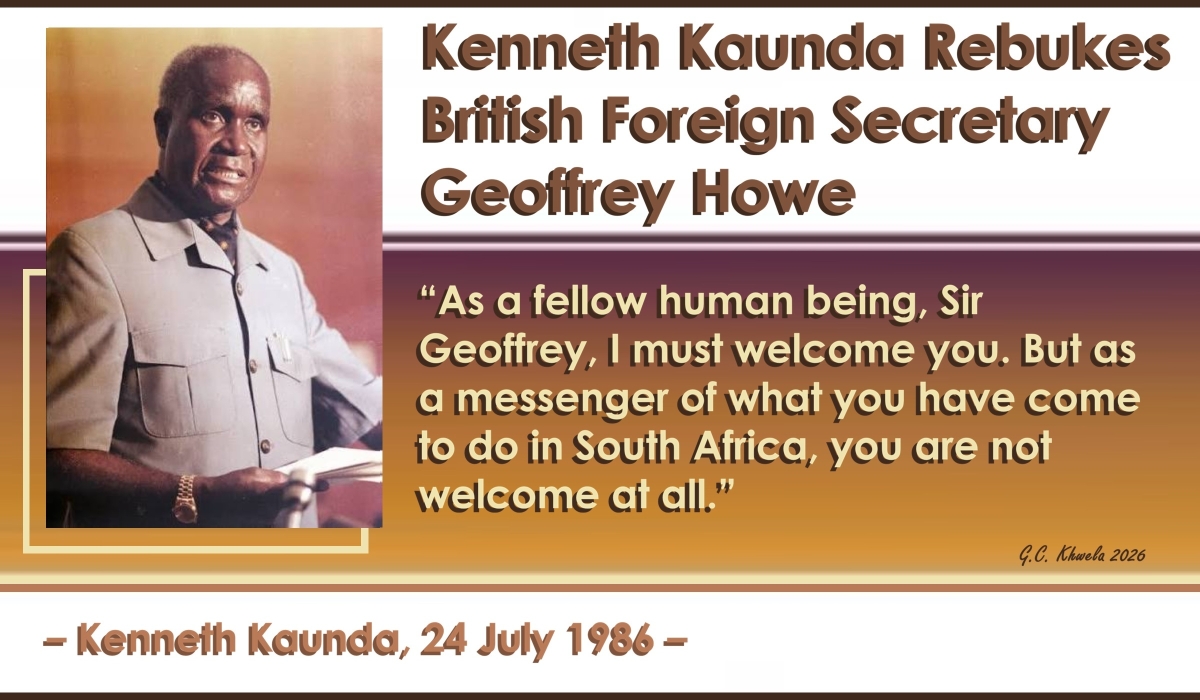
On 24 July 1986, precisely 40 years ago, Zambian President, Kenneth Kaunda publicly rebuked Britain’s foreign secretary, Geoffrey Howe, accusing him and President Reagan of supporting South Africa’s apartheid government. Kaunda famously accused the British and United States governments of “kissing apartheid” and blessing South Africa’s oppressive regime. The confrontation was triggered by U.S. President Ronald Reagan’s policy speech earlier that week, where he firmly rejected imposing stricter economic sanctions against Pretoria. Kaunda viewed the Western resistance to punitive sanctions as a joint conspiracy between Washington and London.
He argued it signalled to white South Africans that they had nothing to fear from the West. In this context, Kaunda famously stunned Howe by stating, “As a fellow human being, Sir Geoffrey, I must welcome you. But as a messenger of what you have come to do in South Africa, you are not welcome at all.” He added that Western leaders would “not be forgiven by history” as the region faced an imminent explosion of violence. The attack by Kaunda on Howe and Reagan came at the height of popular unrest across South Africa and his anger was prompted by Reagan’s rejection of stronger United States (US) economic sanctions.
Sir Geoffrey Howe, traveling on behalf of the European Economic Community (EEC) peace mission, listened in silence before denying the conspiracy allegations. Howe argued that the UK was trying to dismantle apartheid via peaceful dialogue and negotiation rather than through economic warfare, which he claimed would aggravate black suffering. Despite the public humiliation of her Foreign Secretary, British Prime Minister Margaret Thatcher continued to resist comprehensive international sanctions throughout that period. Kaunda went on lashing out at Reagan and British Prime Minister Margaret Thatcher, accusing them of conspiring to defend white supremacy in South Africa by resisting international pressure for sanctions.
US President Ronald Reagan and British Prime Minister Margaret Thatcher resisted international sanctions against South Africa primarily due to Cold War strategic alignments, adherence to free-market capitalism, and a shared belief in a diplomatic strategy known as “Constructive Engagement”. They contended that isolating the Pretoria regime would eliminate Western political leverage and destabilise a critical anti-communist ally. Both leaders viewed South Africa as a vital bulwark against Soviet expansionism in Sub-Saharan Africa. Reagan and Thatcher publicly categorised the African National Congress (ANC) as a terrorist organisation heavily funded and influenced by the Soviet Union.
For them, South Africa controlled massive global supplies of platinum, chromium and manganese, which the West relied upon for its defence industries and military infrastructure. The diplomatic strategy known as “Constructive Engagement”, orchestrated by Reagan’s Assistant Secretary of State Chester Crocker, maintained open diplomatic ties with Pretoria to quietly pressure President P.W. Botha into incremental reforms. They argued that total economic isolation would completely destroy the South African economy, empowering Marxist extremists and turning the region into a war zone.
Thatcher held a deep ideological opposition to trade barriers, considering economic sanctions to be an unnecessary violation of free-market capitalism. Both the UK and US had billions invested in South African industries and Thatcher explicitly warned that British job losses would follow any serious commercial decoupling. She argued that sanctions were “the way of poverty [and] starvation” for the very black majority the international community wanted to protect. To justify their policy, they frequently hosted anti-sanctions South African figures, such as KwaZulu Chief Mangosuthu Gatsha Buthelezi, to argue that ordinary workers opposed international boycotts.
Western historians generally conclude that while Kaunda’s claim of a “conspiracy to defend white supremacy” was inaccurate regarding their explicit motives, his accusation was correct and fair regarding the practical impact of their policies. By consistently blocking UN Security Council sanctions, Reagan and Thatcher effectively provided diplomatic cover to Pretoria and allowed the apartheid government to continue its internal repression without facing immediate economic collapse. Both Western leaders treated the anti-apartheid struggle primarily as a Cold War proxy conflict. They ignored the fact that the primary driver of the unrest was the brutal domestic denial of fundamental human rights to the black majority.
Kaunda’s anger was vindicated by local South African leaders like Archbishop Desmond Tutu, who famously remarked that the West’s policy of “constructive engagement” was an unmitigated disaster that only prolonged the suffering of black South Africans. Declassified documents show that Reagan and Thatcher were not motivated by a desire to defend white supremacy itself. Instead, they were driven by class interests, an intense, rigid anti-communism and a commitment to free-market capitalism.
They genuinely feared that a sudden collapse of the Pretoria regime would allow a Soviet-backed, Marxist government to take power, cutting off the West’s access to vital cape sea routes and strategic minerals. Their resistance to sanctions stemmed from a misplaced, naive belief that they could gently persuade the white minority government to reform itself from within, rather than a malicious plot to maintain racial subjugation.
The global community, African independent states, Southern African countries, and national liberation movements unanimously condemned and deeply resented Ronald Reagan’s and Margaret Thatcher’s opposition to sanctions. Their stance was widely viewed as a betrayal of human rights that prolonged the violence of the apartheid regime. The African National Congress (ANC) and the Pan Africanist Congress (PAC) were outraged by Thatcher publicly labelling the ANC as a “terrorist organisation”.
Liberation leaders like Oliver Tambo and Sam Nujoma argued that Reagan’s policy of “constructive engagement” gave Pretoria a free pass to assassinate political dissidents and suppress internal uprisings. The movements insisted that international sanctions were the most viable non-military mechanism to force the National Party government to negotiate a transition to majority rule. According to ANC President Oliver Tambo:
“In its report, the Commonwealth Group of Eminent Persons has warned of the certainty of unspeakable bloodshed in southern Africa if the international community does not intervene by imposing effective sanctions. It should be clear from what we have said that we ourselves agree with this conclusion. The use of violence is an imperative internal to the apartheid system, inherent in it, the motor that drives its engine of survival. Already a man-hating system, apartheid will be particularly destructive of black people because, in any case, it describes us as less than human and therefore capable of being annihilated as so much vermin.”
Similarly, the Frontline States – including Zambia, Zimbabwe, Mozambique and Angola – bore the direct military and economic brunt of Pretoria’s destabilisation campaigns. They viewed Anglo-American anti-sanctions policies as an enablement of South African cross-border raids and proxy wars. Despite their own severe economic dependence on South African trade infrastructure, these countries actively lobbied for total global boycotts. Leaders like Kenneth Kaunda and Julius Nyerere repeatedly argued that Western inaction made Washington and London complicit in regional bloodshed.
Unified under the Organisation of African Unity (OAU), independent African nations viewed apartheid as the final vestige of colonialism on the continent. They leveraged their voting blocs in the United Nations General Assembly to continuously pass anti-apartheid resolutions, routinely facing vetoes from the US, UK and France in the UN Security Council. They weaponised forums like the Commonwealth to diplomatically isolate Thatcher. Within the Commonwealth of Nations, 48 out of 49 member countries fiercely disagreed with Britain. The absolute refusal of Thatcher to budge almost fractured the entire organisation, leading to threats of boycotts against the 1986 Commonwealth Games.
In both the US and the UK, civil society, student groups, and trade unions fiercely opposed their own governments’ stances. This culminated in massive anti-apartheid movements across Western universities and corporate boards. Public pressure grew so immense that the US Congress launched a bipartisan rebellion, overriding Reagan’s presidential veto to enact the Comprehensive Anti-Apartheid Act of 1986, officially shattering his administration’s policy.
Ultimately, Kenneth Kaunda’s public rebuke of Geoffrey Howe was highly effective in accelerating the collapse of Western resistance to apartheid sanctions. While it did not immediately alter the policies of Reagan and Thatcher, it served as a powerful catalyst that dramatically shifted international public opinion and catalysed legislative action in the West. By delivering the tirade directly in front of the international press, Kaunda stripped away the diplomatic politeness surrounding Howe’s mission. It exposed “constructive engagement” to the global public not as a peace strategy, but as an enabling policy that protected a brutal regime.
The public humiliation effectively declared the British peace mission a failure, proving to the world that frontline African leaders would no longer tolerate Western stalling tactics. Kaunda’s raw, emotional warning that a “bloodbath” was imminent if the West did not act, gave immense ammunition to anti-apartheid activists in Washington. Just over a few months after Kaunda’s rebuke, the US Congress delivered a historic blow to Reagan’s foreign policy. Deeply moved by the growing global fury and the visible anger of African heads of state, Congress overrode Reagan’s veto to pass the Comprehensive Anti-Apartheid Act of October 1986, officially forcing the US to impose severe sanctions.
Kaunda’s public stance set the tone for the Commonwealth mini summit in London just days later in August 1986. Surrounded by furious African and Caribbean leaders who threatened to dismantle the Commonwealth, Thatcher was forced to break her absolute embargo on sanctions. To save the organisation, she reluctantly agreed to a limited package of British sanctions, including bans on new investments and tourism promotion. The explosive political theatre in Lusaka signalled to the global business community that the political situation in Southern Africa was reaching a point of no return.
Fearing total instability and intense public boycotts at home, major Western corporations, such as Barclays, General Motors and IBM, began pulling out of South Africa by late 1986, crippling the apartheid economy far faster than state-enforced sanctions alone. The apartheid government, led by State President P.W. Botha, reacted to the imposition of sanctions from Washington and London with a defiant mixture of propaganda, domestic crackdowns, economic retaliation against its neighbours and systematic sanctions-busting.
While Pretoria publicly dismissed the restrictions, the measures triggered severe psychological panic and internal economic adjustments within the white ruling structure. The state-controlled South African Broadcasting Corporation (SABC) and government media channels blasted Western nations for hypocrisy. They pointed out that Washington and London carefully excluded strategic minerals – like vanadium, platinum and chromium – from their sanctions lists because the West desperately needed them for military manufacturing. The National Party government used the international restrictions to rally its white electorate, framing the sanctions “as an unjustified, communist-inspired attack on a sovereign, Christian and anti-communist nation”.
Instead of reforming, Botha’s government doubled down on authoritarianism. The state expanded its nationwide State of Emergency, deploying the military into black townships, imposing strict press censorship and detaining thousands of activists without due process. In order to prevent the global community from seeing the violent domestic fallout of the sanctions, the regime banned international journalists from filming or reporting on civil unrest and police brutality. Pretoria weaponised its position as the economic hub of Southern Africa to punish independent neighbouring states that had lobbied for the sanctions.
The apartheid regime introduced strict border controls, slowed down freight transport, and placed special levies on goods passing through South African ports from landlocked countries like Zambia and Zimbabwe. It also threatened to deport hundreds of thousands of foreign black migrant workers back to neighbouring nations to cripple those countries’ economies. It then set up elaborate, state-sanctioned undercover networks to bypass trade bans. Utilising front companies, the racist government falsified certificates of origin and used third-party countries to illegally import oil and weapons.
State-owned corporations were heavily funded to make South Africa self-sufficient. Companies like Armscor produced domestic weaponry, while Sasol scaled up the technology to convert coal into liquid fuel, successfully blunting the immediate impact of the international oil embargo. While the economic defences held temporarily, the Comprehensive Anti-Apartheid Act of 1986 and the threat of total Western disinvestment broke the morale of the white business elite and moderate politicians.
Sources:
Wikipedia.
South African History Online (SAHO).
Darryl C. Thomas, “United Nations Sanctions South Africa for Apartheid”, EBSCO, 30 November 1973.
Reuters, “Zambian Lectures Briton on Apartheid”, Los Angeles Times, 25 July 1986.
No Author, “South Africa Reacts Quickly to Sanctions”, Cayman Compass, 7 August 1986.
E. S. Reddy (Ed.), “Oliver Tambo: Apartheid and the International Community”, Sterling Publishers, 1991.
Milestones, “The End of Apartheid”, Office of the Historian: Milestones in the History of U.S. Foreign Relations, 1989–1992.
Philip I. Levy, “Sanctions on South Africa: What Did They Do?”, Economic Growth Center Yale University, February 1999.
Aaron Griffiths with Catherine Barnes, “Powers of Persuasion: Incentives, Sanctions and Conditionality in Peacemaking”, Accord: Conciliation Resources, 2008.
Richard Dowden, “How Margaret Thatcher Helped End Apartheid – Despite Herself”, The Guardian, 10 April 2013.
No Author, “National Context: President Reagan and ‘Constructive Engagement’”, Divestment for Humanity: The Anti-Apartheid Movement at the University of Michigan, 2015.
Becky Little, “Key Steps That Led to End of Apartheid”, History.com, November 20, 2020
Martin Plaut, “The Real History of the Crown: Thatcher and Apartheid”, History Extra, 28 November 2020.
Editors, “On this Day in History 24 July”, Roodeport Record, 24 July 2016.
Samuel Mallinson and Richard Johnson, “The Discourses of the Anti-Apartheid Sanctions Movement in the United States, 1972–86”, Safundi, Vol. 23, No. 3–4, 2022.
Sam Matthews Boehmer, “Questionable Allies: British Collaboration with Apartheid South Africa, 1960–90”, The International History Review, Vol. 46, No. 1, 2024.
No Author, “Constructive Engagement and the Sullivan Principles”, The Anti-Apartheid Movement in North Texas, https://blog.smu.edu/theanti-apartheidmovementinnorthtexas/history/constructive-engagement/
David Frank Gordon, “The Unraveling of Apartheid”, Encyclopaedia Britannica, 24 July 2026.
Castro Khwela
Good morning fellow Compatriots!🙏🏾✊🏾👊🏾
Discover more from CASTRO KHWELA
Subscribe to get the latest posts sent to your email.