
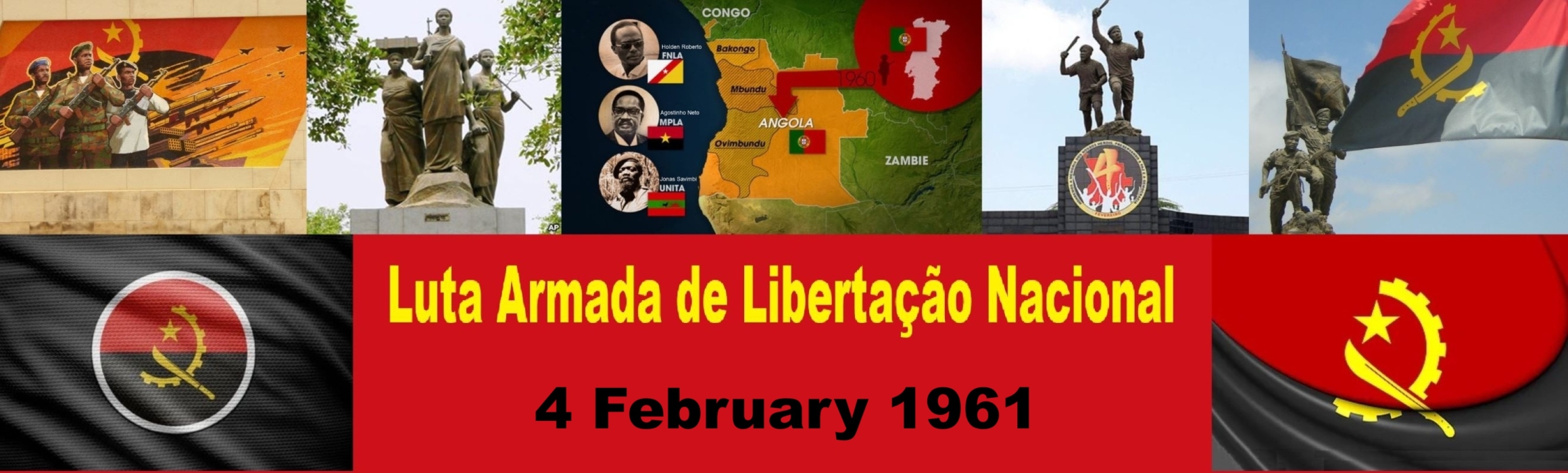
4 February 1961 was the beginning of the Angolan War of Independence, called the “Dia do Início da Luta Armada de Libertação Nacional” (Day of the Beginning of the National Liberation Armed Struggle). It began as an uprising against forced cultivation of cotton, and it became a multi-faction struggle for the control of Portugal’s overseas province of Angola among three nationalist movements: the Popular Movement for the Liberation of Angola (MPLA); the National Liberation Front of Angola (FNLA); the National Union for the Total Independence of Angola (UNITA); and a separatist movement, the Front for the Liberation of the Enclave of Cabinda (FLEC).
It was a guerrilla war in which the Portuguese security forces waged a counter-insurgency campaign against armed guerrilla groups mostly dispersed across sparsely populated areas of a sizable Angolan countryside. The conflict is usually approached as a branch or a theatre of the wider Portuguese Colonial War, which also included the independence wars of Mozambique and Guinea-Bissau.
On the early morning of 4 February 1961, a number of African militants, mostly armed with machetes, ambushed a Public Security Police (PSP) patrol-car and stormed the Civil Jail of São Paulo, the Military Detection House and the PSP Mobile Company Barracks, with the apparent objective of freeing political prisoners that were being held in those facilities. The militants were able to kill the crew of the patrol-car, taking their weapons, but their assaults against the several facilities was repulsed, not being able to release any prisoners.
In the assaults, the security forces suffered seven dead, which included five white and one black police constable, as well as a white Army corporal, besides having several seriously injured elements. The MPLA always officially claimed to be the originator of the attacks, and it was the beginning of the armed struggle against Portuguese rule.
The protracted guerrilla war ended when a leftist military coup in Lisbon, the Carnation Revolution, in April 1974, overthrew Portugal’s Estado Novo dictatorship, and the new regime immediately stopped all military action in the African colonies, declaring its intention to grant them independence without delay. In August 1974, a few months after the Carnation Revolution in Lisbon, the MPLA announced the formation of People’s Armed Forces for the Liberation of Angola (FAPLA), which replaced its armed wing, the EPLA (Exército Popular de Libertação de Angola).
Angola achieved its independence on 11 November 1975 as a one-party Republic, led by the MPLA’s Agostinho Neto. On the eve of independence Angola faced aggression from apartheid South Africa and the country descended into a devastating civil war the same year, between the ruling MPLA, backed by the Soviet Union and Cuba; the insurgent UNITA, an anti-communist group supported by the United States and apartheid South Africa; the militant FNLA, backed by Zaire; and FLEC, seeking the independence of the Cabinda exclave, also backed by Zaire.
In August 1975, the MPLA requested direct assistance from the Soviet Union, which sent military hardware and advisers, but no military forces. However, Cuba was more forthcoming and in late September dispatched approximately five hundred combat personnel to Angola, along with sophisticated weaponry and supplies to combat apartheid South African aggression. By independence, there were over a thousand Cuban soldiers in the country, which were supplied by a massive airbridge carried out with Soviet aircraft.
The consistent buildup of Cuban and Soviet military aid allowed the MPLA to drive its opponents from Luanda and to neutralise an abortive intervention by Zairean and South African troops, which had deployed in a belated attempt to assist the FNLA and UNITA. The FNLA was largely annihilated after the decisive Battle of Quifangondo, while UNITA managed to withdraw its civil officials and military personnel from Luanda to the southern provinces. From there, Savimbi continued to mount a determined insurgent campaign against the MPLA with the assistance of the apartheid forces and United States’ support.
After independence Angola provided military training and logistic bases to the national liberation movements of Southern Africa, including the Zimbabwe African People’s Union (ZAPU), the South West African People’s Organisation (SWAPO) and South Africa’s African National Congress (ANC). Following the defeat of the apartheid forces in the pivotal Battle of Cuito Cuanavale in 1988, which led to the independence of Namibia and the withdrawal of the Cuban Revolutionary Forces and the ANC’s Umkhonto we Sizwe (MK) from Angola, FAPLA focused its efforts on completely neutralising the UNITA insurgency.
On 22 February 2002, FAPLA forces killed Jonas Savimbi, the leader of UNITA, in a skirmish in the Moxico province of Angola. Subsequently, UNITA and the MPLA consented to the Luena Memorandum of Understanding in April of the same year, leading UNITA agreeing to give up its armed wing. Under a multi-party system that emerged from the Luena Memorandum, the MPLA has remained a dominant party, with UNITA and the FNLA as opposition parties.
Sources: Wikipedia and “Dawn: Monthly Journal of Umkhonto we Sizwe”, Vol. 3, No. 9, October 1979.
Castro Khwela
Good day fellow Compatriots!
Discover more from CASTRO KHWELA
Subscribe to get the latest posts sent to your email.

Thank you for sharing such rich history and equiping us who are facing oppression and need to liberate ourselves asap.
The valuable information is needed like yesterday
Well researched articles good to read I always enjoy reading them though some are painful