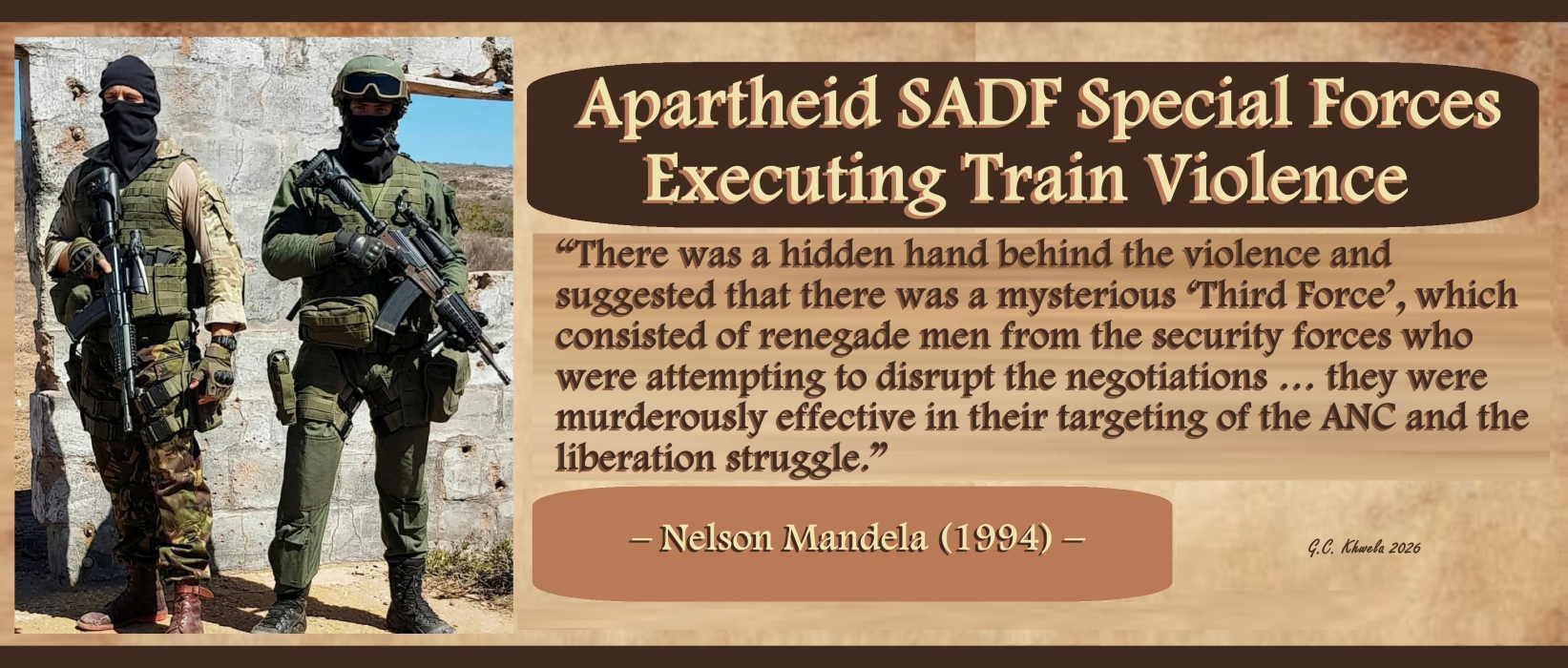
Apartheid SADF Special Forces Executing Train Violence
On 19 July 1991, 45 years ago, a bombshell interview published in the ‘New Nation’ newspaper officially implicated South African Special Forces units in orchestrating brutal, indiscriminate train violence against black commuters. Felix Isaias Ndimene, a former Sergeant in the Five Reconnaissance Regiment (5RR) – a highly secretive apartheid South African Defence Force (SADF) Special Forces unit – exposed the state’s hidden hand behind the massacres. Also involved, were the Selous Scouts of Pietersburg and operatives from RENAMO (the Mozambican Rebel Movement), who were named by Ndimene as co-conspirators in the attacks.
The Benrose Massacre of 13 September 1990, for example, which left 26 dead and over 100 commuter train passengers injured, was explicitly identified as an operation carried out by Ndimene’s unit. Spoornet Security’s intelligence division was alleged to be heavily staffed by former Special Forces members who intentionally masterminded and enabled the violence on the rail networks. This whistleblowing event happened during a dark era of South Africa’s democratic transition, frequently referred to as the “Third Force” operations.
When Felix Ndimene’s whistleblowing interview was published in the ‘New Nation’ on 19 July 1991, it triggered an immediate political firestorm. The responses from the apartheid state, the military establishment, and opposing political parties perfectly mirrored the deeply fractured, suspicious environment of the ongoing CODESA Negotiations. The SADF leadership immediately went on the defensive, employing a strategy of flat denial, deflection, and procedural delay. Senior SADF generals and Defence Minister Magnus Malan aggressively dismissed Ndimene’s allegations as baseless “propaganda” designed to smear the military’s reputation.
They maintained that the Five Reconnaissance Regiment (5RR) was a conventional, highly disciplined elite unit that did not engage in domestic civilian policing or train operations. To formally counter the accusations, the military hierarchy provided the Goldstone Commission with fabricated operational logs. They argued that the 5 Recce commando Ndimene named was deployed on a completely different, legitimate border patrol operation in the Eastern Transvaal during the 13 September 1990 Benrose massacre. The military attempted to frame Ndimene as a disgruntled, unreliable low-ranking soldier whose claims were entirely “hearsay”. They omitted the fact that he was a Mozambican citizen who had been brutally abducted and press-ganged into their ranks against his will in 1982.
President F.W. de Klerk’s administration was deeply embarrassed by the revelations, coming right on the heels of the “Inkathagate” scandal, which exposed secret state funding to the Inkatha Freedom Party. To signal a false sense of accountability to international onlookers, De Klerk used the mounting pressure from Ndimene’s allegations to strip Magnus Malan of his Defence portfolio later in 1991, shifting him to the minor Department of Water Affairs. Rather than opening immediate criminal investigations into the named Special Forces operatives, the government pushed the allegations into the lengthy administrative machinery of the Goldstone Commission, effectively burying immediate legal consequences.
For the African National Congress (ANC), Ndimene’s testimony was the definitive, long-awaited “smoking gun” proof of what they had alleged for over a year. The ANC used the interview to publicly declare that the random township massacres were not an organic ethnic civil war between black South Africans, but a state-engineered campaign to weaken the liberation movements. The leadership of the ANC weaponised the revelations during the constitutional negotiations. They threatened to halt peace talks unless the National Party government agreed to international monitoring, the immediate fencing of migrant worker hostels, and the banning of traditional weapons carried by political rivals on trains.
Because Ndimene explicitly tied the state hit squads to the manipulation of hostel residents, the Inkatha Freedom Party (IFP) reacted with intense hostility. The IFP leadership vehemently denied that their members were acting as proxies or foot soldiers for apartheid Special Forces. The party claimed that the violence on the rail networks was a direct result of political conflict initiated by the ANC’s aggressive township mobilisation campaigns. They claimed hostel residents were merely defending their enclaves from ANC-aligned self-defence units (SDUs).
Between 1990 and 1993, more than 572 people died in over 600 separate incidents of train violence. State security forces and covert hit squads, often operating alongside hostel dwellers aligned with the Inkatha Freedom Party (IFP), aimed to spread mass terror, destabilise black communities, and derail the ongoing peace negotiations led by the African National Congress (ANC). The Truth and Reconciliation Commission (TRC) explicitly confirmed that apartheid security forces actively fomented and participated in the catastrophic train violence of the early 1990s. In its TRC Final Report, the Commission investigated the exact whistleblowing allegations made by Felix Ndimene and cross-referenced them with amnesty applications and intelligence findings.
The Goldstone Commission initially claimed that the 5 Recce commando named by Ndimene was on a separate, legitimate operation in the Eastern Transvaal during the Benrose train massacre. Senior Goldstone investigators later testified to the TRC that this did not disprove Ndimene’s claims, as Special Forces routinely operated in highly covert, independent cells of three to four men, making a deniable deployment completely plausible. A senior 5 Recce commander ultimately confirmed to the TRC that members of his unit were involved in the train violence. Military intelligence experts testified that the sheer randomness, combined with absolute military precision, strongly pointed to Special Forces tactical training.
The TRC found no evidence of a centrally directed, formal agency named the “Third Force”. Instead, it concluded that a decentralised network of current and former security force members deliberately fomented the violence. State operatives actively colluded with Inkatha Freedom Party (IFP) members and hostel dwellers to carry out attacks. The strategic goal was to spark a bloody cycle of revenge that would make the ANC and IFP blame each other, thereby derailing democratic transition.
High-profile operatives, such as the apartheid South African Police member Wayne Hugh Swanepoel, applied for amnesty. He admitted that his unit threw innocent commuters off moving trains while wearing balaclavas and body paint to conceal their identities, ensuring the victims were dead before opening artificial police investigations. Former Vlakplaas askari Joe Mamasela and other state operatives testified that operational briefings for specific train squads took place directly at the notorious Vlakplaas counter-insurgency base.
The Truth and Reconciliation Commission (TRC) hearings and subsequent amnesty applications meticulously exposed how the notorious Vlakplaas counter-insurgency unit (C10), operating under Colonel Eugene de Kock, orchestrated the train massacres. Rather than a chaotic outburst of public anger, the testimonies revealed a highly calculated, state-sponsored campaign to foment “black-on-black” violence and destabilise the democratic transition. Joe Mamasela, a notorious Vlakplaas askari (a turncoat former liberation fighter), chose not to officially apply for amnesty, opting instead to provide damning insider evidence directly to investigators and the media. Mamasela revealed that the hit squads executing the train massacres were not random hostel residents. He testified that the killers were housed, fed, and hidden at the Eikenhof farm in the Vaal area.
Mamasela explicitly alleged that the operatives carrying out these massacres were funded via the Civil Cooperation Bureau (CCB) – a covert special forces unit of the apartheid South African Defence Force – meaning the orders and money flowed from the highest echelons of the security police. Moreover, embedded within the TRC amnesty files of high-profile Vlakplaas operatives Thapelo Johannes Mbelo and Wilhelm Riaan Bellingan was a comprehensive, chilling statement by askari Xola Frank Mbane, who had testified under oath that the operational briefings, planning, and tactical mapping for the train massacres took place directly on-site at the Vlakplaas farm, near Pretoria.
Mbane identified the core operational unit: a commander named Kilino, who headed the squad, and operatives named Khayo, Sylvester, Mvelase, Shushe and Joss, who executed the platform ambushes. In addition, Mbane revealed that Vlakplaas paid each operative a flat cash bounty of R1,000 per successful train attack. He also detailed how the unit selectively radicalised and used Inkatha-aligned hostel dwellers, specifically from the Nancefield Hostel, as front-line foot soldiers to mask the state’s involvement. Though an apartheid South African Police member, Wayne Hugh Swanepoel’s application directly mapped the tactical savagery utilised by these state hit squads.
Swanepoel testified that before boarding the commuter lines, operatives went to extreme lengths to conceal their identities. They wore balaclavas, heavy gloves, and painted their skin with dark body paint so they could pass as black township residents in the dark. Swanepoel admitted that his primary role in the unit was to act as a technical advisor. Because of his knowledge of the rail infrastructure, he explicitly mapped out and advised the hit squads on the most lethal curves and bridges to fling terrified commuters off moving trains.
The TRC Amnesty Committee ultimately granted Swanepoel partial amnesty for five counts of murder because his actions met the legal threshold: that they were “committed for political reasons to fuel black-on-black violence” and that he had made a full disclosure. The TRC ultimately concluded from these collective testimonies that the train violence was a highly successful, decentralised state strategy. The state had successfully turned public focus away from its own oppression and painted the liberation movement as an uncontrollable ethnic civil war. The legal fallout from these admissions is still felt today, especially regarding the lack of follow-up trials.
The failure of the National Prosecuting Authority (NPA) to prosecute the perpetrators of the train massacres and other apartheid-era atrocities is widely recognised as one of the greatest failures of South Africa’s post-apartheid justice system. When the TRC wrapped up, it handed over a list of roughly 300 cases – including the train violence networks – to the NPA for further investigation and prosecution. Decades later, almost none of these perpetrators have faced criminal courts. The primary reason for the lack of prosecutions is systemic, high-level political interference.
In subsequent court challenges, former NPA leaders – including former National Director of Public Prosecutions (NDPP) Vusi Pikoli – admitted under oath that senior government officials and politicians heavily pressured the NPA to halt apartheid-era prosecutions. There was a covert, unofficial agreement to protect both former state operatives and ANC members from further scrutiny. For years, the NPA’s Priority Crimes Litigation Unit (PCLU) and the police’s Directorate for Priority Crime Investigation (the Hawks) were denied the necessary budget, staff, and political backing to investigate the complex networks behind the train massacres.
Between 2005 and 2007, the executive branch attempted to bypass traditional prosecutions entirely by introducing amendments to the NPA’s prosecution policy. These amended guidelines allowed the NDPP to decline prosecution if a perpetrator “disclosed the truth” or if prosecution was deemed “not in the public interest”. In a landmark legal challenge brought by apartheid victims’ families, the High Court and later the Constitutional Court struck down these amendments. The courts ruled that the government was trying to create an illegal, unconstitutional “second amnesty process” that bypassed the strict requirements of the TRC.
Following decades of absolute stagnation, relentless activism by victims’ families, such as the Cradock Four and Ahmed Timol foundations, forced a slow reopening of some TRC cases. The NPA has begun reversing its historical inaction by reopening inquests into specific high-profile murders. However, because the train violence involved dozens of low-profile, decentralised Vlakplaas and Special Forces operatives rather than single prominent figures, these massacres remained largely not investigated.
The NPA’s decades-long delay has resulted in a “justice by mortality”. Key witnesses, masterminds, and operatives have passed away without ever stepping foot inside a courtroom. In a twist of fate illustrating the delayed wheels of justice, the Vlakplaas askari who exposed the train hit squads, Joe Mamasela, was arrested in 2021 – not for his apartheid-era Vlakplaas actions, but for the modern-day murder of a landlord. He passed away in prison in 2025 while awaiting trial, closing a major chapter of potential historical testimony.
In September 1991, Nelson Mandela gave a speech in which he said, “There was a hidden hand behind the violence and suggested that there was a mysterious ‘Third Force’, which consisted of renegade men from the security forces who were attempting to disrupt the negotiations. I could not say who the members of the Third Force were, for I did not know myself, but I was certain that they existed and that they were murderously effective in their targeting of the ANC and the liberation struggle.”
Sources:
South African History Online (SAHO).
Amnesty international, “Statement of Amnesty International USA On South Africa Before the Subcommittee on Africa and the Subcommittee on International Economic Policy & Trade of the House Foreign Affairs Committee”, Amnesty International USA, 31, July 1991.
Anti-Apartheid Movement, “‘Apartheid Kills Commuters’”, Forward to Freedom: The History of the British Anti-Apartheid Movement, AAM Archives Committee, 1992.
Nelson Mandela, “Long Walk to Freedom”, Abacus, 1994.
SAPA, “Third Force Fomented Violence: TRC”, South African Press Association, 29 October 1998.
Truth and Reconciliation Commission, “Truth and Reconciliation Commission of South Africa Report, Vol. 2”, Truth and Reconciliation Commission, 29 October 1998.
Truth and Reconciliation Commission, “Truth and Reconciliation Commission of South Africa Report, Vol. 3”, Truth and Reconciliation Commission, 29 October 1998.
SAPA, “Former Cop Swanepoel Gets Partial Amnesty” Independent Online, 3 April 2001.
Horace Campbell, “Magnus Malan and Crimes Against Humanity in Africa”, Pambazuka News, 21 July 2011.
Karyn Maughan, “Joe Mamasela, Apartheid Askari and Remorseless Killer”, Mail & Guardian, 21 April 2016.
Padraig O’Malley, “Political Violence in the Era of Negotiations and Transition, 1990-1994”, O’Malley: The Heart of Hope, Nelson Mandela Foundation, https://omalley.nelsonmandela.org/index.php/site/q/03lv02167/04lv02264/05lv02335/06lv02357/07lv02372/08lv02379.htm
Castro Khwela
Good morning fellow Compatriots!🙏🏾✊🏾👊🏾
Discover more from CASTRO KHWELA
Subscribe to get the latest posts sent to your email.